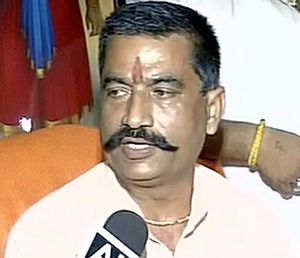
Punjab: Gau Raksha Dal chief booked, lashes out at PM Modi

August 8, 2016

Patiala, Aug 8: Punjab police has booked Gau Raksha Dal Chief Satish Kumar for allegedly assaulting some persons on pretext of cow protection, a day after Prime Minister Narendra Modi asked the states to act against "fake" cow protectors.gau raksha

The FIR was lodged on the basis of a video clip which appeared on social media, showing Gau Raksha Dal members brutally thrashing people, SSP Gurmeet Chauhan today said.

A case under sections 382 (having made preparation for causing death), 384 (committing extortion), 341 (wrongfully restraining any person), along with sections 148 and 149, of the
Indian Penal Code (IPC) was registered, police said.

Kumar, who is yet to be arrested, said he has no information regarding the case. He alleged that the Prime Minister's remarks against cow vigilantism were motivated by
"votebank politics" due to upcoming elections in many states.

"The PM's statement is politically motivated. It is one-sided. If he had warned the butchers not to slaughter or smuggle cow, then his statement would have been justified.

"He is doing vote bank politics to get the butchers' vote," Kumar said. He said the police were free to arrest him.

The Prime Minister's statement denunciating cow vigilantism came after a string of incidents of attacks on Dalits, including in Una, Gujarat where some youths were brutally assaulted for skinning a dead cow.

Comments

Mohammed SS
 - 
Tuesday, 9 Aug 2016

He looks like Born Dacoit, he should be behind bars

Add new comment

  • Coastaldigest.com reserves the right to delete or block any comments.
  • Coastaldigset.com is not responsible for its readers’ comments.
  • Comments that are abusive, incendiary or irrelevant are strictly prohibited.
  • Please use a genuine email ID and provide your name to avoid reject.
coastaldigest.com web desk
June 16,2020

New Delhi, Jun 16: Despite Prime Minister Narendra Modi led government’s attempt to downplay the border dispute with China, matters have heated up unprecedentedly along the Line of Actual Control (LAC)- the effective Sino-India border in Eastern Ladakh. 

The country has lost three precious lives – an army officer and two soldiers. The last time blood was spilled on the LAC, before the latest episode, was 45 years ago when the Chinese ambushed an Assam Rifles patrol in Tulung La.

India had lost four soldiers on October 20, 1975 in Tulung La, the last time bullets were fired on the India-China border though both the countries witnessed bitter stand-offs later at Sumdorong Chu valley in 1987, Depsang in 2013, Chumar in 2014 and Doklam in 2017.

Between 1962 and 1975, the biggest clash between India and China took place in Nathu La pass in 1967 when reports suggest that around 80 Indian soldiers were killed and many more Chinese personnel.

While three soldiers, including a Commanding Officer, were killed in the latest episode in Galwan Valley, the government describes it as a "violent clash" and does not mention opening fire.

New Delhi described the locality where the 1975 incident took place as "well within" its territory only to be rebuffed by Beijing as "sheer reversal of black and white and confusion of right and wrong".

The Ministry of External Affairs had then said that the Chinese had crossed the LAC and ambushed the soldiers while Beijing claimed the Indians entered their territory and did not return despite warnings.

The Indian government maintained that the ambush on the Assam Rifles' patrol in 1975 took place "500 metres south of Tulung" on the border between India and Tibet and "therefore in Indian territory". It said Chinese soldiers "penetrating" Indian territory implied a "change in China's position" on the border question but the Chinese denied this and blamed India for the incident.

The US diplomatic cables quoted an Indian military intelligence officer saying that the Chinese had erected stone walls on the Indian side of Tulung La and from these positions fired several hundred rounds at the Indian patrol.

"Four of the Indians had gone into a leading position while two (the ones who escaped) remained behind. The senior military intelligence officer emphasised that the soldiers on the Indian patrol were from the area and had patrolled that same region many times before," the cable said.

One of the US cables showed that former US Secretary of State and National Security Adviser Henry Kissinger sought details of the October 1975 clash "without approaching the host governments on actual location of October 20 incident". He also wanted to know what ground rules were followed regarding the proximity of LAC by border patrols.

A cable sent from the US mission in India on November 4, 1975 appeared to have doubts about the Chinese account saying it was "highly defensive".

"Given the unsettled situation on the sub-continent, particularly in Bangladesh, both Chinese and Indian authorities have authorised stepped up patrols along the disputed border. The clash may well have ensued when two such patrols unexpectedly encountered each other," it said.

Another cable from China on the same day quoted another October 1974 cable, which spoke about Chinese officials being concerned for long that "some hotheaded person on the PRC (People's Republic of China) might provoke an incident that could lead to renewed Sino-Indian hostilities. It went on to say that this clash suggested that "such concerns and apprehensions are not unwarranted".

According to the United States diplomatic cables, Chinese Foreign Ministry on November 3, 1975 disputed the statement of the MEA spokesperson, who said the incident took place inside Indian territory.

The Chinese had said "sheer reversal of black and white and confusion of right and wrong". In its version of the 1975 incident, they said Indian troops crossed the LAC at 1:30 PM at Tulung Pass on the Eastern Sector and "intruded" into their territory when personnel at the Civilian Checkpost at Chuna in Tibet warned them to withdraw.

Ignoring this, they claimed, Indian soldiers made "continual provocation and even opened fire at the Chinese civilian checkpost personnel, posing a grave threat to the life of the latter. The Chinese civilian checkpost personnel were obliged to fire back in self defence."

The Chinese Foreign Ministry spokesperson had also said they told the Indian side that they could collect the bodies "anytime" and on October 28, collected the bodies, weapons and ammunition and "signed a receipt".

The US cables from the then USSR suggested that the official media carried reports from Delhi on the October 1975 incident and they cited only Indian accounts of the incident "ridiculing alleged Chinese claims that the Indians crossed the line and opened fire first".


Comments

Add new comment

  • Coastaldigest.com reserves the right to delete or block any comments.
  • Coastaldigset.com is not responsible for its readers’ comments.
  • Comments that are abusive, incendiary or irrelevant are strictly prohibited.
  • Please use a genuine email ID and provide your name to avoid reject.
News Network
July 1,2020

New Delhi, Jul 1: Jet fuel or ATF price on Wednesday was hiked by 7.5 per cent, the third increase in a month, while petrol and diesel rates were unchanged for the second day in a row.

Aviation turbine fuel (ATF) price was hiked by Rs 2,922.94 per kilolitre (kl), or 7.48 per cent, to Rs 41,992.81 per kl in the national capital, according to a price notification by state-owned oil marketing companies.

This is the third straight increase in ATF prices in a month. Rates were hiked by a record 56.6 per cent (Rs 12,126.75 per kl) on June 1, followed by Rs 5,494.5 per kl (16.3 per cent) increase on June 16.

Simultaneously, non-subsidised cooking gas LPG rates were increased by Re 1 to Rs 594 per 14.2-kg cylinder in the national capital. Prices were up by Rs 4 in other metros mostly because of different local sales tax or VAT rate.

On the other hand, petrol and diesel prices were unchanged for the second day in a row.

This, after diesel rates scaled a new high after prices were hiked 22 times in just over three weeks.

In Delhi, a litre of petrol comes for Rs 80.43 per litre, while diesel is priced at Rs 80.53 per litre.

Rates vary from state to state depending on the incidence of local sales tax or VAT.

While the diesel price had been hiked on 22 occasions since June 7, petrol price had been raised on 21 occasions.

The cumulative increase since the oil companies started the cycle on June 7 totals to Rs 9.17 for petrol and Rs 11.14 for diesel.

Comments

Add new comment

  • Coastaldigest.com reserves the right to delete or block any comments.
  • Coastaldigset.com is not responsible for its readers’ comments.
  • Comments that are abusive, incendiary or irrelevant are strictly prohibited.
  • Please use a genuine email ID and provide your name to avoid reject.
News Network
April 11,2020

Thiruvananthapuram, Apr 11: The effective handling of Covid-19 pandemic by the Kerala Government has received a big endorsement in the International media with the latest being a report in Washington Post which suggests that the State’s success could prove instructive to the entire country.

The Washington Post quoted Kerala Health Minister K K Shailaja Teacher as saying “We hoped for the best but planned for the worst. Now, the curve has flattened, but we cannot predict what will happen next week.”

"The Minister said six states had reached out to Kerala for advice. She, however, noted that it might not be easy to replicate Kerala’s lessons elsewhere," according to the Minister's office quoting the report here on Saturday.

Comments

Add new comment

  • Coastaldigest.com reserves the right to delete or block any comments.
  • Coastaldigset.com is not responsible for its readers’ comments.
  • Comments that are abusive, incendiary or irrelevant are strictly prohibited.
  • Please use a genuine email ID and provide your name to avoid reject.