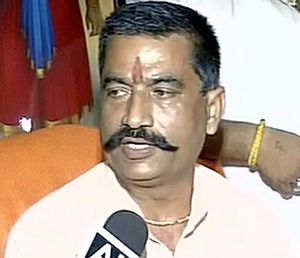
Punjab: Gau Raksha Dal chief booked, lashes out at PM Modi

August 8, 2016

Patiala, Aug 8: Punjab police has booked Gau Raksha Dal Chief Satish Kumar for allegedly assaulting some persons on pretext of cow protection, a day after Prime Minister Narendra Modi asked the states to act against "fake" cow protectors.gau raksha

The FIR was lodged on the basis of a video clip which appeared on social media, showing Gau Raksha Dal members brutally thrashing people, SSP Gurmeet Chauhan today said.

A case under sections 382 (having made preparation for causing death), 384 (committing extortion), 341 (wrongfully restraining any person), along with sections 148 and 149, of the
Indian Penal Code (IPC) was registered, police said.

Kumar, who is yet to be arrested, said he has no information regarding the case. He alleged that the Prime Minister's remarks against cow vigilantism were motivated by
"votebank politics" due to upcoming elections in many states.

"The PM's statement is politically motivated. It is one-sided. If he had warned the butchers not to slaughter or smuggle cow, then his statement would have been justified.

"He is doing vote bank politics to get the butchers' vote," Kumar said. He said the police were free to arrest him.

The Prime Minister's statement denunciating cow vigilantism came after a string of incidents of attacks on Dalits, including in Una, Gujarat where some youths were brutally assaulted for skinning a dead cow.

Comments

Mohammed SS
 - 
Tuesday, 9 Aug 2016

He looks like Born Dacoit, he should be behind bars

Add new comment

  • Coastaldigest.com reserves the right to delete or block any comments.
  • Coastaldigset.com is not responsible for its readers’ comments.
  • Comments that are abusive, incendiary or irrelevant are strictly prohibited.
  • Please use a genuine email ID and provide your name to avoid reject.
News Network
June 11,2020

New Delhi, Jun 11: The death toll due to COVID-19 rose to 8,102 and the number of cases climbed to 2,86,579 in the country after it registered the highest single-day spike of 357 fatalities and 9,996 cases till Thursday 8 AM, according to the Union Health Ministry data.

The number of recoveries remained more than the active novel coronavirus cases for the second consecutive day.

The number of active cases stands at 1,37,448 while 1,41,028 people have recovered and one patient has migrated to another country, as per the data.   

"Thus, around 49.21 per cent patients have recovered so far," an official said.

The total number of confirmed cases include foreigners.

Of the 357 new deaths reported till Thursday morning, 149 were in Maharashtra, 79 in Delhi, 34 in Gujarat, 20 in Uttar Pradesh, 19 in Tamil Nadu, 17 in West Bengal, eight in Telangana, seven each in Madhya Pradesh and Haryana, four in Rajasthan, three each in Jammu and Kashmir and Karnataka, two each in Kerala and Uttarakhand, one each in Andhra Pradesh, Bihar and Himachal Pradesh.

Out of the total 8,102 fatalities, Maharashtra tops the tally with 3,438 deaths followed by Gujarat with 1,347 deaths, Delhi with 984, Madhya Pradesh with 427, West Bengal with 432, Tamil Nadu with 326, Uttar Pradesh with 321, Rajasthan with 259 and Telangana with 156 deaths.

The death toll reached 78 in Andhra Pradesh, 69 in Karnataka and 55 in Punjab. Jammu and Kashmir has reported 51 fatalities due to the coronavirus disease, while 52 deaths have been reported from Haryana, 33 from Bihar, 18 from Kerala, 15 from Uttarakhand, nine from Odisha and eight from Jharkhand.

Chhattisgarh and Himachal Pradesh have registered six COVID-19 fatalities each, Chandigarh has five while Assam has recorded four deaths so far. Meghalaya, Tripura and Ladakh have reported one COVID-19 fatality each, according to the ministry's data.

More than 70 per cent of the deaths are due to comorbidities, the ministry's website stated.

Comments

Add new comment

  • Coastaldigest.com reserves the right to delete or block any comments.
  • Coastaldigset.com is not responsible for its readers’ comments.
  • Comments that are abusive, incendiary or irrelevant are strictly prohibited.
  • Please use a genuine email ID and provide your name to avoid reject.
News Network
June 25,2020

India has jumped past 4.5 lakh coronavirus cases and 14,476 people have succumbed to the viral infection so far. In this backdrop, speaking to IANS in an exclusive interview, AIIMS Director Randeep Guleria said India is also vulnerable to second wave of coronavirus and people should continue to follow social distancing, wearing mask and other precautions, after cases begin to decline.

He added that in order to contain the outbreak of Covid-19, a limited lockdown in hotspots, where volume of cases is very high, may be considered along with a micro-plan to prevent leakage of cases from these areas to other non-containment areas. Excerpts of the interview are below:

Q: Reports say China and South Korea are witnessing a second wave of coronavirus infection, what is this second wave, is India also vulnerable to this?

A: When cases come down significantly, people tend to drop their guard against the viral infection, and this leads to the second wave (which means a sudden increase in the number of cases). After cases begin to decline, people should continue to follow the precautions -- continue to maintain social distancing and wear masks regularly. See what happened in Singapore, it was struck by a second wave of coronavirus. Look, what happened in the 1918 pandemic, people dropped their guard and the second wave of viral infection struck back. If people do not follow social distancing then the spike in cases is apparent. We need to take these precautions at least for one year. India is also vulnerable to this second wave.

Q: If Covid-19 cases continue to rise rapidly, do you think we need another lockdown in areas where volume of cases are very high?

A: A large volume of cases is concentrated in specific areas like hotspots, and in order to maintain things in order, we may need a limited lockdown in these areas. This should be followed by a micro-plan which entails extensive testing of people and also extensive contact tracing of people who have got in touch with positive people. Need to ensure there is no leakage of cases from these areas. People from these areas should not mix with others in non-containment areas. This will aid in containing the outbreak of the virus. People who have developed symptoms should get themselves tested, especially in the containment areas.

Q: With more than 4.5 lakh cases and close to 14,500 deaths, do you think India has reached its peak and a decline in cases is prominent?

A: The cases will continue to increase for some time. The doubling time of cases has also increased. But, the cases will also begin to flatten. Though, it is difficult to give an exact time period in this viral infection, it seems, the growth in cases will flatten in the end of July or beginning of August. A decline will come to this viral infection, but it does not mean that people should drop their guard. As a measure, we need to decrease community participation and citizens should continue to follow social distancing. People should get themselves tested. All these efforts will help in preventing people from contracting this virus. These precautions will also prevent us from the second wave, and we must continue to take precautions. The virus has not gone away, it is still lurking.

Q: India has crossed the 4.5 lakh coronavirus cases so far, although our recovery rate is good, but still 10,000 to 15,000 cases are reported daily. Why do cases continue to spiral, what is the reason?

A: We have to remember a few things -- the bulk of cases are in 10 cities, nearly 70 per cent, and if we take into account cases per million population, the number is not very high, as compared with countries including countries in Europe. Many European countries put together still do not add up to the Indian population. Do not compare India to countries like Italy, Spain etc. We need to focus on hotspots, which contribute to between 70 -80 per cent of cases, and we have to identify cases in these areas at an early stage. The population density is very high in these cities. People in lower socio-economic status are highly vulnerable to the viral infection, as many live together in small spaces and there is a lot of mixing of people happening there. Look at the market places, people are not following social distancing and not wearing masks. In fact, many are in close vicinity of each other.


Comments

Add new comment

  • Coastaldigest.com reserves the right to delete or block any comments.
  • Coastaldigset.com is not responsible for its readers’ comments.
  • Comments that are abusive, incendiary or irrelevant are strictly prohibited.
  • Please use a genuine email ID and provide your name to avoid reject.
News Network
February 21,2020

Thiruvananthapuram, Feb 21: Hindu temples, dedicated to Lord Shiva, witnessed heavy rush on Friday as devotees celebrated Maha Shivratri festival with traditional zeal and religious fervour across Kerala.

Cutting across age barriers, devotees, including women and children, thronged small and big shrines since early morning to offer prayers and take part in special poojas and rituals on the occasion.

Devotees used to mark the auspicious occasion by observing 'orikkal' (fasting), dedicating the leaves of Koovalam plant, which is considered holy according to Hindu tradition, to the Lord and by abandoning their sleep chanting 'Om Nama Shivaya' mantras.

Ardent devotees even remain awake throughout the night and spend their whole day in temples.

The Sreekandeswaram Mahadeva Temple here, Vadakkunnathan temple in Thrissur and Maha Deva temple in Vaikom were among the major shrines which witnessed heavy rush since early morning.

Temple authorities, especially Devaswom Boards which manage many major shrines in the state, have made elaborate arrangements in Shiva temples to ensure smooth darshan for devotees.

All arrangements have been put in place on the banks of River Periyar in Aluva in Ernakulam for 'Balitharppanam', a ritual in which people pay obeisance to their ancestors.

Performing the ritual on the midnight of Shivratri is considered auspicious by devotees.

Hundreds of 'bali taras' (specially erected platforms) have been set up on the banks of the river to perform the ritual and a large number of priests have been deployed to assist devotees.

Thousands of police personnel were deployed in view of the large turnout of devotees.

Comments

Add new comment

  • Coastaldigest.com reserves the right to delete or block any comments.
  • Coastaldigset.com is not responsible for its readers’ comments.
  • Comments that are abusive, incendiary or irrelevant are strictly prohibited.
  • Please use a genuine email ID and provide your name to avoid reject.