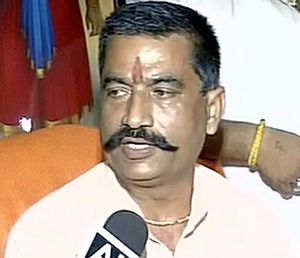
Punjab: Gau Raksha Dal chief booked, lashes out at PM Modi

August 8, 2016

Patiala, Aug 8: Punjab police has booked Gau Raksha Dal Chief Satish Kumar for allegedly assaulting some persons on pretext of cow protection, a day after Prime Minister Narendra Modi asked the states to act against "fake" cow protectors.gau raksha

The FIR was lodged on the basis of a video clip which appeared on social media, showing Gau Raksha Dal members brutally thrashing people, SSP Gurmeet Chauhan today said.

A case under sections 382 (having made preparation for causing death), 384 (committing extortion), 341 (wrongfully restraining any person), along with sections 148 and 149, of the
Indian Penal Code (IPC) was registered, police said.

Kumar, who is yet to be arrested, said he has no information regarding the case. He alleged that the Prime Minister's remarks against cow vigilantism were motivated by
"votebank politics" due to upcoming elections in many states.

"The PM's statement is politically motivated. It is one-sided. If he had warned the butchers not to slaughter or smuggle cow, then his statement would have been justified.

"He is doing vote bank politics to get the butchers' vote," Kumar said. He said the police were free to arrest him.

The Prime Minister's statement denunciating cow vigilantism came after a string of incidents of attacks on Dalits, including in Una, Gujarat where some youths were brutally assaulted for skinning a dead cow.

Comments

Mohammed SS
 - 
Tuesday, 9 Aug 2016

He looks like Born Dacoit, he should be behind bars

Add new comment

  • Coastaldigest.com reserves the right to delete or block any comments.
  • Coastaldigset.com is not responsible for its readers’ comments.
  • Comments that are abusive, incendiary or irrelevant are strictly prohibited.
  • Please use a genuine email ID and provide your name to avoid reject.
News Network
January 24,2020

New Delhi, Jan 24: Although India's Ujjwala programme encouraged adoption of liquefied petroleum gas (LPG) for cooking among the poor, households availing the scheme have not shifted away from using highly polluting fuels like firewood, a study reveals.

The researchers, including those from the University of British Columbia (UBC) in Canada, found that additional incentives to encourage regular use of cooking gas are necessary for a complete transition to clean cooking fuel among poor rural households.

They noted that about 2.9 billion people across Asia, Africa, and Latin America burn solid fuels like firewood to meet their cooking energy needs.

This has significant negative implications for public health, the environment, and societal development, according to the researchers.

Through the Pradhan Mantri Ujjwala Yojana (PMUY), India has provided capital cost subsidies to poor women to adopt a clean-burning cooking fuel or LPG.

The researchers explained that within the first 40 months of the scheme, more than 80 million households obtained LPG stoves.

However, the full benefits of LPG adoption depend on near complete replacement of polluting fuels with LPG, according to a research-based policy brief published in the journal Nature Energy.

The scientists said this cannot be assumed solely on the basis of LPG presence in the household.

"Our research shows that Ujjwala was able to attract new consumers rapidly, but those consumers did not start using LPG on a regular basis," Abhishek Kar, a postdoc at Columbia University in the US, told PTI.

The study analysed LPG sales data for over 25,000 consumers, including PMUY beneficiaries, as well as general rural LPG consumers in Koppal district of Karnataka.

The scientists employed data covering all LPG purchases of PMUY beneficiaries through their first year in the programme.

They also assessed the general rural population's purchases during their first five years as consumers to assess the effect of experience on use.

The findings estimate that an average rural family needs to purchase five 14.2 kilogramme-cylinders annually to meet half of their cooking needs.

However, the study said just seven per cent of PMUY beneficiaries in Koppal purchased five or more cylinders annually, suggesting that the beneficiaries seldom use LPG.

The general (nonPMUY) consumers in this region use on average two times more LPG cylinders than PMUY beneficiaries, the researchers noted.

Yet, only 45 per cent of nonPMUY consumers use five or more cylinders per year -- even after several years of experience with LPG, they said.

The team assessed price and seasonal factors affecting LPG use among the general population over a three-year period.

It found that LPG consumers are sensitive to price and seasonality -- LPG cylinder refill rates are lower in the summer when agricultural activity is limited, and cash is scarce.

"There was no scheme incentives to promote use, except general LPG subsidies which is available to all, including the urban middle class," said Kar, who was a Ph.D. scholar at UBC when the research was published.

"If there is no additional income, what cost would a poor family on an already tight budget cut to pay for an extra expense on a regular basis.

"Ujjwala has started the scheme of 5 kg-cylinder in response, but the impact of that on LPG sales is still publicly unknown," he said.

These findings, the researchers noted, suggest the need for additional measures to promote regular LPG use for all rural populations.

Although the finding come from a single district in Southern India, it may also apply to other areas with similar socio-economic conditions, they said.

A more expansive evaluation of PMUY would help design targeted incentives to transform infrequent users to regular users, according to the researchers.


Comments

Add new comment

  • Coastaldigest.com reserves the right to delete or block any comments.
  • Coastaldigset.com is not responsible for its readers’ comments.
  • Comments that are abusive, incendiary or irrelevant are strictly prohibited.
  • Please use a genuine email ID and provide your name to avoid reject.
Agencies
June 19,2020

New Delhi, Jun 19: Delhi minister Satyendar Jain's health has deteriorated further. He is infected with the coronavirus. Jain has also been diagnosed with pneumonia. He is being shifted to an ICU.  According to doctors, Jain is now kept full-time on oxygen support as his oxygen saturation level has dipped.  

Jain was admitted to Rajiv Gandhi Super Speciality Hospital early Tuesday after running high fever and suffering a sudden drop in oxygen level. The 55-year-old leader's test result came positive on Wednesday evening after a second test. Jain was brought to the hospital and was administered a test for the novel coronavirus infection on Tuesday morning, for which he tested negative. But he still ran fever and showed symptoms, so another test was done after 24 hours of the first.

He will now be shifted Max Hospital in Saket and administered plasma therapy. 

Union Home Minister Amit Shah has also wished for Jain's speedy recovery.

On Thursday, Delhi Deputy Chief Minister Manish Sisodia took over the charge of health, PWD, power and other departments held by Jain. Jain will remain the cabinet minister without any portfolio in the Arvind Kejriwal government until he recovers. 

On Sunday, Jain attended a high-level meeting on the coronavirus situation in the national capital, chaired by Union Home Minister Amit Shah, which was also attended by Delhi Lt Governor Anil Baijal, Kejriwal, Sisodia and Union Health Minister Harsh Vardhan.

Comments

Add new comment

  • Coastaldigest.com reserves the right to delete or block any comments.
  • Coastaldigset.com is not responsible for its readers’ comments.
  • Comments that are abusive, incendiary or irrelevant are strictly prohibited.
  • Please use a genuine email ID and provide your name to avoid reject.
News Network
May 21,2020

Bengaluru, May 21: The top two food-delivery startups, Swiggy and Zomato, will begin delivering alcohol in some cities starting from today, as they cash in on the high demand for booze during the country's coronavirus lockdown.

India was among the few countries to restrict liquor and tobacco sales as it announced one of the world's strictest lockdowns in March.

Hundreds of people started queuing up at liquor stores earlier this month when the government eased some restrictions, leading the police to resort to baton-charges to disperse crowds in some cases.

The companies will roll out the service in select cities in Jharkhand, starting with Ranchi from today, Swiggy and Zomato said in separate statements.

Swiggy said it was in advanced talks with multiple states to launch the service in more locations, and both firms said the move to allow alcohol orders through smartphones will promote social distancing and customer safety.

"By enabling home delivery of alcohol, we can generate additional business for retail outlets while solving the problem of overcrowding," said Anuj Rathi, vice president of products at Bengaluru-based Swiggy.

The new service also comes as both Swiggy and Zomato face sharp declines in their core business, with restaurants remaining shut during the two-month lockdown, forcing the companies to cut hundreds of jobs to save cash.

News agency reported earlier this month that Zomato was aiming to branch out into delivering alcohol. Swiggy is backed by South African internet group Naspers Ltd, while Ant Financial, an affiliate of Chinese e-commerce giant Alibaba Group Holding Ltd, is a major investor in Zomato.

Comments

Add new comment

  • Coastaldigest.com reserves the right to delete or block any comments.
  • Coastaldigset.com is not responsible for its readers’ comments.
  • Comments that are abusive, incendiary or irrelevant are strictly prohibited.
  • Please use a genuine email ID and provide your name to avoid reject.