


Punjab: Gau Raksha Dal chief booked, lashes out at PM Modi

August 8, 2016

Patiala, Aug 8: Punjab police has booked Gau Raksha Dal Chief Satish Kumar for allegedly assaulting some persons on pretext of cow protection, a day after Prime Minister Narendra Modi asked the states to act against "fake" cow protectors.gau raksha
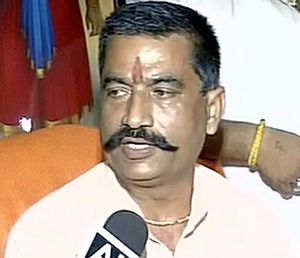
The FIR was lodged on the basis of a video clip which appeared on social media, showing Gau Raksha Dal members brutally thrashing people, SSP Gurmeet Chauhan today said.

A case under sections 382 (having made preparation for causing death), 384 (committing extortion), 341 (wrongfully restraining any person), along with sections 148 and 149, of the
Indian Penal Code (IPC) was registered, police said.

Kumar, who is yet to be arrested, said he has no information regarding the case. He alleged that the Prime Minister's remarks against cow vigilantism were motivated by
"votebank politics" due to upcoming elections in many states.

"The PM's statement is politically motivated. It is one-sided. If he had warned the butchers not to slaughter or smuggle cow, then his statement would have been justified.

"He is doing vote bank politics to get the butchers' vote," Kumar said. He said the police were free to arrest him.

The Prime Minister's statement denunciating cow vigilantism came after a string of incidents of attacks on Dalits, including in Una, Gujarat where some youths were brutally assaulted for skinning a dead cow.

Comments

Mohammed SS
 - 
Tuesday, 9 Aug 2016

He looks like Born Dacoit, he should be behind bars

Add new comment

  • Coastaldigest.com reserves the right to delete or block any comments.
  • Coastaldigset.com is not responsible for its readers’ comments.
  • Comments that are abusive, incendiary or irrelevant are strictly prohibited.
  • Please use a genuine email ID and provide your name to avoid reject.
News Network
July 10,2020

London, Jul 10: India's Reliance will load its first cargo of Venezuelan crude in three months this week in exchange for diesel under a swap deal the parties say is permitted under the US sanctions regime on the Latin American country, according to a Reliance source and a shipping document from state oil firm PDVSA.

Washington has exempted some Venezuelan oil trade from sanctions when transactions are in exchange for fuel and food or to repay debts rather than for cash. But that trade slowed as the US tightened restrictions and refiners, shippers and insurers have been steering clear of Venezuela to avoid any risk they may fall foul of sanctions.

Washington aims to deprive Venezuelan socialist President Nicolas Maduro of his main source of revenue with the sanctions, which have driven Venezuelan oil exports to their lowest level since the 1940s.

Reliance gave the US State Department and the Office of Foreign Assets Control (OFAC) notice of the diesel swap and received word back that the policies that allowed the transaction were still in place, the Reliance source told Reuters.

Reliance has previously said that its supplies of fuel to PDVSA in exchange for crude were permitted under sanctions.

An oil tanker named Commodore would load the cargo of crude in Venezuela and ship it to India, the tanker's manager NGM Energy said.

"All details of the transaction and transportation were shared with US authorities, who confirmed that the U.S. policy authorizing such transactions remained in place," NGM Energy said in a statement to Reuters.

"The shipment is made in connection with the humanitarian exchange of oil for diesel fuel."

The Commodore is loading a 1.9-million barrel cargo of crude for Reliance at Venezuela's main oil port of Jose, according to an internal PDVSA cargo schedule seen by Reuters.

The Liberian-flagged Commodore was at the Jose Terminal on Thursday, ship tracking data on Refinitiv Eikon showed.

The US State Department, Treasury's enforcement arm OFAC, and PDVSA did not immediately respond to a request for comment.

Reliance has a swap deal to provide diesel to Venezuela in exchange for fuel but has not received a cargo of crude since April. Sources at Indian refiners told Reuters earlier this year they planned to wind down their purchases of Venezuelan oil to avoid any problems with supply due to sanctions.

Other long-time customers of PDVSA, including Italy's Eni and Spain's Repsol, have continued taking cargoes of Venezuelan crude this year under permission granted by the US Treasury Department to exchange the oil for diesel supply as part of debt repayment deals, according to sources from the companies.

NGM Energy also manages the Voyager I tanker, which the United States removed from its list of sanctioned vessels last week after NGM and the ship's owner Sanibel Shiptrade said they would increase measures to ensure vessels complied with international sanctions.

"Last month, NGM Energy SA adopted a firm policy of not allowing vessels under its commercial management to trade to Venezuela, or to carry Venezuelan petroleum cargoes, absent US government authorization," NGM said.

"NGM continues to stand by that pledge."

Comments

Add new comment

  • Coastaldigest.com reserves the right to delete or block any comments.
  • Coastaldigset.com is not responsible for its readers’ comments.
  • Comments that are abusive, incendiary or irrelevant are strictly prohibited.
  • Please use a genuine email ID and provide your name to avoid reject.
News Network
April 9,2020

Thiruvananthapuram, Apr 9: Kerala, which was among the first state in the country to report a Corona positive case, has turned its entire public healthcare system into a single interconnected grid to generate uninterrupted information and provide flawless services, thanks to the daily zoom or video conferences of top health authorities for chalking out a dynamic strategy to tackle the COVID-19 pandemic.

The daily zoom or remote conferences held by Health Minister K K Shailaja and top health sector officials with the medical and paramedical personnel on the ground have lent a cutting edge to the state government’s all out efforts in monitoring the situation on the ground and formulating effective responses to address the various needs and concerns of the people, an official release said on Thursday.

The Minister is joined in this meticulous exercise by top administrators and planners, including Dr Rajan N Khobragade, Principal Secretary, Health; Dr. Rathan U Kelker, State Mission Director, National Health Mission, Dr Saritha, Director of Health Services, Dr Ramla Beevi, Director of Medical Education and other senior officials.

Comments

Add new comment

  • Coastaldigest.com reserves the right to delete or block any comments.
  • Coastaldigset.com is not responsible for its readers’ comments.
  • Comments that are abusive, incendiary or irrelevant are strictly prohibited.
  • Please use a genuine email ID and provide your name to avoid reject.
News Network
January 6,2020

Jan 6: India’s Finance Ministry has delivered a challenge to its revenue collectors: meet tax targets despite $20 billion of corporate tax cuts.

Through a video conference on Dec. 16, officials were exhorted to meet the direct tax mop-up target of 13.4 trillion rupees ($187 billion), a government official told reporters. Collection in the eight months to November grew at 5% from a year earlier, against the desired 17%.

The missive shows Prime Minister Narendra Modi’s urgent need to buoy public finances in a slowing economy where April-November tax collections were half the amount budgeted. Authorities withheld some payments to states and have capped ministries’ expenditure as the fiscal deficit ballooned beyond the target.

The government’s efforts to maintain its deficit goal goes against advice from some quarters, including central bank Governor Shaktikanta Das, who urged more spending to spur economic growth.

It’s uncertain though how much room Modi’s administration has to boost expenditure, given that it may already be borrowing as much as 540 billion rupees through state-run companies, a figure that isn’t reflected on the federal balance sheet. Uncertainty about public finances pushed up sovereign yields in November and December, compelling Das to announce unconventional policies to keep costs in check.

“This is not a time to conceal the fiscal deficit by off-budget borrowing or deferring payments,” said Indira Rajaraman, an economist and a former member of the Reserve Bank of India’s board. “If they were to stick to the target, that would be catastrophic because there is so much pump-priming that is needed right now.”

GDP grew 4.5% in the quarter ended September, the slowest pace in more than six years as both consumption and investments cooled in Asia’s third-largest economy. Only government spending supported the expansion, piling pressure on Modi to keep stimulating.

S&P Global Ratings warned in December it may downgrade India’s sovereign ratings if economic growth doesn’t recover. Government support seems to be waning now, with ministries asked to cap spending in the final quarter of the financial year at 25% of the amount budgeted rather than 33% allowed earlier. This new rule will hamstring sectors including agriculture, aviation and coal, where not even half of annual targets have been disbursed.

As the federal government runs short of money, it’s been delaying payouts to state administrations.

Private hospitals have threatened to suspend cash-less services to government employees over non-payment of dues, while a builder informed the stock exchange about delayed rental payments from no less than the tax office itself.

India is considering a litigation-settlement plan that will allow companies to exit lingering tax disputes by paying a portion of the money demanded by the government, the Economic Times newspaper reported Saturday.

The move will help improve the ease of doing business besides unlocking a part of the almost 8 trillion rupees ($111 billion) caught up in these disputes. The step, which is being considered as part of the annual budget, could also bridge India’s fiscal gap.

Finance Minister Nirmala Sitharaman has refused to comment on the deficit goal before the official budget presentation due Feb. 1.

A deviation from target, if any, “will need to be balanced with a credible consolidation plan further-out,” said Radhika Rao, an economist at DBS Group Holdings Ltd. in Singapore.

Comments

Add new comment

  • Coastaldigest.com reserves the right to delete or block any comments.
  • Coastaldigset.com is not responsible for its readers’ comments.
  • Comments that are abusive, incendiary or irrelevant are strictly prohibited.
  • Please use a genuine email ID and provide your name to avoid reject.