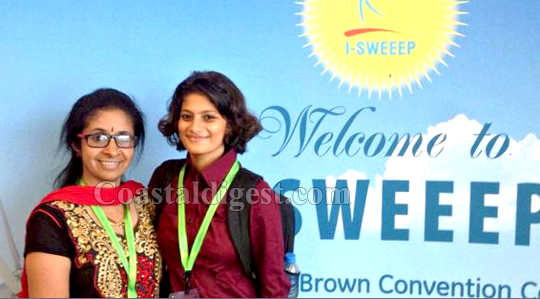
Puttur girl Aneesha Nayak wins bronze at international science fair in the US

[email protected] (CD Network)
May 2, 2016

Mangaluru, Apr 2: A 14-year-old multi-talented girl from Puttur in Dakshina Kannada district has won a bronze medal at the International Sustainable World (Energy Engineering Environment) Project Olympiad (I-SWEEP).

aneesha

I-SWEEP, a largest science fair of its kind worldwide, organised by Harmony Public Schools, a K-12 Public Charter School System, was held at Houston, Texas in United States of America from April 26 to May 1.

Aneesha Nayak, who has just passed Class 9 at Sudana Residential School, Puttur, and will be studying in Class 10 during 2016-17, won the medal for her project titled Hydrophobicity of Colocasia Esculenta leaves as a wall protector' under the Environment-Management and Pollution' category. Sadhana Hebbar, a science teacher at the school, was her guide.

There were 585 projects from 62 countries in the race.

“I feel proud of my daughter. It is an honour for the country,” said Shaila Bhakta, Ms. Nayak's mother.

Ms. Nayak was one among the two girls who represented India at the competition. She will return to Mangaluru on May 4. This was her first attempt at I-SWEEP, Ms. Bhakta added.

Shobha Nagaraj, the headmistress of Sudhana school, is elated at the achievement of her student. “Ms. Nayak is a multifarious person. She is the country's first girl surfer and has won many prizes in the sport. She is a keen science student and is into social service projects taken up by the school from time to time,” she said.

Ms. Nayak is also an Asian-level surfer and a member of Mantra Surf Club in Mulki, near Mangaluru.

aneesha11

aneesha12

aneeshan3

Comments

mahesh
 - 
Monday, 2 May 2016

congrats Aneesha, make a history in all field, we want a girl like you for our country, really proud of you.

Sulthan
 - 
Monday, 2 May 2016

proud to have her in our country.

Priyanka
 - 
Monday, 2 May 2016

Congrats Aneesha, Shining Star of Puttur, i must say.

Shahajan
 - 
Monday, 2 May 2016

Shaila Bhakta lucky mother, she is wonderful talented girl, really proud to have her in our city.

Add new comment

  • Coastaldigest.com reserves the right to delete or block any comments.
  • Coastaldigset.com is not responsible for its readers’ comments.
  • Comments that are abusive, incendiary or irrelevant are strictly prohibited.
  • Please use a genuine email ID and provide your name to avoid reject.
News Network
April 21,2020

Global oil markets remained under intense pressure on Tuesday, with Brent crude dropping below $20 per barrel for the first time in 18 years while other major benchmarks across the world tumbled. 

Brent, the international crude marker, slipped to $18.10, indicating that markets see no immediate let-up to the collapse in oil demand that sent some US oil benchmarks plunging under $0 for the first time on Monday, leaving producers paying for buyers to take their oil away while available storage is scarce.

Coronavirus has sent the oil sector into a state of crisis, with lockdowns implemented by authorities to smother the outbreak slashing demand for crude by as much as a third.

Contracts for the US benchmark West Texas Intermediate for delivery next month tumbled as low as minus $40 a barrel on Monday. Analysts at Citi warned that “if global storage worsens more quickly, Brent could chase WTI down to the bottom”.

The collapse in the May WTI contract was partly a technical product of the fact that it expires on Tuesday, meaning trading volumes were low and making the contract for June delivery more noteworthy, analysts said. That contract held above $20 a barrel on Monday but slid as much as 42 per cent on Tuesday to trade at lows of $11.79, suggesting the blowout in the May contract was more than a blip and that the entire global oil market faced challenges.

Goldman Sachs analysts said the June contact was likely to face downward pressure in the coming weeks, pointing to the “still unresolved market surplus”.

“As storage becomes saturated, price volatility will remain exceptionally high in coming weeks,” they said. “But with ultimately a finite amount of storage left to fill, production will soon need to fall sizeably to bring the market into balance, finally setting the stage for higher prices once demand gradually recovers.”

Warren Patterson, head of commodities strategy at ING, said it was likely that “storage this time next month will be even more of an issue, given the surplus environment”.

“And so in the absence of a meaningful demand recovery, negative prices could return for June,” he added.

European equities traded lower, partly dragged down by weaker energy stocks. The continent-wide Stoxx 600 was down 1.9 per cent, with its oil and gas sub-index dropping 3.3 per cent. In London the FTSE shed 1.7 per cent, while Frankfurt’s Dax slid 2.3 per cent. 

Equities were also broadly lower in Asia, with futures tipping US stocks to fall 1 per cent when trading in New York begins later.

On Wall Street overnight, the S&P 500 closed down 1.8 per cent, partly because of weakness in energy shares, but also due to increased pessimism over the time it will take for countries to emerge from lockdowns.

In fixed income, the yield on the 10-year US Treasury fell 0.03 percentage points to 0.585 per cent as investors retreated to the safety of the debt.

Comments

Add new comment

  • Coastaldigest.com reserves the right to delete or block any comments.
  • Coastaldigset.com is not responsible for its readers’ comments.
  • Comments that are abusive, incendiary or irrelevant are strictly prohibited.
  • Please use a genuine email ID and provide your name to avoid reject.
News Network
June 8,2020

Shivamogga, Jun 8: Tyavarekoppa Tiger and Lion Safari in Shivamogga re-opened on Monday at 9 am.

Zoo authorities said that they are ensuring that all standard operating procedures are being followed, including ensuring social distancing and wearing of masks by visitors.

It is being ensured that pairs of birds are being kept inside enclosures.

Regular sweeping and spraying on the premises are also being taken care of, authorities said.

Floor markings have been made at the ticket counter to maintain social distancing.

Comments

Add new comment

  • Coastaldigest.com reserves the right to delete or block any comments.
  • Coastaldigset.com is not responsible for its readers’ comments.
  • Comments that are abusive, incendiary or irrelevant are strictly prohibited.
  • Please use a genuine email ID and provide your name to avoid reject.
Media Release
February 14,2020

Veteran journalist P. Sainath has said that the nation is in a crisis. And this crisis is not limited to just the rural area. It has become a national crisis at various areas such as agriculture, education, economy, job creation etc.

He was delivering the endowment lecture on the topic ‘Indian democracy at the post-liberalization and post-truth era’ at Media Manthan 2020 organized by the PG department of journalism and mass communication at St Aloysius College (Autonomous). 

Mr Sainath said that the many policies adopted in the 90s led to India becoming unusually unequal. Referring to the speech Ambedkar had made at the Constituent Assembly while handing over the draft of the Constitution, Mr Sainath said, “Ambedkar had warned about the weakness of Indian democracy that liberty without equality allows the supremacy of a few over the multitude. Liberty, equality and fraternity must be kept together as we cannot have one without the other.” 

Mr Sainath stated that the agrarian crisis was no longer about the loss of productivity, employment or about farmer suicide; it was a societal, civilizational crisis. Commenting on the lopsided policies such as cow-slaughter ban, he explained how cow slaughter ban had adversely affected many industries due to their interdependency. While Muslims who slaughtered cows were rendered helpless, the cattle traders who were mostly OBCs lost their earnings as the cattle prices crashed. An important industry like Kolhapur sandals industry in Maharashtra went bankrupt as a result of the cow slaughter ban in Maharashtra. He said the policymakers had no idea how the rural industries were interconnected. Demonetisation too devastated the rural economy as 98 percent of rural transactions happen through cash. 

Mr Sainath also spoke about the crisis of inequality which affects the Dalits and the Adivasis far more than anyone else as 90 percent of the rural households take home less than Rs 10,000/- per month. “Women are yet another group whose labour is never counted in the gross domestic product. Women and girls globally do unpaid work which amounts to about 12.5 billion working hours per year. Monetarily speaking, this is worth 10.8 trillion dollars,” Mr Sainath added. 

Speaking about the crisis of jobs Mr Sainath said that major companies were laying off employees just to create more profits for the investors and the adoption of artificial intelligence in the industry would further destroy millions of jobs.

Rector of St Aloysius College Institutions Fr Dionysius Vaz SJ, Principal Dr (Fr) Praveen Martis SJ, HOD of Journalism and Mass Communication department Dr (Fr) Melwyn Pinto SJ were present.

‘Veerappan and Vijay Mallya’s business models are interesting!’

Addressing the gathering during his endowment lecture on Friday, Mr Sainath made an interesting comment on the so called ‘revenue model’. “Whenever I visit IIMs and IITs for lectures on my PARI project, the students there ask me what my revenue model for my project is. I tell them that I do not have a revenue model. In fact, journalism does not begin with a revenue model. Gandhiji, Ambedkar, Bhagat Singh were all great journalists. But they did not have a revenue model,” Mr Sainath said.

On a lighter note, he said that the best revenue model that he liked was that of forest brigand Veerappan and liquor baron Vijay Mallya. “Veerappan ruled the forest for forty years and from the top ministers to the villagers he could dictate terms and liver royally. Similarly, Mallya’s revenue model was to steal the banks and run away abroad and live like a king,” Mr Sainath added.

Journalism is not and can never be a business. It is a calling, he opined. While newspaper can be a business, television can be a business, journalism per se cannot be reduced to a business. “Unfortunately today, journalists are recruited on a contract basis and they have no bargaining power; and there are no unions to fight for their cause. Hence, they are at the mercy of the corporate media houses for their survival and are made to write stories that cannot be called journalism,” Mr Sainath said.

Answering a question as to the pressures he faced as a journalist, he said that external pressures from the government or others could be very well handled. It is the internal pressures from once own media house that journalists find it difficult to manage.


 

Comments

Add new comment

  • Coastaldigest.com reserves the right to delete or block any comments.
  • Coastaldigset.com is not responsible for its readers’ comments.
  • Comments that are abusive, incendiary or irrelevant are strictly prohibited.
  • Please use a genuine email ID and provide your name to avoid reject.