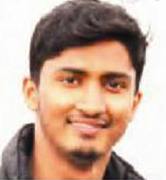
Puttur techie Hafiz KA appointed sub-lieutenant of Indian Navy

[email protected] (CD Network)
May 12, 2016

hafizMangaluru, May 12: A young mechanical engineer from Puttur in Dakshina Kannada district has been appointed as the sub-lieutenant (general service - first grade) of the Indian Navy.

23-year-old Hafiz KA is said to be the only candidate from among 150 engineers from across India who appeared for technical, social, psychological, physical and medical exams held in Coimbatore and Kochi.

Son of health department official K Aboobakar and Ayisha couple, Hafiz is an alumnus of Mountain View English Medium School and Sudana Residential School, and St Philomena College, Puttur.

Comments

Mohammed musthafa
 - 
Sunday, 27 Nov 2016

Mabrook.... keep it up

naren kotian
 - 
Friday, 13 May 2016

kesarinalli kamala :) hahaha.. good I like it i like it , ofcourse great achievement ,but... 150/1 no is very bad ratio ... not even 1% from one particular community ... benefits togolodiikke more than 70% queue iratte and anti India force galalli 99.9% iratte participation .. rashtra seve ge just 1% .. bharata maata ya rakshane ge 1% and bharatha maate a bhakshane ge 99% hahaha ... taaye bharatambe neene dhanya ... bholo bharat mata ki jai ... vande mataram ...

Siraj
 - 
Thursday, 12 May 2016

Congratulations Hafiz.

Ibrahim Sayed
 - 
Thursday, 12 May 2016

Masha Allah...Great Achievement....keep it up...Congratulation

Prof.M.Abubake…
 - 
Thursday, 12 May 2016

Congratulations. Keep it up.

Peace
 - 
Thursday, 12 May 2016

Masha allah.... May Allah give him power to serve his responsibility in best way... Congratulations brother...

Add new comment

  • Coastaldigest.com reserves the right to delete or block any comments.
  • Coastaldigset.com is not responsible for its readers’ comments.
  • Comments that are abusive, incendiary or irrelevant are strictly prohibited.
  • Please use a genuine email ID and provide your name to avoid reject.
News Network
April 11,2020

Bengaluru, Apr 11: The coronavirus-driven lockdown will continue for another 15 days, but relaxations will be allowed in a graded manner, Karnataka Chief Minister B S Yediyurappa said after a four-hour-long video conference with Prime Minister Narendra Modi on Saturday.

“Agriculture and industrial sectors will be given relaxation. Government offices will be allowed to work with partial strength. But the PM said detailed guidelines will be issued in two days,” Yediyurappa said, briefing reporters. 

“Importantly, the lockdown for the next two weeks will be different than how it was in the past three weeks. The Centre, keeping in mind economic activities, especially agriculture, industry and employment of labourers, the Centre will tell us what needs to be done,” the CM said.
 
According to Yediyurappa, PM Modi told all chief ministers that the next 2-3 weeks will be critical. “The next few weeks will decide whether or not we have succeeded. If the situation worsens, we have to face the crisis,” Yediyurappa said, quoting Modi. 

Apparently, Modi sought details on the COVID-19 situation from 12-13 states where the situation is grave. “He did not take a report from Karnataka,” Yediyurappa said. “This morning, seven new cases were reported in the state, taking our tally to 214. Nationally, we were in the third place; we’re now 11th,” he said, hailing the efforts of officials involved in fighting the pandemic. 

The CM said it was “inevitable” to continue the lockdown for another 15 days. “But for citizens to get essential supplies, there’s no bar on them going by walk alone. Also, we will see to it that agricultural activities are not affected anywhere,” Yediyurappa said.

Comments

Add new comment

  • Coastaldigest.com reserves the right to delete or block any comments.
  • Coastaldigset.com is not responsible for its readers’ comments.
  • Comments that are abusive, incendiary or irrelevant are strictly prohibited.
  • Please use a genuine email ID and provide your name to avoid reject.
News Network
June 20,2020

Bengaluru, Jun 20: The Karnataka Health Department has issued guidelines on the admission of COVID-19 patients in private hospitals after clinical assessment, mandating that the district surveillance officer (DSO) should be first informed to initiate further procedures, an official said on Friday.

"A health team sent by the DSO should visit the home or hospital where the patient is staying. The team should conduct a rapid assessment of his or her health condition," said Karnataka's Additional Chief Secretary Jawaid Akhtar.

In the rapid health condition assessment, the team should first check the patient's body temperature, followed by SpO2 (oxygen saturation) level and confirm if there are any comorbidities such as hypertension, diabetes, tuberculosis, HIV, cancer, stroke etc.

Depending on the health condition of patients, Akhtar said, two categories have been made.

"Those who have body temperature greater than 37.5 degrees Celsius, SpO2 level below 94 percent, elderly (above 60 years) and suffering from known comorbid conditions should be taken to a dedicated Covid hospital (DCH)," he said.

"All other patients, even if older but not suffering from co-morbidities, those below 60 and suffering from co-morbidities and asymptomatic cases should be taken to a dedicated Covid health centre (DCHC) or a private hospital as opted by the patient," he added.

Private hospitals have been asked to pitch in due to the rising number of cases in Karnataka. Currently, there are 2943 active cases in the state after 337 cases were reported on Friday.

"The patients are assessed clinically and evaluated at DCHCs or private hospitals with appropriate diagnostic tests. After evaluation, if the patients are asymptomatic, they are shifted to a COVID Care Centre (CCC) for further management," said Akhtar.

CCCs are expected to be equipped with ventilated rooms, pulse oximeters, handheld thermal scanners and blood pressure apparatus.

A nurse has to be present round the clock for every 50 patients and should visit each patient twice a day for assessment whereas the medical officer has to visit the CCC once a day. He should also be available on call in case of an emergency.

Staff serving food and others should wear personal protective equipment and an N-95 mask. Explaining the procedures at DCHCs, Akhtar said general examinations for medical conditions like body temperature, BP, pulse, oxygen saturation and urine output should be in place.

Investigations such as complete blood count, fasting blood sugar, random blood sugar, liver function tests, renal function tests, ECG and chest X-ray facilities should be available.

"DCHCs should ensure that above examinations are over in an orderly timeline of 24 hours and depending on the examination, the patient is continued to be lodged at the DCHC or sent to DCH or CCC," said the senior officer.

Likewise, the discharge policy should be done as per the protocols issued by the Health Department from time to time.

The Karnataka government is yet to fix an upper limit on the cost of treating COVID-19 patients in private hospitals. While reports indicated that this could be capped at Rs 5200 per day, health officials are yet to specify this is the case. Private hospitals in the state have asked the government to take a collaborative approach in deciding the fixed cap on treatment cost.


Comments

Add new comment

  • Coastaldigest.com reserves the right to delete or block any comments.
  • Coastaldigset.com is not responsible for its readers’ comments.
  • Comments that are abusive, incendiary or irrelevant are strictly prohibited.
  • Please use a genuine email ID and provide your name to avoid reject.
News Network
April 24,2020

Riyadh, Apr 24: As many as eleven Indian nationals have died due to COVID-19 in Saudi Arabia.

"As per information available with the Embassy as of April 22, eleven Indian nationals (four in Madinah, three in Makkah, two in Jeddah, one in Riyadh and one in Dammam) have passed away due to COVID-19 in Saudi Arabia," the Embassy of India in Saudi Arabia said in a press release on Wednesday.

It urged the Indian community to remain calm and avoid spreading of rumours amid the COVID-19 crisis.

"The Embassy also reiterates the need for the community to remain calm and avoid spreading of rumours that may create panic. It is important that social media is not used to disseminate false messages and spread hatred along communal lines that can vitiate the atmosphere," the Embassy said.

"As stated by Prime Minister Narendra Modi, COVID-19 does not see race, religion, colour, caste, creed, language or borders before striking, and our response and conduct should attach primacy to unity and brotherhood," it said.

Moreover, several measures on the supply of food, medicines and other emergency assistance to Indians in need are being implemented across the Kingdom.

Earlier, Indian Ambassador to Saudi Arabia, Ausaf Sayeed on April 22 had interacted with Indian community volunteers from the smaller towns all across the Kingdom to discuss the impact of the COVID-19 situation, and evaluate the implementation of various measures to ensure the welfare of Indian nationals.

Comments

Add new comment

  • Coastaldigest.com reserves the right to delete or block any comments.
  • Coastaldigset.com is not responsible for its readers’ comments.
  • Comments that are abusive, incendiary or irrelevant are strictly prohibited.
  • Please use a genuine email ID and provide your name to avoid reject.