


Qatar demands 'blockade' lifted before Gulf crisis talks

Agencies
June 20, 2017

Doha, Jun 20: Qatar's foreign minister today called on neighbouring states to lift their "blockade" of his country before Doha takes part in any negotiations on ending the Gulf diplomatic crisis.Qatar
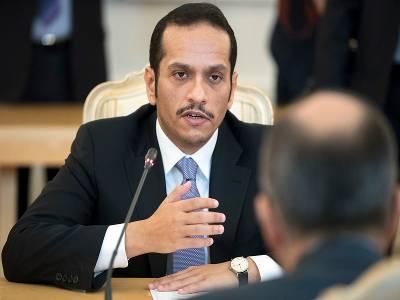
Sheikh Mohammed bin Abdulrahman Al-Thani called measures to isolate Qatar imposed by Saudi Arabia, the United Arab Emirates, Bahrain and others "an act of aggression", adding that lifting them was a "pre-condition" for talks.

"We have to make it very clear for everyone, negotiations must be done in a civilised way and should have a solid basis and not under pressure or under blockade," the foreign minister told reporters in Doha.

"Qatar under blockade -- there is no negotiation. They have to lift the blockade."

On June 5, Saudi Arabia and allied states cut all ties with Qatar, pulling their ambassadors from the emirate and ordering its citizens to repatriate by June 19.

The measures also included closing Qatar's only land border, banning its planes from using their airspace and barring Qatari nationals from transiting through their airports.

Saudi Arabia, the UAE, Egypt, Bahrain and other states accuse Qatar of supporting and funding "terrorism" and of working with regional rival Iran, charges Doha firmly denies.

Sheikh Mohammed's demand came as a UAE minister warned that Qatar's diplomatic isolation could "last years".

"We do not want to escalate, we want to isolate," state minister for foreign affairs Anwar Gargash told journalists during a visit to Paris. "This isolation can take years."

The minister said that while Qatar's rivals were "betting on time", a solution could not be brokered until it abandoned its support for "extremist Islamists".

Sheikh Mohammed said that Qatar had not received any demands from the Gulf states or from countries seeking a diplomatic solution, including Kuwait, the United States, France and Britain.

"Why they didn't submit their demands yet? For us, there is no clear answer for this," he said.

"But what we have seen until now, there is no solid ground for these demands, that's why they didn't submit their demands yet."

The foreign minister added that the economic impact on Qatar had so far proved minimal but added: "We are not claiming we are living in a perfect condition."

The Gulf political crisis has also affected countries outside the region.

"France, UK or the United States -- they are strong allies of Qatar and we have a great deal of cooperation together in terms of military, defence, security, economically," said Sheikh Mohammed.

"So a blockade on Qatar and measures being taken against Qatar in this way is affecting the interests of those countries as well, directly."

Comments

Truth teller
 - 
Tuesday, 20 Jun 2017

you say "you can't negotiate until blockade is lifted, Really! but other gulf sates say there is no negotiation with Terrorists or their supporters until you stop it.

The reality is you have been given earlier warning years back when they cut only diplomatic ties with you by calling the ambassador back.you did not know why was it for?

secondly, you have broken the covenant you made with other states. and acting as if you know nothing. first stop funding and supporting terrorist groups and stop meddling with other nations internal affair. and stop your double face attitude with iran and gulf. be straight forward be brave! not coward.

Add new comment

  • Coastaldigest.com reserves the right to delete or block any comments.
  • Coastaldigset.com is not responsible for its readers’ comments.
  • Comments that are abusive, incendiary or irrelevant are strictly prohibited.
  • Please use a genuine email ID and provide your name to avoid reject.
News Network
January 16,2020

Abu Dhabi, Jan 16: The number of people being killed by terrorism activities worldwide has decreased significantly over the recent years, according to the latest Global Terrorism Index.

The 2019 Global Terrorism Index, which was presented at a forum in Abu Dhabi on Wednesday also showed that the UAE improved its ranking in the index by coming down to 130th rank among the 163 countries. The terrorism impact in the UAE is categorised as 'very low'. In the UAE, only two terrorism incidents were reported over the past decade - one in 2010 and another in 2014 - and there were no casualties.

Commenting on the report, Mansour Al Mansouri, director of the UAE National Media Council (NMC) said: "These findings rightly show the UAE as one of the safest countries in the world in terms of terror threat."

The index showed that the total number of deaths from terrorism declined for the fourth consecutive year in 2018, falling by 15.2 per cent to 15,952 deaths. This represents a 53 per cent reduction since its peak in 2014 when 33,555 people were killed in terrorist attacks.

The index published for the seventh year in a row, ranks 163 countries across the globe according to the relative impact of terrorism. This takes into account the number of terrorist incidents, deaths caused by terror and total value of property damage.

The latest results saw three Middle East countries - Iraq, Syria and Yemen - continue in the top 10 positions of the index.

The findings also showed Taleban overtaking Daesh as the deadliest terrorist group in the world, accounting for 38 per cent of all terrorist deaths. This is an increase of 71 per cent. Afghanistan is the country most affected by terrorism in 2018 followed by Iraq, Nigeria, Syria and Pakistan, according to the report. The least impacted nations were Belarus, Guinea-Bissau, Oman, The Gambia and North Korea.

During his presentation of the key findings of the index at the Foreign Correspondent's Club of the UAE (FCC), Serge Stroobants, director of Europe and Mena at the Institute of Economics and Peace, said lesser people were now being killed in terrorism activities.

"There have been long-term trends in global terrorism, with deaths caused by terror down by 52 per cent compared to high point of 2014, which saw Daesh and Boko Haram at their peak," said Stroobants attributing the decrease in the deaths to the increase in security measures and cooperation among nations in the fight against terrorism.

In contrast to this, there has been a 320 per cent increase in far-right terrorist incidents in the West, with political ideology being the driving force behind an increased proportion of terror motivation.

"There has been an increase in far-right terrorism in Western Europe, North America and Oceania for the third consecutive year," said Stroobants.

Terrorism still remains a global security threat, according the index, with 71 countries recording more than one death - the second highest number of countries since 2002.

Stroobants said conflicts remain the main cause of terrorism with 90 per cent of terrorist incidents occurring in places where there are conflicts or insurgencies.

The report said the global economic impact of terrorism was $33 billion in 2018, a substantial decrease of 38 per cent from the previous year.

Boko Haram was responsible for 80 per cent of all female suicide attacks, said the terrorism index.

Global Terrorism Index: Most affected countries

>Afghanistan (7379 deaths)

>Iraq (1,054 deaths)

>Nigeria (2,040 deaths)

>Syria (662 deaths)

>Pakistan (537 deaths)

>Somalia (646 deaths)

>India (350 deaths)

>Yemen (301 deaths)

>The Philippines (297 deaths)

>Democratic Republic of the Congo (410 deaths)

Comments

Add new comment

  • Coastaldigest.com reserves the right to delete or block any comments.
  • Coastaldigset.com is not responsible for its readers’ comments.
  • Comments that are abusive, incendiary or irrelevant are strictly prohibited.
  • Please use a genuine email ID and provide your name to avoid reject.
Arab News
March 9,2020

Dubai, Mar 9: The eyes of the world will be on the oil markets when the big trading hubs in Europe and North America open following the end of the deal between Saudi Arabia and Russia that has helped to sustain crude at relatively high levels for the past three years.

There were big falls on Friday when ministers from the Organization of the Petroleum Exporting Countries (OPEC) failed to get a deal with non-OPEC members — the so-called OPEC+ — to extend output agreements. Brent oil was down nearly 10 percent at $45.27 going into the western weekend.

Saudi Aramco took immediate action to cut prices after the OPEC+ collapse, offering big discounts for crude deliveries from next month, when the current output restrictions end.

According to a notification sent to customers by Saudi Aramco, seen by Arab News, the Kingdom’s oil giant will cut between $4 and $8 per barrel, with the biggest discounts being offered to buyers in northwest Europe and the US.

Roger Diwan, an oil analyst at consultancy IHS Market, said: “We are likely to see the lowest oil prices of the past 20 years in the next quarter.”

West Texas Intermediate, the US oil benchmark, fell to $28.27 in November 2001.

The move raises the possibility of a “crude war” between the three biggest oil blocs — the US, Russia and the Arabian Gulf. Some analysts believe the American shale industry is more vulnerable to low prices than either the Russians or the Saudis.

Robin Mills, head of the Qamar consultancy, told Arab News: “I don’t think this was premeditated but Saudi Arabia has clearly swung quickly into action to put the Russians under pressure. But the Russians, with low debt and a flexible exchange rate, can cope with a few months of low prices.”

The boom in US shale has made the country the biggest oil producer in the world, but with high financing costs. Lower global prices would put a lot of shale companies out of business.

On the other hand, American motorists, and President Donald Trump, would be pleased to see lower fuel prices in an election year.

In Moscow, one prominent financier with ties to the Kingdom played down the long-term significance of the Vienna fallout.

Kirill Dmitriev, chief executive of the Russian Direct Investment Fund, told Arab News: “Saudi Arabia is our strategic partner, and cooperation between our two countries will continue in all areas. We will also continue to work within the framework of the Russia-Saudi Economic Council.”

One Russian official, who asked not to be named, added: “There is a good relationship between Alexander Novak, Russian energy minister, and his Saudi counterpart Prince Abdul Aziz bin Salman, and I am sure they will continue talking to each other less formally.”

Comments

Add new comment

  • Coastaldigest.com reserves the right to delete or block any comments.
  • Coastaldigset.com is not responsible for its readers’ comments.
  • Comments that are abusive, incendiary or irrelevant are strictly prohibited.
  • Please use a genuine email ID and provide your name to avoid reject.
News Network
July 20,2020

Abu Dhabi, Jul 20: The United Arab Emirates launched its first-ever interplanetary Hope Probe mission to Mars from Japan's Tanegashima Space Centre at 01:58 a.m. (local time) on Monday.

"United Arab Emirates (UAE) launches its first mission to Mars, the 'Hope Mars Mission' from Japan's Tanegashima Space Center," UAE Space Agency said on its Twitter page.

The spacecraft is expected to reach Mars orbit in about 200 days from now and then begin its mission to study the Red Planet's atmosphere, WAM news agency reported.

Once it enters Mars' orbit in the first quarter of 2021, the Hope probe will mark the UAE's 50th anniversary.

The probe will travel 493 million kilometres into space in a journey that will take seven months, and will orbit the Red Planet for one full Martian year of 687 days to provide the first truly global picture of the Martian atmosphere.

The Hope probe will be the first to study the Martian climate throughout daily and seasonal cycles. It will observe the weather phenomena on Mars such as the massive famous dust storms that have been known to engulf the Red Planet, as compared to the short and localised dust storms on Earth.

It will also examine the interaction between the upper and lower layers of the Martian atmosphere and causes of the Red Planet's surface corrosion, as well as study why Mars is losing its upper atmosphere.

Exploring connections between today's Martian weather and the ancient climate of the Red Planet will give deeper insights into the past and future of Earth as well as the potential of life on Mars and other distant planets.

The Hope Mars Mission is considered as the biggest strategic and scientific national initiative announced by UAE's President His Highness Sheikh Khalifa bin Zayed Al Nahyan and His Highness Sheikh Mohammed bin Rashid Al Maktoum in 2014. The UAE will be the first Arab nation to embark on a space mission to the Red Planet in a journey that contributes to the international science community as a service to human knowledge.

The interplanetary mission is the first by any West Asian, Arab or Muslim majority country.

Comments

Add new comment

  • Coastaldigest.com reserves the right to delete or block any comments.
  • Coastaldigset.com is not responsible for its readers’ comments.
  • Comments that are abusive, incendiary or irrelevant are strictly prohibited.
  • Please use a genuine email ID and provide your name to avoid reject.