


Qatar demands 'blockade' lifted before Gulf crisis talks

Agencies
June 20, 2017

Doha, Jun 20: Qatar's foreign minister today called on neighbouring states to lift their "blockade" of his country before Doha takes part in any negotiations on ending the Gulf diplomatic crisis.Qatar
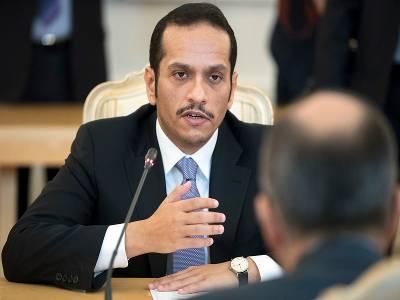
Sheikh Mohammed bin Abdulrahman Al-Thani called measures to isolate Qatar imposed by Saudi Arabia, the United Arab Emirates, Bahrain and others "an act of aggression", adding that lifting them was a "pre-condition" for talks.

"We have to make it very clear for everyone, negotiations must be done in a civilised way and should have a solid basis and not under pressure or under blockade," the foreign minister told reporters in Doha.

"Qatar under blockade -- there is no negotiation. They have to lift the blockade."

On June 5, Saudi Arabia and allied states cut all ties with Qatar, pulling their ambassadors from the emirate and ordering its citizens to repatriate by June 19.

The measures also included closing Qatar's only land border, banning its planes from using their airspace and barring Qatari nationals from transiting through their airports.

Saudi Arabia, the UAE, Egypt, Bahrain and other states accuse Qatar of supporting and funding "terrorism" and of working with regional rival Iran, charges Doha firmly denies.

Sheikh Mohammed's demand came as a UAE minister warned that Qatar's diplomatic isolation could "last years".

"We do not want to escalate, we want to isolate," state minister for foreign affairs Anwar Gargash told journalists during a visit to Paris. "This isolation can take years."

The minister said that while Qatar's rivals were "betting on time", a solution could not be brokered until it abandoned its support for "extremist Islamists".

Sheikh Mohammed said that Qatar had not received any demands from the Gulf states or from countries seeking a diplomatic solution, including Kuwait, the United States, France and Britain.

"Why they didn't submit their demands yet? For us, there is no clear answer for this," he said.

"But what we have seen until now, there is no solid ground for these demands, that's why they didn't submit their demands yet."

The foreign minister added that the economic impact on Qatar had so far proved minimal but added: "We are not claiming we are living in a perfect condition."

The Gulf political crisis has also affected countries outside the region.

"France, UK or the United States -- they are strong allies of Qatar and we have a great deal of cooperation together in terms of military, defence, security, economically," said Sheikh Mohammed.

"So a blockade on Qatar and measures being taken against Qatar in this way is affecting the interests of those countries as well, directly."

Comments

Truth teller
 - 
Tuesday, 20 Jun 2017

you say "you can't negotiate until blockade is lifted, Really! but other gulf sates say there is no negotiation with Terrorists or their supporters until you stop it.

The reality is you have been given earlier warning years back when they cut only diplomatic ties with you by calling the ambassador back.you did not know why was it for?

secondly, you have broken the covenant you made with other states. and acting as if you know nothing. first stop funding and supporting terrorist groups and stop meddling with other nations internal affair. and stop your double face attitude with iran and gulf. be straight forward be brave! not coward.

Add new comment

  • Coastaldigest.com reserves the right to delete or block any comments.
  • Coastaldigset.com is not responsible for its readers’ comments.
  • Comments that are abusive, incendiary or irrelevant are strictly prohibited.
  • Please use a genuine email ID and provide your name to avoid reject.
News Network
July 23,2020

Beirut, Jul 23: The pandemic will exact a heavy toll on Arab countries, causing an economic contraction of 5.7% this year, pushing millions into poverty and compounding the suffering of those affected by armed conflict, a U.N. report said Thursday.

The U.N.'s Economic and Social Commission for Western Asia expects some Arab economies to shrink by up to 13%, amounting to an overall loss for the region of $152 billion.

Another 14.3 million people are expected to be pushed into poverty, raising the total number to 115 million — a quarter of the total Arab population, it said. More than 55 million people in the region relied on humanitarian aid before the COVID-19 crisis, including 26 million who were forcibly displaced.

Arab countries moved quickly to contain the virus in March by imposing stay-at-home orders, restricting travel and banning large gatherings, including religious pilgrimages.

Arab countries as a whole have reported more than 830,000 cases and at least 14,717 deaths. That equates to an infection rate of 1.9 per 1,000 people and 17.6 deaths per 1,000 cases, less than half the global average of 42.6 deaths, according to the U.N.

But the restrictions exacted a heavy economic toll, and authorities have been forced to ease them in recent weeks. That has led to a surge in cases in some countries, including Lebanon, Iraq and the Palestinian territories.

Wealthy Gulf countries were hit by the pandemic at a time of low oil prices, putting added strain on already overstretched budgets. Middle-income countries like Jordan and Egypt have seen tourism vanish overnight and a drop in remittances from citizens working abroad.

War-torn Libya and Syria have thus far reported relatively small outbreaks. But in Yemen, where five years of civil war had already generated the world's worst humanitarian crisis, the virus is running rampant in the government-controlled south while rebels in the north conceal its toll.

Rola Dashti, the head of the U.N. commission, said Arab countries need to “turn this crisis into an opportunity” and address longstanding issues, including weak public institutions, economic inequality and over-reliance on fossil fuels.

“We need to invest in survival, survival of people and survival of businesses,” she said.

Comments

Add new comment

  • Coastaldigest.com reserves the right to delete or block any comments.
  • Coastaldigset.com is not responsible for its readers’ comments.
  • Comments that are abusive, incendiary or irrelevant are strictly prohibited.
  • Please use a genuine email ID and provide your name to avoid reject.
News Network
March 5,2020

Dubai, Mar 5: A 16-year-old Indian girl here has tested positive for the deadly coronavirus, bringing the total number of confirmed infection cases in the UAE to 28, according to media reports.

Health officials here confirmed on Wednesday that a new coronavirus case was detected in the girl who attended an Indian school in Dubai, Al-Arabiya website reported.

The girl tested positive for the COVID-19 after she contracted the infection from her father who travelled overseas, Dubai Health Authority (DHA) was quoted as saying by the report.

The Indian High School in Dubai will be closed from Thursday as a precautionary measure, the Gulf News reported.

"As a precautionary measure, Indian High School Group of schools is closed from Thursday, March 5. Detailed circular about exams will be mailed. Your well-being is important. Take care," the report said.

The father developed symptoms of the virus five days after returning to Dubai. Both the student and family members have been quarantined in hospital and are stable and recovering well. All other family members have also been quarantined, the Khaleej Times reported.

"Within the framework of comprehensive preventive measures against the spread of coronavirus, the DHA is conducting tests and monitoring the students, staff and workers of the school that may have interacted with the coronavirus patient," the DHA was quoted as saying by the Gulf News.

Comments

Add new comment

  • Coastaldigest.com reserves the right to delete or block any comments.
  • Coastaldigset.com is not responsible for its readers’ comments.
  • Comments that are abusive, incendiary or irrelevant are strictly prohibited.
  • Please use a genuine email ID and provide your name to avoid reject.
News Network
July 10,2020

Dubai, Jul 10: Saudi Minister of Culture Prince Badr bin Abdullah bin Farhan has appointed Dina Amin as CEO of the Visual Arts Commission.

She will take the lead in implementing the ministry’s vision and directions in promoting and developing visual arts in the Kingdom and empowering practitioners in the field.

Amin is a leading Saudi specialist in visual arts and the international contemporary art field. She gained a bachelor’s degree in art history and architecture from Wellesley College, in the US, and also attended a collaborative program in architecture at Massachusetts Institute of Technology.

During her career, spanning more than two decades, she has held senior positions in prominent international arts companies, including most recently Phillips, a global auction house for art, design, watches, jewels, and more.

She has also worked at Christie’s, one of the world’s most famous auction houses, employed in senior roles at the company’s international offices including New York, Dubai, and London.

The Visual Arts Commission is one of 11 new cultural bodies recently launched by the Ministry of Culture in line with the Saudi Vision 2030 reform plan to manage the empowerment and development of the Kingdom’s cultural sector. The commission will be responsible for managing and developing the visual arts sector to help achieve the ministry’s goals.

Comments

Add new comment

  • Coastaldigest.com reserves the right to delete or block any comments.
  • Coastaldigset.com is not responsible for its readers’ comments.
  • Comments that are abusive, incendiary or irrelevant are strictly prohibited.
  • Please use a genuine email ID and provide your name to avoid reject.