Qatar releases 23 Indian prisoners, PM Modi expresses deepest' gratitude

June 7, 2016

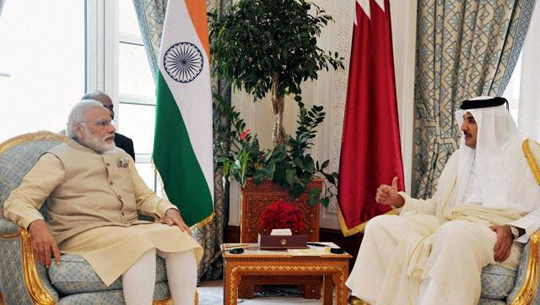
New Delhi, Jun 7: With Qatar Emir Tamim Bin Hamad Al Thani pardoning several prisoners for Ramadan, including 23 Indians, Prime Minister Narendra Modi has expressed his gratitude to the Emir.

namo

“A special gesture to mark the start of a special month...the Government of Qatar releases 23 prisoners, who will return home to India. My deepest gratitude to the Emir of Qatar for the gesture.” tweeted Prime Minister Modi, who is in Washington on a bilateral visit at the invitation of President Barack Obama.

“HH the Emir Sheikh Tamim bin Hamad Al-Thani issued an Emiri gesture pardoning a number of prisoners on the occasion of the Holy Month of Ramadan,” reported Qatar News Agency.

Though official figures have yet to be released, many of the pardoned prisoners, typically hail from nations that have a lot of nationals here, including India, Nepal, Bangladesh and the Philippines, said Doha News, adding Sheikh Tamim Bin Hamad Al Thani typically pardons inmates twice a year, including National Day on Dec. 18.

Those who are freed have usually already served a significant portion of their jail terms and the pardons are seen as a sign of goodwill toward Qatar's large expat population, said embassy officials.

More information about those who are pardoned will be sent to their respective embassies in the coming weeks.

Nearly 100 people were pardoned during Ramadan for crimes related to theft, possession of drugs and fraud, among other crimes in previous years.

On Sunday, Prime Minister Modi concluded his visit to Qatar, where he held meetings with business leaders and the Emir of Qatar, followed by signing of agreements, a lunch hosted by the Emir, a meeting with the father Emir and an interaction with the Indian community.

Comments

satyameva jayate
 - 
Tuesday, 7 Jun 2016

Ha Ha.......Always running behind credit......PM saheb please come back.
All the Gulf nations releases prisoners (not criminals) from jail...its normal....You dont have to go and sit there for it....Do some work here..
People are looking for a Bajrangee Bhaijan to bring you back...ha ha.

Sayed
 - 
Tuesday, 7 Jun 2016

Emir typically pardons inmates twice year on Ramadan and National Day. It has nothing to do with PM visit.

Rikaz
 - 
Tuesday, 7 Jun 2016

He has pardoned not released them yet, it will take place in a couple of weeks, another feku screw-up.

Add new comment

  • Coastaldigest.com reserves the right to delete or block any comments.
  • Coastaldigset.com is not responsible for its readers’ comments.
  • Comments that are abusive, incendiary or irrelevant are strictly prohibited.
  • Please use a genuine email ID and provide your name to avoid reject.
News Network
May 23,2020

Bengaluru, May 23: The Karnataka government on Friday said returnees from six states with high COVID-19 cases will be kept in institutional quarantine for seven days.

The states are - Maharashtra, Gujarat, Delhi, Tamil Nadu, Rajasthan and Madhya Pradesh.

As per the standard operating procedure released by the government, all people to arrive via rain, air road are expected to quarantine.

After they test negative for the disease in pool testing, they will be sent for home quarantine for another seven days, the government said.

Returnees from other low prevalence states will be asked to follow 14 days of home quarantine, according to the standard operating procedure (SOP) for entry of persons from other states to Karnataka issued by the state health department late on Friday night.

However home quarantine is allowed for pregnant ladies, people above 80 years, patients with comorbidities and children below 10 years of age, along with one attendant after they test negative.

In special cases like businessmen coming for urgent work, the quarantine period will be waived if they furnish a report from an ICMR-approved laboratory showing they tested negative for COVID-19, it said.

However, if they don't have reports, they will have to stay in institutional quarantine and can leave once their results test negative.

In case their stay exceeds 5 days, they will be sent to the fever clinic and get a five-day extension if found asymptomatic.

The report should not be more than two days old from the date of travel.

All Karnataka returnees who entered from 4 May will be tested from 5-7 days from the time of their arrival.

If found COVID-19 negative, they will be sent to home quarantine and will have to follow due precautions, the SOP stated.

Comments

Add new comment

  • Coastaldigest.com reserves the right to delete or block any comments.
  • Coastaldigset.com is not responsible for its readers’ comments.
  • Comments that are abusive, incendiary or irrelevant are strictly prohibited.
  • Please use a genuine email ID and provide your name to avoid reject.
Ram Puniyani
March 14,2020

In the wake of Citizenship Amendment Act (CAA) UN High Commissioner, Michele Bachelet, has filed an intervention in the Supreme Court petition challenging the constitutionality of the Citizenship Amendment Act, as she is critical of CAA. Responding to her, India’s Foreign Minister S. Jai Shanker strongly rebutted her criticism, saying that the body (UNHCR) has been wrong and is blind to the problem of cross border terrorism. The issue on hand is the possibility of scores of people, mainly Muslims, being declared as stateless. The problem at hand is the massive exercise of going through the responses/documents from over 120 crore of Indian population and screening documents, which as seen in Assam, yield result which are far from truthful or necessary.

The issue of CAA has been extensively debated and despite heavy critique of the same by large number of groups and despite the biggest mass opposition ever to any move in Independent India, the Government is determined on going ahead with an exercise which is reminiscent of the dreaded regimes which are sectarian and heartless to its citizens, which have indulged in extinction of large mass of people on grounds of citizenship, race etc. The Foreign minister’s assertion is that it is a matter internal to India, where India’s sovereignty is all that matters! As far as sovereignty is concerned we should be clear that in current times any sovereign power has to consider the need to uphold the citizenship as per the principle of non-discrimination which is stipulated in Art.26 of the International Covenant on Civil and Political (ICCPR) rights.

Can such policies, which affect large number of people and are likely to affect their citizenship be purely regarded as ‘internal’? With the World turning into a global village, some global norms have been formulated during last few decades. The norms relate to Human rights and migrations have been codified. India is also signatory to many such covenants in including ICCPR, which deals with the norms for dealing with refugees from other countries. One is not talking of Chicago speech of Swami Vivekanand, which said that India’s greatness has been in giving shelter to people from different parts of the World; one is also not talking of the Tattariaya Upanishad’s ‘Atithi Devovhav’ or ‘Vasudhaiva Kutumbkam’ from Mahaupanishad today.

What are being talked about are the values and opinions of organizations which want to ensure to preserve of Human rights of all people Worldwide. In this matter India is calling United Nations body as ‘foreign party’; having no locus standi in the case as it pertains to India’s sovereignty. The truth is that since various countries are signatories to UN covenants, UN bodies have been monitoring the moves of different states and intervening at legal level as Amicus (Friend of the Court) to the courts in different countries and different global bodies. Just to mention some of these, UN and High Commissioner for Human Rights has often submitted amicus briefs in different judicial platforms. Some examples are their intervention in US Supreme Court, European Court of Human Rights, International Criminal Court, and the Inter-American Court of Human Rights. These are meant to help the Courts in areas where UN bodies have expertise.

 Expertise on this has been jointly formulated by various nations. These interventions also remind the nations as to what global norms have been evolved and what are the obligations of individual states to the values which have evolved over a period of time. Arvind Narrain draws our attention to the fact that, “commission has intervened in the European Court of Human Rights in cases involving Spain and Italy to underscore the principle of non-refoulement, which bars compulsory expulsion of illegal migrants… Similarly, the UN has intervened in the International Criminal Court in a case against the Central African Republic to explicate on the international jurisprudence on rape as a war crime.”

From time to time organizations like Amnesty International and Human Rights Watch have been monitoring the status of Human rights of different countries. This puts those countries in uncomfortable situation and is not welcome by those establishments. How should this contradiction between ‘internal matter’, ‘sovereignty’ and the norms for Human rights be resolved? This is a tough question at the time when the freedom indices and democratic ethos are sliding downwards all over the world. In India too has slid down on the scale of these norms.

In India we can look at the intervention of UN body from the angle of equality and non discrimination. Democratic spirit should encourage us to have a rethink on the matters which have been decided by the state. In the face of the greatest mass movement of Shaheen bagh, the state does need to look inwards and give a thought to international morality, the spirit of global family to state the least.

The popular perception is that when Christians were being persecuted in Kandhmal the global Christian community’s voice was not strong enough. Currently in the face of Delhi carnage many a Muslim majority countries have spoken. While Mr. Modi claims that his good relations with Muslim countries are a matter of heartburn to the parties like Congress, he needs to relook at his self gloating. Currently Iran, Malaysia, Indonesia and many Muslim majority countries have spoken against what Modi regime is unleashing in India. Bangladesh, our neighbor, has also seen various protests against the plight of Muslims in India. More than the ‘internal matter’ etc. what needs to be thought out is the moral aspect of the whole issue. We pride ourselves in treading the path of morality. What does that say in present context when while large section of local media is servile to the state, section of global media has strongly brought forward what is happening to minorities in India.   

The hope is that Indian Government wakes up to its International obligations, to the worsening of India’s image in the World due to CAA and the horrific violence witnessed in Delhi.


Comments

Add new comment

  • Coastaldigest.com reserves the right to delete or block any comments.
  • Coastaldigset.com is not responsible for its readers’ comments.
  • Comments that are abusive, incendiary or irrelevant are strictly prohibited.
  • Please use a genuine email ID and provide your name to avoid reject.
News Network
March 7,2020

Bengaluru, Mar 7: As a precautionary measure to control the spread of coronavirus in Karnataka, the state government has planned to suspend biometric attendance for the time-being at its offices, also in corporate and IT companies, Medical Education Minister Dr K Sudhakar said on Saturday.

He said the government has taken all precautionary measures to control the spread of the virus in the state.

"Our Additional Chief Secretary has already spoken to IT companies yesterday on behalf of the government regarding guidelines that need to be followed, it is part of it...we will do it in the government also in the days to come," Sudhakar told reporters here.

He was responding to a question about suspending biometric attendance at offices in the wake of the coronavirus outbreak.

Asked about suspending biometric attendanceat government offices, he said, "we have planned to do it yesterday."

Sudhakar said so far in Karnataka not even one case has been identified, to that extent we have been taking precautionary measures effectively.

He said from villages to state capital Bengaluru at all levels the health department officials have been activated as part of the precautionary measures.

Also, committees headed by Deputy Commissioners have been formed in all district, he added.

"We have given certain guidelines to people. We have also included private hospitals. We have taken all precautionary measures to stop the virus from entering the state," he added.

In response to a question regarding masks, the Minister clarified that those who have the symptoms of the disease only should use them.

He said, "N95 masks are required only for those who have tested positive, there is not even a single positive case in the state so far...surgical masks that will have three layers can be used by those who have symptoms like cough, cold, fever."

In the state as a precautionary measure 2,500 beds have been kept ready if the situation arises, despite not having a single case.

Comments

Add new comment

  • Coastaldigest.com reserves the right to delete or block any comments.
  • Coastaldigset.com is not responsible for its readers’ comments.
  • Comments that are abusive, incendiary or irrelevant are strictly prohibited.
  • Please use a genuine email ID and provide your name to avoid reject.