



RAF deployed in violence-hit Mandsaur in MP

June 8, 2017

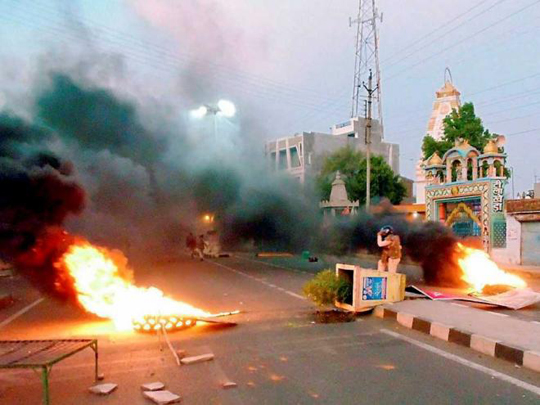
New Delhi/Mandsaur, Jun 8: Contingents of Rapid Action Force (RAF) were on Thursday deployed in Madhya Pradesh's violence-hit Mandsaur district where the situation remained tense.
RAF

Two companies of RAF, comprising around 100 men each, have moved into Pipliamandi in Mandsaur, the site of Tuesday's shooting of five farmers, police said.

While two companies of RAF have been posted in Garoth area in the district, another two have been deployed along the Mwoh-Neemuch Highway to prevent any untoward incidents, they said.

The situation is tense but under control, police said.

Collector, SP of Mandsaur transferred

The Shivraj Singh Chouhan government on Thursday transferred the collector and superintendent of police of Mandsaur district which witnessed the death of five farmers in police firing.

Mandsaur Collector Swatantra Kumar Singh is transferred as deputy secretary Mantralaya. Singh was replaced with OP Shrivastava, official sources said.

The government also transferred Mandsaur SP, OP Tripathi and posted Manoj Kumar Singh in place of him, the sources added.

DIG Ratlam range Avinash Sharma is camping in Pipliamandi where farmers, agitating for the last seven days for loan waiver and better crop prices, defied prohibitory orders yesterday, beat up officials and policemen and resorted to violence and arson.

Senior police officials have also been deployed to oversee the law and order situation in all sub-divisions of Mandsaur district, the official said.

Farmers had on Wednesday resorted to violence and arson in western Madhya Pradesh despite prohibitory measures, posing a major challenge for chief minister Shivraj Singh Chouhan and providing a rallying point for the opposition parties.

In view of the volatile situation, the Centre had rushed 1,100 personnel of RAF to the violence-hit state where the farmers have been agitating for loan waiver and better crop prices.

The Chouhan government had sought to cool the tempers by announcing certain measures, including a loan settlement scheme for those cultivators who had defaulted on repayment of farm loan borrowed by them earlier.

The scheme will cover around six lakh farmers, with accumulated dues of Rs 6000 crore, according to the government.

Rahul leaves for Mandsaur, police say they will stop him

Congress vice-president Rahul Gandhi on Thursday left Delhi for Mandsaur even as the local police made it clear that he will not be allowed to enter the district.

Gandhi left on Thursday morning for the district and would enter Madhya Pradesh from Rajasthan.

However, superintendent of police of Neemuch Manoj Kumar Singh said the Congress leader will not be allowed to enter the violence-hit district where the situation remains tense.

If the Congress leader tries to enter the district, he will be detained, the SP said.

The Congress on Wednesday termed as "coldblooded murder" the killing of five farmers in police firing in Madhya Pradesh and questioned the prime minister's silence over it.

The Congress accused the BJP of "acting as a curse of death for Indian farmers".

AICC spokesperson Abhishek Singhvi said yesterday that it was insulting and unfortunate that the BJP-led NDA government was in denial mode over the firing and accused it of spreading rumours and canards over who fuelled the farmers' protest.

He also hit out at the BJP for denying permission to people who wanted to go and express solidarity with the bereaved farmers, including Gandhi.

The Congress vice-president is visiting Mandsaur to meet the kin of the five persons who were killed in violence during the farmers' agitation.

Comments

Add new comment

  • Coastaldigest.com reserves the right to delete or block any comments.
  • Coastaldigset.com is not responsible for its readers’ comments.
  • Comments that are abusive, incendiary or irrelevant are strictly prohibited.
  • Please use a genuine email ID and provide your name to avoid reject.
News Network
June 18,2020

New Delhi, Jun 18: The border clash between Indian and Chinese soldiers in Ladakh broke the brittle quiet – and also the sense of security for anxious Chinese nationals in India who fear a backlash with anti-Chinese sentiment spiralling in the country.

With the high altitude violent face-off in eastern Ladakh’s Galwan Valley spurring hashtags such as “Boycott China” and “Teach Lesson to China” and leading to street protests, the undercurrents of tension were evident.

Wary of being identified, some said they had been reassured by their friends but were still apprehensive for themselves and their families.

"They (Chinese families) don''t want to speak to the media. They are not going out and are worried about their security and well being. Their families are also worried back home," Mohammed Saqib, secretary general of the India China Economic & Cultural Council, told PTI.

He added that his Chinese friends in India been calling him since they heard news about Monday night’s clashes in which 20 Indian soldiers were killed -- the worst military confrontation in five decades -- and expressed concern over growing anti-China sentiments.

A Chinese national from Beijing working in Gurgaon for a Chinese mobile firm initially refused to talk, saying he did not want to speak to the media and later shared his thoughts only on condition of anonymity.

"There is talk of border standoff and tensions, but we know Indians are very warm people and that is why I have told my family that all is fine here and they should not worry," he said.

Another Chinese national working in Gurgaon said he and his family are feeling the stress amid the spiralling conflict between India and China, but many friends have been reassuring him.

"They (Chinese in India) are under a lot of stress naturally. Such a conflict puts a lot of stress as they could bear the brunt and the same applies to Indians in China," B R Deepak, professor at the Centre for Chinese and South East Asian Studies of the Jawaharlal Nehru University said.

He said it was unfortunate that the border standoff derailed the commemorative programmes aimed at strengthening ties at a time the two countries were gearing to celebrate 70 years of establishment of diplomatic ties.

Experts also feel the border clash is likely to have a significant negative impact on the economic and people to people ties.

There are scores of Chinese in India working in various Chinese firms and also those who are studying in universities like JNU.

About 3,000 Chinese people, doing business or studying in big cities in India, were stranded in India at the start of the COVID-19 crisis, and about half of them returned to China before the lockdown began on March 25.

The Chinese Embassy in New Delhi announced on May 25 that they will arrange for flights to take back students, tourists and businesspersons to five Chinese cities, including Shanghai and Guangzhou.

"It will impact the psychology of the Chinese here. There are 2,000 Chinese firms in various sectors in India which are going to be impacted," Deepak said.

Future investments from the Chinese side could also be impacted, he said.

Moreover, as far as people-to-people contacts are concerned, the number of Chinese students choosing India as a preferred destination is likely to go down, Deepak said.

Alka Acharya, another China expert, said there are two kinds of impacts of such an incident -- short term and medium term.

Usually after the initial nationalistic reaction in the short term things tend to normalise in the medium term, but with such a border clash happening for the first time in decades clearly the resonance would be much more in both India and China, said Acharya, professor at the Centre for East Asian Studies, School of International Studies, in JNU.

“Due to the impact of the COVID-19 crisis on the economy, whether India can take a hardline in terms of economics towards China, is a tricky question,” she said.

In the immediate context, there may be a dip in economic ties with calls for boycott of Chinese goods and services, Acharya said.

The manner in which this crisis is resolved will affect how ties will be affected in the medium term, she said.

The headlines have added to the anxiety.

A group of ex-armymen gathered near the Chinese embassy to protest the killing of 20 Indian Army personnel in Ladakh’s Galwan Valley. And another group of around 10 protesters belonging to the Swadeshi Jagaran Manch protested near the Teen Murti roundabout in Central Delhi.

The anti-China sentiment prevalent among the common public is also finding a reflection in government policy with sources saying the Department of Telecom (DoT) is set to ask state-owned Bharat Sanchar Nigam Ltd (BSNL) not to use Chinese telecom gear in its 4G upgradation.

Trade bodies like CAIT are also calling for a boycott of Chinese products.

And Chinese handset maker Oppo cancelled the livestream launch of its flagship 5G smartphone in the country amid protests.

Monday night’s clashes between the Chinese and Indian troops in Galwan Valley significantly escalated the already volatile border standoff between the two countries.

The casualties on the Chinese side are not yet known. However, government sources, citing an American intelligence report, claimed the total number of soldiers killed and seriously wounded could be 35.

Comments

Add new comment

  • Coastaldigest.com reserves the right to delete or block any comments.
  • Coastaldigset.com is not responsible for its readers’ comments.
  • Comments that are abusive, incendiary or irrelevant are strictly prohibited.
  • Please use a genuine email ID and provide your name to avoid reject.
News Network
May 6,2020

New Delhi, May 6: Taking a cue from states, the Centre announced one of the steepest hikes in duties on petrol and diesel in the recent past, by raising it by Rs 10 and Rs 13 per litre, respectively, in a notification issued late on Tuesday.

Retail prices, however, will see no change as the price hike will be absorbed by oil marketing companies against the fall in crude prices.

Road and infrastructure cess was hiked by Rs 8 for petrol and diesel and the special additional excise duty (SAED) was hiked by Rs 2 per litre and Rs 5 per litre, respectively. While the road cess will only go into the Centre’s coffers, the hike on account of SAED will be passed on to states via devolution at 42 per cent. Hence, the states will get only Rs 0.84 per litre in case of petrol and Rs 2.1 in case of diesel.

The decision comes after several states increased the value added tax (VAT) on petrol and diesel making use of the lower price regime. The Delhi government on Tuesday increased VAT on petrol and diesel to 30 per cent each, from 27 and 16.75, respectively. As a result, the price of petrol in Delhi increased by Rs 1.67 to Rs 71.26 a litre and diesel by Rs 7.10 to Rs 69.29 in Delhi on Tuesday.

Amid falling international crude oil prices, the Centre introduced an enabling provision in March to raise excise duty on petrol and diesel by Rs 8 per litre in the Finance Act. The government had on March 14 raised excise duty on petrol and diesel by? 3 per litre each, which was to help raise an additional ?39,000 crore in revenue annually.

This duty hike included Rs 2 a litre increase in SAED and Rs 1 in road and infrastructure cess. It raised SAED to Rs 10 for petrol and Rs 4 for diesel. The limit has now been increased to Rs 18 a litre in case of petrol and Rs 12 in case of diesel by way of amendment of the Eighth Schedule of the Finance Act.

Economists said the move would impact retail inflation by over half a percentage point at least. “With lower consumption, there was loss of revenue for Centre and states, who earn Rs 6 trillion annually or Rs 50,000 crore monthly from fuel. Amid lockdown in April, the collection must have come down to just Rs 5,000 crore, and this will hold for May.

This means that Centre and states have lost 20 per cent of annual revenue from fuel. Hence, they have hiked duties to recover losses,” said Madan Sabnavis, chief economist, CARE Ratings. He added that the hike will impact inflation by at least 0.6-0.7 percentage points.

According to industry experts, an estimate of the additional government revenue cannot be made as the consumption of petrol and diesel has dropped to 40 per cent of what it was before the lockdown. The duty hike comes following a drop in international crude oil prices in April, owing to lower consumption figures globally. At 11.50 pm on Tuesday, Brent was priced at $30.67 a barrel, while West Texas Intermediate (WTI) crude was seen at $24.36 a barrel. On Monday, the Indian basket of crude oil was priced at $23.38 a barrel, after touching a 15-year low last month.

Comments

Add new comment

  • Coastaldigest.com reserves the right to delete or block any comments.
  • Coastaldigset.com is not responsible for its readers’ comments.
  • Comments that are abusive, incendiary or irrelevant are strictly prohibited.
  • Please use a genuine email ID and provide your name to avoid reject.
News Network
July 11,2020

New Delhi, Jul 11: India's COVID-19 case count crossed the eight lakh-mark on Saturday with yet another highest single-day spike of 27,114 new cases in the last 24 hours.

As many as 519 deaths were reported during this period.

The total number of positive cases in the country stands at 8,20,916, including 2,83,407 active cases, 5,15,386 cured/discharged/migrated and 22,123 deaths, according to the Ministry of Health and Family Welfare.

With as many as 2,38,461 COVID-19 cases, Maharashtra continues to remain the worst-affected state, followed by Tamil Nadu (1,30,261) and Delhi (1,09,140).

Meanwhile, 1,13,07,002 samples have been tested for COVID-19 till July 10. Out of these 2,82,511 samples were tested yesterday, according to the Indian Council of Medical Research (ICMR).

Comments

Add new comment

  • Coastaldigest.com reserves the right to delete or block any comments.
  • Coastaldigset.com is not responsible for its readers’ comments.
  • Comments that are abusive, incendiary or irrelevant are strictly prohibited.
  • Please use a genuine email ID and provide your name to avoid reject.