


Ragpicker finds bag carrying Rs 1,000 notes of 52K face value

November 10, 2016

Pune, Nov 10: A waste picker here today came across a bag full of Rs 1,000 notes totalling upto Rs 52,000, two day after the demonetisation of the currency of these denominations.Pune
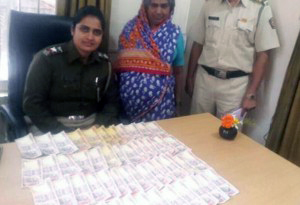
The elderly woman ragpicker, who chanced upon the cash in a plastic bag, however, immediately alerted her supervisor who in-turn informed the police of what she found.

Police said the incident took place in one of the by-lanes of Law College Road here this morning.

"Shanta Ovhal, who is working with the civic body, was segregating the waste this morning in one of the by-lanes of Law College Road, where she found a plastic bag," an officer attached to Deccan-Gymkhana police station said.

"To segregate the waste, she opened the bag and was shocked as she saw currency notes in denominations of Rs 1,000 along with some waste in the bag," he said.

The woman then informed about it to her supervisor."Later, they approached the police and submitted the bag, full of demonetised currency notes," the officer said.

"We are investigating who had left the bag in the waste and also probing the genuineness of the recovered notes," he added.

On Tuesday evening, Prime Minister Narendra Modi had announced that high denomination notes of Rs 500 and Rs 1,000 will no longer be legal tender, in a bid to fight against black money and create a "corruption-free" India.

Comments

Rikaz
 - 
Thursday, 10 Nov 2016

When are citizens getting their 15 Lakhs....cleaning black money in India, agreed...at the same time we need to see how government is going to clean black money stocked in foreign countries too.....

Add new comment

  • Coastaldigest.com reserves the right to delete or block any comments.
  • Coastaldigset.com is not responsible for its readers’ comments.
  • Comments that are abusive, incendiary or irrelevant are strictly prohibited.
  • Please use a genuine email ID and provide your name to avoid reject.
coastaldigest.com news network
July 26,2020

Mangaluru, Jul 26: Rubbishing reports about cancellation of institutional quarantine for international passengers in Mangaluru, local health authorities have clarified that 14 day isolation including first seven day institutional quarantine must for international passengers. 

For past couple of days rumours were doing rounds on social media that the government has done away with quarantine for international passengers. A few Mangaluru-based news portals also had published it as news without quoting any reliable sources. 

Meanwhile, district health officer in his clarification message said that neither Karnataka government nor Dakshina Kannada district administrant has revised the quarantine norms for international passengers. 

“Those who arrive from overseas must remain in isolation for 14 days. Out of this, seven days have to be spent in institutional quarantine (in hotel or lodge). During this period, the throat swab sample of the person will be sent for covid-19 testing. If the report is negative, then they will be sent to home quarantine for another seven days."

He said that concession in terms of number of days has only been given for people with other health conditions, children and the elderly. "For children below 10 years, pregnant women, elderly above the age of 60 years and other with other ailments, the throat swab will be collected on the second day of institutional quarantine. If the report turns negative, they will be sent to home quarantine for 14 days."

Comments

Add new comment

  • Coastaldigest.com reserves the right to delete or block any comments.
  • Coastaldigset.com is not responsible for its readers’ comments.
  • Comments that are abusive, incendiary or irrelevant are strictly prohibited.
  • Please use a genuine email ID and provide your name to avoid reject.
News Network
April 19,2020

Bengaluru, Apr 19:  Karnataka's Technical Education department following Union Home Ministry’s guidelines, on Sunday directed all its colleges not to use the Zoom application to conduct online classes during the ongoing lockdown period.

Considering Union Home Ministry's advisory that Zoom app is not safe, the department has taken the decision and issued a circular asking all government, aided and unaided engineering, polytechnic (Diploma) colleges to stop using the app immediately.

The department recommended the use of a free app developed by TCS: "TCS iON Digital class room" or any other App recommended by All India Council for Technical Education (AICTE) to conduct the online classes.

Comments

Add new comment

  • Coastaldigest.com reserves the right to delete or block any comments.
  • Coastaldigset.com is not responsible for its readers’ comments.
  • Comments that are abusive, incendiary or irrelevant are strictly prohibited.
  • Please use a genuine email ID and provide your name to avoid reject.
News Network
June 21,2020

India on Sunday witnessed annual solar eclipse or 'surya grahan' 2020, the third eclipse even for this year after first two lunar eclipses took place in January and June and the last annual solar eclipse of this decade.

The solar eclipse started from around 9 a.m. across the Indian map as the Sun, the Moon, and the Earth came in a straight line, and the country witnessed the 'deepest' annular solar eclipse in over a century.

Astrologers said it a fourth super rare hybrid eclipse which is a mix between an annular and total solar eclipse.

Areas like Hyderabad, Chennai, Bhubaneshwar, Kolkata, Lucknow, Mumbai, Delhi, Patna, Shillong and more witnessed a partial phase of the annular solar eclipse from 9 a.m.

In the eclipse, the distance of the Moon and Earth will be larger than usual which means the moon will not be able to cover up the sun fully and will leave out the borders of the sun - giving an appearance of a "Ring of Fire".

Press Information Bureau in a tweet informed that it is the last annular solar eclipse in India of this decade.

People can catch glimpse of the partially covered sun between 10 a.m. and 2.28 p.m. as per the time differing as locations in India. The eclipse will continue for over three hours covering 84 per cent Sun.

There are three types of solar eclipses - total, partial, and annular.

Comments

Add new comment

  • Coastaldigest.com reserves the right to delete or block any comments.
  • Coastaldigset.com is not responsible for its readers’ comments.
  • Comments that are abusive, incendiary or irrelevant are strictly prohibited.
  • Please use a genuine email ID and provide your name to avoid reject.