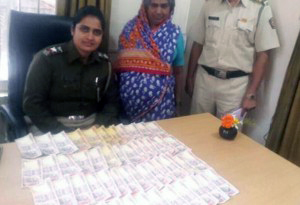
Ragpicker finds bag carrying Rs 1,000 notes of 52K face value

November 10, 2016

Pune, Nov 10: A waste picker here today came across a bag full of Rs 1,000 notes totalling upto Rs 52,000, two day after the demonetisation of the currency of these denominations.Pune

The elderly woman ragpicker, who chanced upon the cash in a plastic bag, however, immediately alerted her supervisor who in-turn informed the police of what she found.

Police said the incident took place in one of the by-lanes of Law College Road here this morning.

"Shanta Ovhal, who is working with the civic body, was segregating the waste this morning in one of the by-lanes of Law College Road, where she found a plastic bag," an officer attached to Deccan-Gymkhana police station said.

"To segregate the waste, she opened the bag and was shocked as she saw currency notes in denominations of Rs 1,000 along with some waste in the bag," he said.

The woman then informed about it to her supervisor."Later, they approached the police and submitted the bag, full of demonetised currency notes," the officer said.

"We are investigating who had left the bag in the waste and also probing the genuineness of the recovered notes," he added.

On Tuesday evening, Prime Minister Narendra Modi had announced that high denomination notes of Rs 500 and Rs 1,000 will no longer be legal tender, in a bid to fight against black money and create a "corruption-free" India.

Comments

Rikaz
 - 
Thursday, 10 Nov 2016

When are citizens getting their 15 Lakhs....cleaning black money in India, agreed...at the same time we need to see how government is going to clean black money stocked in foreign countries too.....

Add new comment

  • Coastaldigest.com reserves the right to delete or block any comments.
  • Coastaldigset.com is not responsible for its readers’ comments.
  • Comments that are abusive, incendiary or irrelevant are strictly prohibited.
  • Please use a genuine email ID and provide your name to avoid reject.
Agencies
May 8,2020

Washington D.C., May 8: The prime time for brain development in a child's life is the first year, where the infant spends most of the time asleep. It is the time when neural connections form and sensory memories are encoded.

However, when sleep is disrupted, as occurs more often among children with autism, brain development may be affected, too.

New research led by the University of Washington finds that sleep problems in a baby's first 12 months may not only precede an autism diagnosis but also may be associated with altered growth trajectory in a key part of the brain, the hippocampus.

The study, which was published in the American Journal of Psychiatry, researchers report that in a sample of more than 400 taken of 6- to 12-month-old infants, those who were later diagnosed with autism were more likely to have had difficulty falling asleep.

It also states that this sleep difficulty was associated with altered growth trajectories in the hippocampus.

"The hippocampus is critical for learning and memory, and changes in the size of the hippocampus have been associated with poor sleep in adults and older children.

As many as 80 per cent of the children with autism spectrum disorder have sleep problems," said Annette Estes, director of the UW Autism Center and senior author of the study.

"In our clinical experience, parents have a lot of concerns about their children's sleep, and in our work on early autism intervention, we observed that sleep problems were holding children and families back," added Estes, who is also a UW professor of speech and hearing sciences.

"It could be that altered sleep is part-and-parcel of autism for some children. One clue is that behavioural interventions to improve sleep don't work for all children with autism, even when their parents are doing everything just right. This suggests that there may be a biological component to sleep problems for some children with autism," said Estes.

To consider links among sleep, brain development, and autism, researchers at the IBIS Network looked at MRI scans of 432 infants, surveyed parents about sleep patterns, and measured cognitive functioning using a standardized assessment.

At the outset of the study, infants were classified according to their risk for developing autism: Those who were at higher risk of developing autism -- about two-thirds of the study sample -- had an older sibling who had already been diagnosed.

Infant siblings of children with autism have a 20 per cent chance of developing autism spectrum disorder -- a much higher risk than children in the general population.

In the current study, 127 of the 432 infants were identified as "low risk" at the time the MRI scans were taken because they had no family history of autism.

They later evaluated all the participants at 24 months of age to determine whether they had developed autism. Of the roughly 300 children originally considered "high familial risk," 71 were diagnosed with autism spectrum disorder at that age.

Problems with sleep were more common among the infants later diagnosed with an autism spectrum disorder, as were larger hippocampi. No other subcortical brain structures were affected, including the amygdala, which is responsible for certain emotions and aspects of memory, or the thalamus, a signal transmitter from the spinal cord to the cerebral cortex.

The authors note that while parents reported more sleep difficulties among infants who developed autism compared to those who did not, the differences were very subtle and only observed when looking at group averages across hundreds of infants.

Sleep patterns in the first years of life change rapidly as infants transition from sleeping around the clock to a more adult-like sleep/wake cycle. Until further research is completed, Estes said, it is not possible to interpret challenges with sleep as an early sign of increased risk for autism.


Comments

Add new comment

  • Coastaldigest.com reserves the right to delete or block any comments.
  • Coastaldigset.com is not responsible for its readers’ comments.
  • Comments that are abusive, incendiary or irrelevant are strictly prohibited.
  • Please use a genuine email ID and provide your name to avoid reject.
News Network
March 16,2020

Belagavi, Mar 16: Despite issuing an order banning large gathering, including lavish weddings, Karnataka Chief Minister B.S. Yediyurappa attended the grand marriage celebrations of the daughter of BJP MLC Mahantesh Kavatagimath in Belagavi on Sunday.

The Chief Minister had advised people to postpone weddings till the COVID-19 scare passed off, or to restrict the number of guests to around 100. But the wedding on the lawns of Shagun gardens in the Udyambag industrial area in Belagavi had many more times the number of visitors.

A police officer on duty at the venue estimated the crowd to be over 3,000.

The large gathering was in clear defiance of the government order and the Chief Minister’s appeal. But Mr. Yediyurappa’s presence seems to have vindicated this act.

Hundreds of cars were parked on both sides of the Khanapur road, outside the venue which was decorated with flowers, buntings, rolls of paper and colourful cloth. Two huge banners about preventing the spread of COVID-19 have been put up at the venue. There are wash basins at two ends and several hand sanitiser counters across the ground.

Apart from Union Minister of State for Railways Suresh Angadi, and ministers Srimanth Patil and MLA Mahesh Kumthalli, there were several leaders from the BJP, the Congress and the JD(S) who attended the marriage. There were some officers from the city corporation and district administration among the guests.

The Chief Minister arrived around 11 a.m. and stayed for nearly an hour at the venue. He left after wishing the couple and greeting some leaders.

On his arrival, at the Sambra airport, Mr. Yediyurappa said the State was well-equipped to handle the spread of the infection. “Over one lakh have been tested. Among the 100 suspected cases, the virus was detected only in six persons. One person has died. But otherwise the situation is under control. Officers are working round the clock,’’ he said.

Comments

Add new comment

  • Coastaldigest.com reserves the right to delete or block any comments.
  • Coastaldigset.com is not responsible for its readers’ comments.
  • Comments that are abusive, incendiary or irrelevant are strictly prohibited.
  • Please use a genuine email ID and provide your name to avoid reject.
News Network
March 28,2020

Bengaluru, Mar 27: A software engineer has been arrested for giving a "call" to the people to sneeze in the open and spread coronavirus, police said on Friday.
The person identified as Mujeeb Mohammad had made this call in a Facebook post.
"Let's join hands, go out and sneeze with open mouth in public. Spread the virus," he wrote.

"The person who put this post saying people should go out and sneeze and spread the virus has been detained. His name is Mujeeb. He works in a software company," Bengaluru Joint Commissioner of Police Sandeep Patil said in a statement.

40 migrant labourers working in Mumbai caught while trying to flee to UP in truck, booked
Meanwhile, Infosys tweeted: "We are deeply concerned with an inappropriate post being attributed to an Infosys employee. We strongly reaffirm our commitment to responsible social-sharing.

The company also said, "Our preliminary enquiry, and discussions with our employees suggest that this could be a case of a mistaken identity."
"However, given the seriousness with which we take such matters, we are investigating this further and will also assist with any independent investigation. The company would take appropriate action based on its investigation," it added

Comments

Add new comment

  • Coastaldigest.com reserves the right to delete or block any comments.
  • Coastaldigset.com is not responsible for its readers’ comments.
  • Comments that are abusive, incendiary or irrelevant are strictly prohibited.
  • Please use a genuine email ID and provide your name to avoid reject.