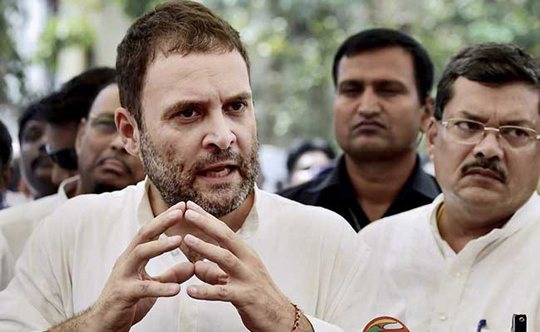
Rahul Gandhi reading Upanishads, Gita to take on RSS, BJP

June 5, 2017

Chennai, Jun 5: Congress Vice-President Rahul Gandhi today said he was reading Upanishads and the Bhagwad Gita to take on the RSS and BJP.

rahul

"Nowadays I study the Upanishads and the Gita since I am fighting the RSS and BJP," he said addressing party functionaries here.

"I ask them (RSS men), my friend, you are doing this, you are oppressing people, but it is written in the Upanishad that all people are the same and how come you are contradicting what your own religion says," party sources quoted him as having told them.

He alleged that BJP does not fundamentally "understand India," and "understand only Nagpur," headquarters of the RSS.

Taking potshots at Narendra Modi, he said BJP men were under the impression that the "entire universal knowledge" came out of the Prime Minister.

Gandhi, who has accused BJP-RSS of attempting to thrust one idea on the nation, said every individual, be it in Tamil Nadu or Uttar Pradesh, had a right to express dissent if they were aggrieved, and imposition of one idea was not acceptable.

While expressing his appreciation for people of Tamil Nadu, their language, culture and culinary, "which is a strength for India like other states," Gandhi said he had a special connect with the state.

He also said that "he has decided to start watching Tamil movies," and "read about the culture of Tamil Nadu people."

"Sent an SMS to my sister, I told my sister that I love coming to Tamil Nadu. I don't know ... some how I feel very connected to Tamil people," Gandhi said.

"I wrote (to Priyanka), I love Tamil, Tamils. She wrote back I love them too," he added.

Tamil Nadu Congress Committee President Su Thirunavukkarasar, Congress Legislature Party leader K R Ramasamy were among the functionaries who attended the meeting.

Comments

Add new comment

  • Coastaldigest.com reserves the right to delete or block any comments.
  • Coastaldigset.com is not responsible for its readers’ comments.
  • Comments that are abusive, incendiary or irrelevant are strictly prohibited.
  • Please use a genuine email ID and provide your name to avoid reject.
News Network
June 25,2020

India has jumped past 4.5 lakh coronavirus cases and 14,476 people have succumbed to the viral infection so far. In this backdrop, speaking to IANS in an exclusive interview, AIIMS Director Randeep Guleria said India is also vulnerable to second wave of coronavirus and people should continue to follow social distancing, wearing mask and other precautions, after cases begin to decline.

He added that in order to contain the outbreak of Covid-19, a limited lockdown in hotspots, where volume of cases is very high, may be considered along with a micro-plan to prevent leakage of cases from these areas to other non-containment areas. Excerpts of the interview are below:

Q: Reports say China and South Korea are witnessing a second wave of coronavirus infection, what is this second wave, is India also vulnerable to this?

A: When cases come down significantly, people tend to drop their guard against the viral infection, and this leads to the second wave (which means a sudden increase in the number of cases). After cases begin to decline, people should continue to follow the precautions -- continue to maintain social distancing and wear masks regularly. See what happened in Singapore, it was struck by a second wave of coronavirus. Look, what happened in the 1918 pandemic, people dropped their guard and the second wave of viral infection struck back. If people do not follow social distancing then the spike in cases is apparent. We need to take these precautions at least for one year. India is also vulnerable to this second wave.

Q: If Covid-19 cases continue to rise rapidly, do you think we need another lockdown in areas where volume of cases are very high?

A: A large volume of cases is concentrated in specific areas like hotspots, and in order to maintain things in order, we may need a limited lockdown in these areas. This should be followed by a micro-plan which entails extensive testing of people and also extensive contact tracing of people who have got in touch with positive people. Need to ensure there is no leakage of cases from these areas. People from these areas should not mix with others in non-containment areas. This will aid in containing the outbreak of the virus. People who have developed symptoms should get themselves tested, especially in the containment areas.

Q: With more than 4.5 lakh cases and close to 14,500 deaths, do you think India has reached its peak and a decline in cases is prominent?

A: The cases will continue to increase for some time. The doubling time of cases has also increased. But, the cases will also begin to flatten. Though, it is difficult to give an exact time period in this viral infection, it seems, the growth in cases will flatten in the end of July or beginning of August. A decline will come to this viral infection, but it does not mean that people should drop their guard. As a measure, we need to decrease community participation and citizens should continue to follow social distancing. People should get themselves tested. All these efforts will help in preventing people from contracting this virus. These precautions will also prevent us from the second wave, and we must continue to take precautions. The virus has not gone away, it is still lurking.

Q: India has crossed the 4.5 lakh coronavirus cases so far, although our recovery rate is good, but still 10,000 to 15,000 cases are reported daily. Why do cases continue to spiral, what is the reason?

A: We have to remember a few things -- the bulk of cases are in 10 cities, nearly 70 per cent, and if we take into account cases per million population, the number is not very high, as compared with countries including countries in Europe. Many European countries put together still do not add up to the Indian population. Do not compare India to countries like Italy, Spain etc. We need to focus on hotspots, which contribute to between 70 -80 per cent of cases, and we have to identify cases in these areas at an early stage. The population density is very high in these cities. People in lower socio-economic status are highly vulnerable to the viral infection, as many live together in small spaces and there is a lot of mixing of people happening there. Look at the market places, people are not following social distancing and not wearing masks. In fact, many are in close vicinity of each other.


Comments

Add new comment

  • Coastaldigest.com reserves the right to delete or block any comments.
  • Coastaldigset.com is not responsible for its readers’ comments.
  • Comments that are abusive, incendiary or irrelevant are strictly prohibited.
  • Please use a genuine email ID and provide your name to avoid reject.
News Network
May 4,2020

New Delhi, May 4: The country's manufacturing sector activity witnessed unprecedented contraction in April amid national lockdown restrictions, following which new business orders collapsed at a record pace and firms sharply reduced their staff numbers, a monthly survey said on Monday.

The headline seasonally adjusted IHS Markit India Manufacturing Purchasing Managers' Index (PMI) fell to 27.4 in April, from 51.8 in March, reflecting the sharpest deterioration in business conditions across the sector since data collection began over 15 years ago.
The index slipped into contraction mode, after remaining in the growth territory for 32 consecutive months.

In PMI parlance, a print above 50 means expansion, while a score below that denotes contraction.

Amid widespread business closures, demand conditions were severely hampered in April. New orders fell for the first time in two-and-a-half years and at the sharpest rate in the survey's history, far outpacing that seen during the global financial crisis, the survey said.

"After making it through March relatively unscathed, the Indian manufacturing sector felt the full force of the coronavirus pandemic in April," said Eliot Kerr, Economist at IHS Markit.
Panellists attributed lower production to temporary factory closures that were triggered by restrictive measures to limit the spread of COVID-19.

Export orders also witnessed a sharp decline. Following the first reduction since October 2017 during March, foreign sales fell at a quicker rate in April. "In fact, the rate of decline accelerated to the fastest since the series began over 15 years ago," the survey said.

On the employment front, deteriorating demand conditions saw manufacturers drastically cut back staff numbers in April. The reduction in employment was the quickest in the survey's history.

"In the latest survey period, record contractions in output, new orders and employment pointed to a severe deterioration in demand conditions.
“Meanwhile, there was evidence of unprecedented supply-side disruption, with input delivery times lengthening to the greatest extent since data collection began in March 2005," Kerr said.

On the prices front, both input costs and output prices were lowered markedly as suppliers and manufacturers themselves offered discounts in an attempt to secure orders.

Going ahead, sentiment regarding the 12-month outlook for production ticked up from March's recent low on hopes that demand will rebound once the COVID-19 threat has diminished and lockdown restrictions eased.

"There was a hint of positivity when looking at firms' 12-month outlooks, with sentiment towards future activity rebounding from March's record low. That said, the degree of optimism remained well below the historical average," Kerr said.

In India, the death toll due to COVID-19 rose to 1,373 and the number of cases climbed to 42,533 as on Monday, according to the health ministry.

Meanwhile, the coronavirus-induced lockdown has been extended beyond May 4, for another two weeks in the country.

Comments

Add new comment

  • Coastaldigest.com reserves the right to delete or block any comments.
  • Coastaldigset.com is not responsible for its readers’ comments.
  • Comments that are abusive, incendiary or irrelevant are strictly prohibited.
  • Please use a genuine email ID and provide your name to avoid reject.
Agencies
January 5,2020

Bikaner, Jan 5: A government-run hospital in Bikaner saw the death of at least 162 children, higher than the number of deaths in Kota's JK Lon Hospital in December.

"In December, we received 2,219 children from different hospitals out of which 162 children died in the Intensive Care Unit here. None of them was born at the hospital," said Dr HS Kumar, Principal, Sardar Patel Medical College, PBM Hospital.

He, however, denied any negligence on the part of the hospital and said that all efforts were made to save every single life.

The official said that all the deceased children had taken birth at the Primary Healthcare Centres (PHC) and the Community Health Centres (CHC) and were referred to the PBM Hospital in a critical condition.

"Their condition was critical and they breathed their last during treatment," he said.

At least 110 children have lost their lives at JK Lon government hospital in Kota, Rajasthan.

Comments

Add new comment

  • Coastaldigest.com reserves the right to delete or block any comments.
  • Coastaldigset.com is not responsible for its readers’ comments.
  • Comments that are abusive, incendiary or irrelevant are strictly prohibited.
  • Please use a genuine email ID and provide your name to avoid reject.