


Rahul, Left leaders back JNU students' protest

February 14, 2016

New Delhi, Feb 14: The protest against the arrest of Jawaharlal Nehru University (JNU) Students’ Union president Kanhaiya Kumar on charges of sedition turned into a political battle on Saturday.
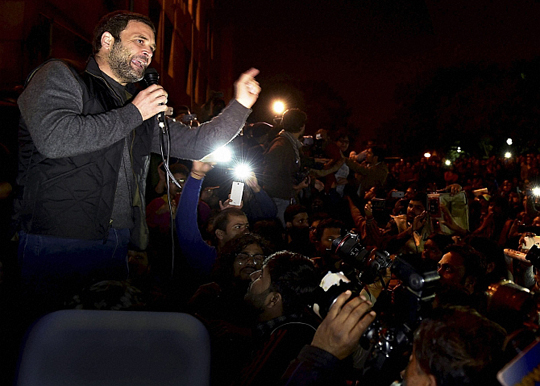
rahul

Congress vice-president Rahul Gandhi’s visit to the campus in the evening along with some party colleagues, including Deputy Leader of the Opposition in the Rajya Sabha Anand Sharma, charged the already tense atmosphere in the campus.

Rahul was welcomed by some “members and supporters” of Akhil Bharatiya Vidyarthi Parishad (ABVP) with black flags.

Left party leaders, including CPM general-secretary Sitaram Yechury and CPI leader D Raja, were also present which triggered counter protests by ABVP members.

Delhi Chief Minister Arvind Kejriwal chose to highlight allegations that ABVP was behind the anti-India slogans against hanging of 2001 Parliament attack convict Afzal Guru. The chief minister has ordered a magisterial enquiry.

Earlier, seven students were taken into preventive custody. They were taken to Parliament Street police station and were released later in the evening.

Though the protest, held outside Indira Gandhi National Centre for the Arts, was thwarted, there were other protests during the day on the university campus.After Kumar’s arrest, students and some teachers have been holding protests demanding to know why students are being treated like “terrorists” and were being arrested from the campus.
Upset by the arrest and heavy police presence on the campus, the professors have also expressed concern over the “threat to democratic ethos”.

“JNU has always been a university where there has been a vibrant culture. Excessive police action is uncalled for and has worsened the situation,” the professors said in a statement.

The police, too, wrote a letter to vice-chancellor Jagadesh Kumar asking the University to produce five students who were involved in “anti-national” activities and told the varsity authorities to alert them if such activities take place in future.

Some former Army officers have also threatened to return their JNU degrees saying that they find it difficult to be associated with a university which has become a hub of anti-national activities.

Comments

Abu Muhammad
 - 
Sunday, 14 Feb 2016

Anti-Indian slogan should be condemned and punished. At the same time hoisting Pakistani flag by Sanghparivar, celebrating Gandhiji's murder, installing killers Godse statue & worship, disrespect to constitution, Arms training to Sanghparivar goons, waging war against secular India by openly declaring it as Hindu Rashtra, honouring assassins of Indira Gandhi, Sanghparivars open support and allegiance to British during Freedom struggle - ARE ALL THESE -ACTS OF PATRIOTISM? or 100% ANTI-NATIONAL?

NationalismBef…
 - 
Sunday, 14 Feb 2016

Exposes true face of Rahul G and Left leaders, shame on them for supporting students raising anti-India slogans.

Add new comment

  • Coastaldigest.com reserves the right to delete or block any comments.
  • Coastaldigset.com is not responsible for its readers’ comments.
  • Comments that are abusive, incendiary or irrelevant are strictly prohibited.
  • Please use a genuine email ID and provide your name to avoid reject.
Agencies
January 5,2020

New Delhi, Jan 5: Senior Congress leader P Chidambaram on Sunday sàid it was "shameful" that Sadaf Jafar, SR Darapuri and Pavan Rao were arrested by the Uttar Pradesh Police for violence without any evidence against them.

He also said that it was a shocking admission by the police that there is no evidence of their involvement.

"Sadaf Jafar, S R Darapuri and Pavan Rao Ambedkar released on bail after police ADMITTED no evidence of their involvement in violence. Shocking admission," he said on Twitter.

"If that were so, why did the police arrest them in the first place? And how did the Magistrate remand them to custody without looking at the evidence," he asked.
"The law says 'find evidence, then arrest'. The reality is 'first arrest, then search for evidence'. Shameful," Chidambaram tweeted.

Comments

Add new comment

  • Coastaldigest.com reserves the right to delete or block any comments.
  • Coastaldigset.com is not responsible for its readers’ comments.
  • Comments that are abusive, incendiary or irrelevant are strictly prohibited.
  • Please use a genuine email ID and provide your name to avoid reject.
Agencies
January 15,2020

New Delhi, Jan 15: Suspended Deputy Superintendent of J&K Police Davinder Singh had ferried Hizbul Mujahideen terrorist Naveed Babu to Jammu last year also and facilitated his return to Shopian after "rest and recuperation", officials interrogating him said here Tuesday.

"Meri mati maari gayi thi (I must have lost my mind to do what I did)," an interrogator quoted Singh as saying after the DSP failed to impress them with his theory of catching a big terrorist.

Singh was arrested last Saturday along with Naveed Babu alias Babar Azam, a resident of Nazneenpora in South Kashmir's Shopian district, and his associate Asif Ahmad.

He is believed to have taken Rs 12 lakh for smuggling the two to Chandigarh for providing them accommodation for a couple of months, officials said. The officials, who have been spending considerable time questioning Singh, said there have been many inconsistencies in his statements and everything was being crosschecked and corroborated with the confessions of captured militants who have been kept in different rooms at an interrogation centre in South Kashmir.

During questioning it emerged that Singh had taken them to Jammu in 2019 also, the officials said.

In a tone laced with sarcasm, they said the DSP was taking the militants for "rest and recuperation".

Naveed told the interrogators that they used to stay in the hilly regions to avoid the J&K police and left the areas to escape harsh winters, they said.

The official said the DSP's bank accounts and other assets were being verified by the police and papers were being collected, amid speculations that the case may be handed over to the National Investigation Agency (NIA).

Going into the service history of Singh, majority of retired and serving officials of the JKP spoken to referred to a proverb -- coming events cast their shadows long before -- to say that if action had been taken against the officer during his probation period, such things would not have happened.

Recruited in 1990 as a sub-inspector, Singh along with another probationary officer were subject of an internal enquiry where some narcotics had been seized from a truck. However, the contraband was sold by Singh and another sub-inspector, the officials recalled.

There was a move to dismiss them from the service which was stalled by an Inspector General rank officer purely on humanitarian ground and the duo was shifted to the Special Operations Group, a team of policemen engaged in counter-militancy offensive.

However, he could not last there for long and was shifted this time to the police lines only to be rehabilitated in 1997 again in the SOG.

During this period, he was posted in Budgam and is alleged to have indulged in extortion for which he was sent back to the police lines.

His proper rehabilitation began in 2015 by the then Director General of Police K Rajendra, who posted him in district headquarters of Shopian and Pulwama, the officials said.

However, after some alleged wrongdoing during his stint in Pulwama, the then Director General of Police S P Vaid transferred him in August 2018 to the sensitive Anti-Hijacking Unit in Srinagar, though the move was opposed by some other officers.

An advocate, Irfan Ahmad Mir, was driving the vehicle when they were caught by the police on National Highway in Kulgam district.

The advocate, who has also been arrested, had travelled to Pakistan five times on an Indian passport.

Comments

Add new comment

  • Coastaldigest.com reserves the right to delete or block any comments.
  • Coastaldigset.com is not responsible for its readers’ comments.
  • Comments that are abusive, incendiary or irrelevant are strictly prohibited.
  • Please use a genuine email ID and provide your name to avoid reject.
News Network
January 31,2020

New Delhi, Jan 31: Substantial competition and low tariff rates by telecom operators since 2016 have led to a financial stress in the sector, the Economic Survey said on Friday.

The data price in the country came down by over 99 per cent during 2016-2019, making it among the lowest tariff in the world, according to the survey.

"Since 2016, the sector has witnessed substantial competition and price cutting by the telecom service providers (TSPs), creating financial stress in the sector. As a result, the sector is experiencing consolidation. While some operators have filed for bankruptcy, others have merged, in their quest to improve viability," the survey report said.

In April-June 2019, the price of data was Rs 7.7 per gigabyte (GB) as compared to Rs 200 per GB in June 2016, it added.

"The Average Revenue Per User (ARPU) for GSM based mobile services has also gone down substantially from Rs 126 in June 2016 to Rs 74.30 in June 2019," the survey said.

The tariff war started in the market with entry of new telecom operator Reliance Jio in September 2016.

"BSNL and MTNL are also affected by the tariff war that has impacted their cash flow resulting in mounting losses," the survey said.

The financial health of the public sector telecom firms plummeted to a level where they have been finding hard to pay employees salaries in time.

The government has drawn up a plan to revive these PSUs which is still in works.

The revival plan consists of several measures, including reduction of staff cost through voluntary retirement scheme, allotment of spectrum for 4G services, monetisation of land and building, tower and fibre assets of BSNL and MTNL, debt restructuring through sovereign guarantee bonds and ''in-principle'' approval for merger of BSNL and MTNL.

The survey said that the wireless telephony now constitutes 98.27 per cent of all subscriptions whereas share of landline telephones now stands at only 1.73 per cent where market share is dominated by private sector players.

"The overall tele-density in India stands at 90.45 per cent, the rural tele-density being 57.35 per cent and urban teledensity being 160.71 per cent at the end of September 2019. The private sector dominates with a share of 88.81 per cent (106.06 crore connections) at the end of September, 2019 while the share of public sector was 11.19 per cent (13.36 crore connections)," the survey said.

The lower price of data has also lead in surge of broadband connections and average consumption of the internet.

Total broadband connections increased by about ten times, from 6.1 crore in 2014 to 59.46 crore in June 2019, the survey said.

The number of internet subscribers (both broadband and narrowband put together) stood at 66.53 crore at the end of June 2019 as compared to 25.16 crore in 2014.

The number of mobile internet subscribers was 64.36 lakh at the end of June 2019 while the number of wireline internet subscribers was 2.17 crore.

"India is now the global leader in monthly data consumption, with average consumption per subscriber per month increasing 157 times from 62 MB in 2014 to 9.8 GB in June 2019. The cost of data has also reduced substantially, enabling affordable internet access for millions of citizens," the survey said.

Comments

Add new comment

  • Coastaldigest.com reserves the right to delete or block any comments.
  • Coastaldigset.com is not responsible for its readers’ comments.
  • Comments that are abusive, incendiary or irrelevant are strictly prohibited.
  • Please use a genuine email ID and provide your name to avoid reject.