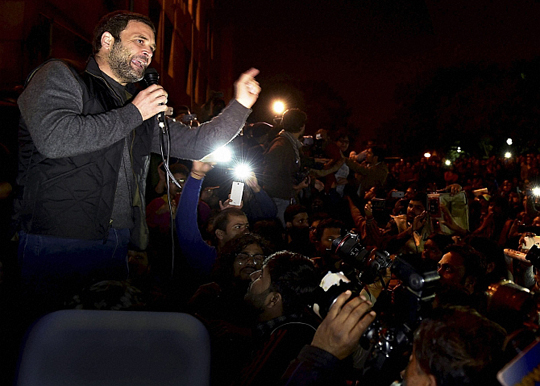
Rahul, Left leaders back JNU students' protest

February 14, 2016

New Delhi, Feb 14: The protest against the arrest of Jawaharlal Nehru University (JNU) Students’ Union president Kanhaiya Kumar on charges of sedition turned into a political battle on Saturday.

rahul

Congress vice-president Rahul Gandhi’s visit to the campus in the evening along with some party colleagues, including Deputy Leader of the Opposition in the Rajya Sabha Anand Sharma, charged the already tense atmosphere in the campus.

Rahul was welcomed by some “members and supporters” of Akhil Bharatiya Vidyarthi Parishad (ABVP) with black flags.

Left party leaders, including CPM general-secretary Sitaram Yechury and CPI leader D Raja, were also present which triggered counter protests by ABVP members.

Delhi Chief Minister Arvind Kejriwal chose to highlight allegations that ABVP was behind the anti-India slogans against hanging of 2001 Parliament attack convict Afzal Guru. The chief minister has ordered a magisterial enquiry.

Earlier, seven students were taken into preventive custody. They were taken to Parliament Street police station and were released later in the evening.

Though the protest, held outside Indira Gandhi National Centre for the Arts, was thwarted, there were other protests during the day on the university campus.After Kumar’s arrest, students and some teachers have been holding protests demanding to know why students are being treated like “terrorists” and were being arrested from the campus.
Upset by the arrest and heavy police presence on the campus, the professors have also expressed concern over the “threat to democratic ethos”.

“JNU has always been a university where there has been a vibrant culture. Excessive police action is uncalled for and has worsened the situation,” the professors said in a statement.

The police, too, wrote a letter to vice-chancellor Jagadesh Kumar asking the University to produce five students who were involved in “anti-national” activities and told the varsity authorities to alert them if such activities take place in future.

Some former Army officers have also threatened to return their JNU degrees saying that they find it difficult to be associated with a university which has become a hub of anti-national activities.

Comments

Abu Muhammad
 - 
Sunday, 14 Feb 2016

Anti-Indian slogan should be condemned and punished. At the same time hoisting Pakistani flag by Sanghparivar, celebrating Gandhiji's murder, installing killers Godse statue & worship, disrespect to constitution, Arms training to Sanghparivar goons, waging war against secular India by openly declaring it as Hindu Rashtra, honouring assassins of Indira Gandhi, Sanghparivars open support and allegiance to British during Freedom struggle - ARE ALL THESE -ACTS OF PATRIOTISM? or 100% ANTI-NATIONAL?

NationalismBef…
 - 
Sunday, 14 Feb 2016

Exposes true face of Rahul G and Left leaders, shame on them for supporting students raising anti-India slogans.

Add new comment

  • Coastaldigest.com reserves the right to delete or block any comments.
  • Coastaldigset.com is not responsible for its readers’ comments.
  • Comments that are abusive, incendiary or irrelevant are strictly prohibited.
  • Please use a genuine email ID and provide your name to avoid reject.
News Network
June 2,2020

New Delhi, Jun 2: Prime Minister Narendra Modi on Tuesday said India will definitely get its economic growth back as the government continues to pursue various reforms.

Speaking at industry association CII's annual session, he said the government has taken tough steps to fight the coronavirus pandemic and has also taken care of the economy.

"On the one hand we have to safe lives of our people and on the other hand we have to stabilise the economy and speed up the economy," he said.

He said he gets the confidence from farmers, small businesses and entrepreneurs for getting the economic growth back.

"Corona may have slowed our speed (of growth) but India has now moved ahead from lockdown with the phase one of unlock. Unlock Phase-1 has reopened a large part of the economy," he said.

He said intent, inclusion, investment, infrastructure and innovation are crucial for India to revert back to a high-growth trajectory.

Comments

Add new comment

  • Coastaldigest.com reserves the right to delete or block any comments.
  • Coastaldigset.com is not responsible for its readers’ comments.
  • Comments that are abusive, incendiary or irrelevant are strictly prohibited.
  • Please use a genuine email ID and provide your name to avoid reject.
News Network
May 15,2020

New Delhi, May 15: A group of doctors from the AIIMS, Raipur has recommended restrictions on the use of mobile phones in healthcare institutions amid the COVID-19 pandemic, warning that such devices can be a potential carrier of the virus and lead to infection among healthcare workers.

In a commentary published in the BMJ Global Health journal, the doctors stated that mobile phone surfaces are a peculiar 'high-risk' surface, which can directly come in contact with the face or mouth, even if hands are properly washed and one study indicates that some healthcare workers use phones every 15 minutes to two hours.

Though there have been many significant guidelines from various health organisations like the WHO and CDC focusing on prevention and control of disease, the commentary highlighted "there is no mention of or focus on mobile phones in these guidelines, including the WHO infection control and prevention guidelines, which recommends the use of handwashing".

In healthcare facilities, phones are used to communicate with other health care workers, look up recent medical guidelines, research drug interactions, understand adverse events and side effects, conduct telemedicine appointments and track patients among others, stated the document.

The document has been authored by Dr Vineet Kumar Pathak, Dr Sunil Kumar Panigrahi, Dr M Mohan Kumar, Dr Utsav Raj and Dr Karpaga Priya P from the Department of Community and Family Medicine.

"In their tendency to come in direct contact with the face, nose or eyes in healthcare settings, mobile phones are perhaps second only to masks, caps or goggles," the authors said.

"However, they are neither disposable nor washable like these other three, thus warranting disinfection. Mobile phones can effectively negate hand hygiene... There is growing evidence that mobile phones are a potential vector for pathogenic organisms," they said.

It is the need of the hour to address proper hygienic use of mobile phones in healthcare settings. In a study in India, almost 100 per cent of health workers of a tertiary care hospital used mobile phones in the hospital, but only 10 per cent of them had at any time wiped their mobile phones clean, the commentary published on April 22 said.

"The safest thing to do is to consider your phone as an extension of your hand, so remember you are transferring whatever is on your phone to your hand," Dr Pathak said.

Amidst the ongoing pandemic, two biggest mobile phone companies have uploaded their user support guidelines, saying that 70 pc isopropyl alcohol or Clorox Disinfecting Wipes can be used to gently wipe the exterior surface of phones in switched-off mode.

However, in doing so, the use of bleach or entry of moisture through any of the openings must be avoided, and any harsh chemical may damage the oleophobic screen, leading to damage in the touch screen sensitivity of the phone, the article stated.

Mobile phones are one of the most highly touched surfaces according to the Centers for Disease Control and Prevention (CDC), along with counters, tabletops, doorknobs, bathroom fixtures, toilets, keyboards, tablets and bedside tables.

The doctors recommended restriction on mobile phone usage in healthcare settings like hospital wards, ICUs and operation theatres, while advocating the use of headphones to prevent contact with the face while talking.

There should be no sharing of mobile phones, headphones or headsets of any kind. In addition, where available, the use of interdepartmental intercom facility may be promoted.

"Although hand hygiene and mobile phone use by a person are not mutually exclusive, it is high time to acknowledge the potential role of mobile phones in disease transmission cascade and to take evidence-based appropriate actions. This is especially important, given the ongoing COVID-19 pandemic," the authors said.

They said it is necessary for government agencies and the WHO to generate public awareness and to formulate suitable information, education and communication material on mobile phone hygiene, especially in healthcare settings.

AIIMS, New Delhi, Resident Doctors' Association (RDA) General Secretary, Dr Srinivas Rajkumar T said even outside health care settings, people should pay special attention to the usage of mobile phones as they carry them to all places.

"Phone and computer peripherals like keyboard, mouse, etc. should be covered with transparent plastic covers which can be cleaned without interfering with their function. Cleaning hands by soap or alcohol-based hand sanitizer before and after contact with phone and between contact with other surfaces can decrease the risk of potential transmission.

"Using a handsfree headset, dedicated operator/assistant per ward handling the communication via common line in hospitals while on duty can enable communication without compromising safety," Dr Srinivas said.


Comments

Add new comment

  • Coastaldigest.com reserves the right to delete or block any comments.
  • Coastaldigset.com is not responsible for its readers’ comments.
  • Comments that are abusive, incendiary or irrelevant are strictly prohibited.
  • Please use a genuine email ID and provide your name to avoid reject.
News Network
February 11,2020

New Delhi, Feb 11: The Aam Aadmi Party on Tuesday appeared to be heading back to power for a second term in Delhi with the party leading in 52 seats of the 70 and the BJP ahead in 18 as votes for last week's assembly elections were counted, according to Election Commission figures. The contest for political power over the national capital was a bipolar one with the Congress nowhere in the reckoning, according to initial trends.

AAP supremo and chief minister Arvind Kejriwal was leading in the New Delhi seat by 4,300 seats, while his deputy Manish Sisodia from Patparganj seat was ahead by 102 votes.

BJP leader Vijender Gupta, who is also leader of opposition in the Delhi legislative assembly, was trailing by over 1,200 votes from Rohini.

As early celebrations broke out in the AAP headquarters in Rouse Avenue, BJP's Delhi unit chief Manoj Tiwari asked his party supporters not to lose hope.

"There are 27 seats where the difference of votes is between 700 to 1,000," Tiwari told reporters.

Looking ahead at victory, he said he was not nervous and was ready to take on the responsibilities that a win would bring.

"All talk is over. We have to wait for the blessings of the people. I am confident it will be a good day for BJP. We are coming to power in Delhi today. Don't be surprised if we win 55 seats," Tiwari said.

Kejriwal, who had led his party to a spectacular win of 67 of 70 seats in 2015, is expected to address party workers and the media later in the day. However, his party workers were upbeat and in celebratory mode.

"We have been saying since the beginning that the upcoming polls will be fought on the basis of work done by us... You wait and watch, we will register a massive win," AAP spokesperson Sanjay Singh told reporters.

"We hope we get such a clear majority that a message goes out that doing Hindu-Muslim politics will not work anymore," said AAP volunteer Fareen Khan at the party office.

The headquarters were decorated with blue and white balloons and big cutouts of Kejriwal were placed in different parts of the office.

Labour minister and AAP's Delhi unit convenor Gopal Rai was leading in Badarpur constituency by 1,994 votes.

Atishi, AAP's Kalkaji candidate, who was also instrumental in the transformation of Delhi government schools, was trailing by 190 votes.

AAP's Timarpur candidate Dilip Pandey was leading by over 1,500 votes.

BJP's Tajinder Singh Bagga was trailing on Hari Nagar seat by over 50 votes, while AAP's Raghav Chadha is leading from Rajinder Nagar constituency.

Congress' Chandni Chowk candidate Alka Lamba, who is sitting MLA from the constituency, was trailing by over 5,800 votes.

Counting centres are spread across 21 locations in 11 districts, including at the CWG Sports Complex in east Delhi, NSIT Dwarka in west Delhi, Meerabai Institute of Technology and G B Pant Institute of Technology in southeast Delhi, Sir CV Raman ITI, Dheerpur in central Delhi, and Rajiv Gandhi Stadium in Bawana in north Delhi.

The assembly elections were held on February 8.

A total of 672 candidates, including 593 men and 79 women, were in the fray for the hotly contested, often divisive polls with the anti-CAA protests in Shaheen Bagh occupying centrestage towards the end of the campaign.

While the AAP, of course, put forward Kejriwal, Prime Minister Narendra Modi, home minister Amit Shah and Uttar Pradesh chief minister Yogi Adityanath were among those who extensively campaigned for the BJP.

The Congress, still recovering maybe from the death of its three-time Delhi chief minister Sheila Dikshit in July last year, got into campaign mode much later. Former prime minister Manmohan Singh and party leaders Rahul Gandhi and Priyanka Gandhi were among those who campaigned for the Congress.

Comments

Add new comment

  • Coastaldigest.com reserves the right to delete or block any comments.
  • Coastaldigset.com is not responsible for its readers’ comments.
  • Comments that are abusive, incendiary or irrelevant are strictly prohibited.
  • Please use a genuine email ID and provide your name to avoid reject.