


Rahul, Left leaders back JNU students' protest

February 14, 2016

New Delhi, Feb 14: The protest against the arrest of Jawaharlal Nehru University (JNU) Students’ Union president Kanhaiya Kumar on charges of sedition turned into a political battle on Saturday.
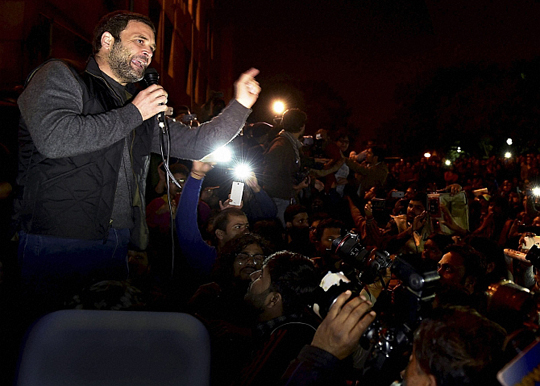
rahul

Congress vice-president Rahul Gandhi’s visit to the campus in the evening along with some party colleagues, including Deputy Leader of the Opposition in the Rajya Sabha Anand Sharma, charged the already tense atmosphere in the campus.

Rahul was welcomed by some “members and supporters” of Akhil Bharatiya Vidyarthi Parishad (ABVP) with black flags.

Left party leaders, including CPM general-secretary Sitaram Yechury and CPI leader D Raja, were also present which triggered counter protests by ABVP members.

Delhi Chief Minister Arvind Kejriwal chose to highlight allegations that ABVP was behind the anti-India slogans against hanging of 2001 Parliament attack convict Afzal Guru. The chief minister has ordered a magisterial enquiry.

Earlier, seven students were taken into preventive custody. They were taken to Parliament Street police station and were released later in the evening.

Though the protest, held outside Indira Gandhi National Centre for the Arts, was thwarted, there were other protests during the day on the university campus.After Kumar’s arrest, students and some teachers have been holding protests demanding to know why students are being treated like “terrorists” and were being arrested from the campus.
Upset by the arrest and heavy police presence on the campus, the professors have also expressed concern over the “threat to democratic ethos”.

“JNU has always been a university where there has been a vibrant culture. Excessive police action is uncalled for and has worsened the situation,” the professors said in a statement.

The police, too, wrote a letter to vice-chancellor Jagadesh Kumar asking the University to produce five students who were involved in “anti-national” activities and told the varsity authorities to alert them if such activities take place in future.

Some former Army officers have also threatened to return their JNU degrees saying that they find it difficult to be associated with a university which has become a hub of anti-national activities.

Comments

Abu Muhammad
 - 
Sunday, 14 Feb 2016

Anti-Indian slogan should be condemned and punished. At the same time hoisting Pakistani flag by Sanghparivar, celebrating Gandhiji's murder, installing killers Godse statue & worship, disrespect to constitution, Arms training to Sanghparivar goons, waging war against secular India by openly declaring it as Hindu Rashtra, honouring assassins of Indira Gandhi, Sanghparivars open support and allegiance to British during Freedom struggle - ARE ALL THESE -ACTS OF PATRIOTISM? or 100% ANTI-NATIONAL?

NationalismBef…
 - 
Sunday, 14 Feb 2016

Exposes true face of Rahul G and Left leaders, shame on them for supporting students raising anti-India slogans.

Add new comment

  • Coastaldigest.com reserves the right to delete or block any comments.
  • Coastaldigset.com is not responsible for its readers’ comments.
  • Comments that are abusive, incendiary or irrelevant are strictly prohibited.
  • Please use a genuine email ID and provide your name to avoid reject.
News Network
March 29,2020

New Delhi, Mar 29 : Notwithstanding the 21-day coronavirus lockdown, the Reserve Bank of India (RBI) has decided to go ahead with the merger plan of ten state-run banks into four larger bank from April 1. The apex bank has issued four separate releases announcing that the branches of merging banks will operate as of the banks in which these have been amalgamated from next month.

RBI's statement comes after Finance Minister Nirmala Sitharaman's clarification on Thursday that the mega bank consolidation plan was very much on track and would take effect from April 1.

The government on March 4 had notified the amalgamation schemes for 10 state owned banks into four as part of its consolidation plan to create bigger size stronger banks in the public sector.

Bank officers' unions, however, earlier this week wrote to the prime minister seeking to defer the merger schemes of lenders due to the lockdown triggered by coronavirus outbreak.

As per the scheme, Oriental Bank of Commerce and United Bank of India will be merged into Punjab National Bank; Syndicate Bank into Canara Bank; Allahabad Bank into Indian Bank; and Andhra and Corporation banks into Union Bank of India.

Under this, the branches of Oriental Bank of Commerce and United Bank of India will operate as branches of Punjab National Bank from April 1, 2020, and branches of Syndicate Bank as that of Canara Bank, the RBI said in a separate releases.

Allahabad Bank branches will operate as those of Indian Bank while the branches of Andhra Bank and Corporation Bank will function as the branches of Union Bank of India from the beginning of next fiscal year 2020-21, the RBI said.

"The Amalgamation of Oriental Bank of Commerce and United Bank of India into Punjab National Bank Scheme, 2020 dated March 4, 2020, issued by the Government of India... The scheme comes into force on the 1st day of April 2020," RBI said.

Customers, including depositors of merging banks will be treated as customers of the banks in which these banks have been merged with effect from April 1, 2020, the RBI noted.

Banking services across the country are impacted due to the effect of COVID-19 as a near shut down is being observed across the country.

In a letter written to the Prime Minister on March 25, the All India Bank Officers'' Confederation (AIBOC) said, "The finance minister yesterday announced a slew of measures in view of the deleterious effect of the contagion. We are also expecting an extension of closing related activities and the revision of the closing date itself from March 31 to June 30, which is the need of the hour."

Comments

Add new comment

  • Coastaldigest.com reserves the right to delete or block any comments.
  • Coastaldigset.com is not responsible for its readers’ comments.
  • Comments that are abusive, incendiary or irrelevant are strictly prohibited.
  • Please use a genuine email ID and provide your name to avoid reject.
News Network
May 21,2020

United Nations, May 21: At least 19 million children in parts of Bangladesh and India are at "imminent risk" from flash flooding and heavy rain as Cyclone Amphan makes landfall and the state of West Bengal is expected to take a direct hit from the powerful storm, the UN's children agency has warned.

The extremely severe cyclonic storm Amphan made a landfall at Digha in West Bengal and Bangladesh on Wednesday, leaving a trail of destruction. At least three persons were killed in India and seven in Bangladesh.

The UNICEF said that at least 19 million children in parts of Bangladesh and India are at “imminent risk from flash flooding, storm surges and heavy rain as Cyclone Amphan makes landfall.”

West Bengal, “home to more than 50 million people, including over 16 million children, is expected to take a direct hit from the powerful storm,” the UN agency said in a statement on Wednesday.

The UNICEF said it is also very concerned that the COVID-19 could deepen the humanitarian consequences of Cyclone Amphan in both the countries. Evacuees who have moved to crowded temporary shelters would be especially vulnerable to the spread of respiratory diseases like COVID-19, as well as other infections.

“We continue to monitor the situation closely,” said UNICEF Regional Director for South Asia Jean Gough.

“The safety of children and their families in the areas that will be impacted is a priority and it is good to see that the authorities have planned their urgent response factoring in the on-going COVID-19 pandemic.”

Across the region, the UNICEF is “working closely with the governments of Bangladesh and India and stands ready to support humanitarian operations to reach children and families affected by Cyclone Amphan.”

Based on the storm’s current trajectory, Cox’s Bazar in Bangladesh – now sheltering over 850,000 Rohingya refugees – is likely to experience high winds and heavy rains which may cause damage to homes and shelters in the refugee camps and Bangladeshi communities. This population is already highly vulnerable and cases of COVID-19 have recently been confirmed in the camps and host communities.

The UNICEF said it is working with the Deputy Commissioner’s Office in Cox’s Bazar, the Office of the Refugee Relief and Repatriation Commissioner, and humanitarian partners to help ensure Bangladeshi and Rohingya children and families remain protected.

These efforts include raising awareness among Rohingya and Bangladeshi communities on cyclone preparedness and prepositioning emergency life-saving water, sanitation, hygiene and medical supplies to meet immediate humanitarian needs.

Meanwhile, UN Secretary-General Antonio Guterres’ spokesperson Stephane Dujarric said at the daily press briefing that UN teams on the ground continue to work with the Government of Bangladesh to prepare and support those in need in the wake of the cyclone.

“Given the current pandemic, this support includes distributing personal protective equipment, disinfectants and other materials to evacuation shelters. To reduce the person-to-person contact during the delivery of aid, e-cash distributions will be used,” he said adding that the UN along with its partners is mobilising more than 1,700 mobile health teams and preparing for emergency food deliveries.

“The Super Cyclone is taking a westerly trajectory towards India, but nearly 8 million people in Bangladesh remain at risk,” he said adding that the Bangladesh government has evacuated more than 2 million people in high-risk areas. 

Comments

Add new comment

  • Coastaldigest.com reserves the right to delete or block any comments.
  • Coastaldigset.com is not responsible for its readers’ comments.
  • Comments that are abusive, incendiary or irrelevant are strictly prohibited.
  • Please use a genuine email ID and provide your name to avoid reject.
News Network
March 27,2020

Mumbai, Mar 27: The Reserve Bank of India (RBI) on Friday lowered the key repo rate by 75 basis points to 4.4 per cent in a bid to arrest the economic slowdown amid coronavirus (COVID-19) outbreak.
The reverse repo rate now stands at 4 per cent, down by 90 basis points, said RBI Governor Shaktikanta Das adding this has been done to make it unattractive for banks to passively deposit funds with the central bank and instead lend it to the productive sectors.
The six-member monetary policy committee (MPC) met on March 24, 25 and 27 and voted 4:2 in favour of the repo rate reduction. The MPC also decided to continue with the accommodative stance as long as it is necessary to revive growth and mitigate the impact of COVID-19 on the economy while ensuring that inflation remains within the target.
"The need of the hour is to shield the economy from the pandemic," said Das. "We need to mitigate the impact of coronavirus, revive economic growth and provide financial stability."
Repo rate is the rate at which a country's central bank lends money to commercial banks, and the reverse repo rate is the rate at which it borrows from them.
The RBI Governor further said that the economic growth and inflation projection will be highly contingent depending on the duration, spread and intensity of the pandemic.
"Global economic activity has come to a near standstill as COVID-19 related lockdowns and social distancing are imposed across a widening swathe of affected countries. Expectations of a shallow recovery in 2020 from 2019's decade low in global growth have been dashed," said Das.
"The outlook is now heavily contingent upon the intensity, spread and duration of the pandemic. There is a rising probability that large parts of the global economy will slip into recession," he said.
However, the RBI has injected liquidity of Rs 2.8 lakh crore via various instruments equal to 1.4 per cent of GDP. "Along with today's measures, liquidity measures equal to 3.2 per cent of GDP. The RBI will take continuous measures to ensure liquidity in the system."
The RBI governor has said that all banking institutions can offer a three-month moratorium on all loans for a period of three months. The RBI has also allowed banks to restructure the working capital cycle for companies without worrying that these will have to be classified as a non-performing asset (NPA).
The three-month moratorium will permit banks to avoid a large onset of NPAs during the 21-day lockdown and keep their books healthy.
Das said banks and other financial institutions should do all they can to keep credit flowing to economic agents facing financial stress on account of the isolation that the virus has imposed.
"Market participants should work with regulators like the RBI and the Securities and Exchange Board of India (SEBI) to ensure the orderly functioning of markets in their role of price discovery and financial intermediation," he said.

Comments

Add new comment

  • Coastaldigest.com reserves the right to delete or block any comments.
  • Coastaldigset.com is not responsible for its readers’ comments.
  • Comments that are abusive, incendiary or irrelevant are strictly prohibited.
  • Please use a genuine email ID and provide your name to avoid reject.