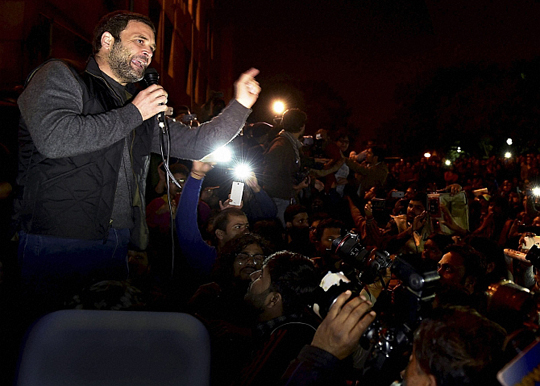
Rahul, Left leaders back JNU students' protest

February 14, 2016

New Delhi, Feb 14: The protest against the arrest of Jawaharlal Nehru University (JNU) Students’ Union president Kanhaiya Kumar on charges of sedition turned into a political battle on Saturday.

rahul

Congress vice-president Rahul Gandhi’s visit to the campus in the evening along with some party colleagues, including Deputy Leader of the Opposition in the Rajya Sabha Anand Sharma, charged the already tense atmosphere in the campus.

Rahul was welcomed by some “members and supporters” of Akhil Bharatiya Vidyarthi Parishad (ABVP) with black flags.

Left party leaders, including CPM general-secretary Sitaram Yechury and CPI leader D Raja, were also present which triggered counter protests by ABVP members.

Delhi Chief Minister Arvind Kejriwal chose to highlight allegations that ABVP was behind the anti-India slogans against hanging of 2001 Parliament attack convict Afzal Guru. The chief minister has ordered a magisterial enquiry.

Earlier, seven students were taken into preventive custody. They were taken to Parliament Street police station and were released later in the evening.

Though the protest, held outside Indira Gandhi National Centre for the Arts, was thwarted, there were other protests during the day on the university campus.After Kumar’s arrest, students and some teachers have been holding protests demanding to know why students are being treated like “terrorists” and were being arrested from the campus.
Upset by the arrest and heavy police presence on the campus, the professors have also expressed concern over the “threat to democratic ethos”.

“JNU has always been a university where there has been a vibrant culture. Excessive police action is uncalled for and has worsened the situation,” the professors said in a statement.

The police, too, wrote a letter to vice-chancellor Jagadesh Kumar asking the University to produce five students who were involved in “anti-national” activities and told the varsity authorities to alert them if such activities take place in future.

Some former Army officers have also threatened to return their JNU degrees saying that they find it difficult to be associated with a university which has become a hub of anti-national activities.

Comments

Abu Muhammad
 - 
Sunday, 14 Feb 2016

Anti-Indian slogan should be condemned and punished. At the same time hoisting Pakistani flag by Sanghparivar, celebrating Gandhiji's murder, installing killers Godse statue & worship, disrespect to constitution, Arms training to Sanghparivar goons, waging war against secular India by openly declaring it as Hindu Rashtra, honouring assassins of Indira Gandhi, Sanghparivars open support and allegiance to British during Freedom struggle - ARE ALL THESE -ACTS OF PATRIOTISM? or 100% ANTI-NATIONAL?

NationalismBef…
 - 
Sunday, 14 Feb 2016

Exposes true face of Rahul G and Left leaders, shame on them for supporting students raising anti-India slogans.

Add new comment

  • Coastaldigest.com reserves the right to delete or block any comments.
  • Coastaldigset.com is not responsible for its readers’ comments.
  • Comments that are abusive, incendiary or irrelevant are strictly prohibited.
  • Please use a genuine email ID and provide your name to avoid reject.
Agencies
May 27,2020

New Delhi, May 27: India’s fourth recession since Independence, first since liberalisation, and perhaps the worst to date is here, according to rating agency, Crisil.

CRISIL sees the Indian economy shrinking 5 per cent in fiscal 2021 (on-year), because of the Covid-19 pandemic. The first quarter will suffer a staggering 25 per cent contraction.

About 10 per cent of gross domestic product (GDP) in real terms could be permanently lost. "So going back to the growth rates seen before the pandemic is unlikely in the next three fiscals", Crisil said.

Crisil has revised its earlier forecast downwards. "Earlier, on April 28, we had slashed our prediction to 1.8 per cent growth from 3.5 per cent growth. Things have only gone downhill since", it said.

While we expect non-agricultural GDP to contract 6 per cent, agriculture could cushion the blow by growing at 2.5 per cent.

In the past 69 years, India has seen a recession only thrice as per available data in fiscals 1958, 1966 and 1980. The reason was the same each time a monsoon shock that hit agriculture, then a sizeable part of the economy.

"The recession staring at us today is different," it added. For one, agriculture could soften the blow this time by growing near its trend rate, assuming a normal monsoon. Two, the pandemic-induced lockdowns have affected most non-agriculture sectors. And three, the global disruption has upended whatever opportunities India had on the exports front.

Economic conditions have slid precipitously since the April-end forecast of 1.8 per cent GDP growth for fiscal 2021 (baseline), Crisil said.

On the lockdown extension, it said that the government has extended the lockdown four times to deal with the rising number of cases, curtailing economic activity severely (lockdown 4.0 is ending on May 31).

The first quarter of this fiscal will be the worst affected. June is unlikely to see major relaxations as the Covid-19 affliction curve is yet to flatten in India.

"Not only will the first quarter be a washout for the non-agricultural economy, services such as education, and travel and tourism among others, could continue to see a big hit in the quarters to come. Jobs and incomes will see extended losses as these sectors are large employers," Crisil said.

CRISIL also foresees economic activity in states with high Covid-19 cases to suffer prolonged disruption as restrictions could continue longer.

A rough estimate based on a sample of eight states, which contribute over half of India's GDP, shows that their 'red zones' (as per lockdown 3.0) contributed 42 per cent to the state GDP on average regardless of the share of such red zones.

On average, the orange zones contribute 46 per cent, while the green zones where activity is allowed to be close to normal contribute only 12 per cent to state GDP.

The economic costs are higher than earlier expectations, according to Crisil. The economic costs now beginning to show up in the hard numbers are far worse than initial expectations.

Industrial production for March fell by over 16%. The purchasing managers indices for the manufacturing and services sectors were at 27.4 and 5.4, respectively, in April, implying extraordinary contraction. That compares with 51.8 and 49.3, respectively, in March.

Exports contracted 60.3 per cent in April, and new telecom subscribers declined 35 per cent, while railway freight movement plunged 35 per cent on-year.

"Indeed, given one of the most stringent lockdowns in the world, April could well be the worst performing month for India this fiscal," it said.

Added to that is the economic package without enough muscle. The government recently announced a Rs 20.9 lakh crore economic relief package to support the economy. The package has some short-term measures to cushion the economy, but sets its sights majorly on reforms, most of which will have payoffs only over the medium term.

"We estimate the fiscal cost of this package at 1.2 per cent of GDP, which is lower than what we had assumed in our earlier estimate (when we foresaw a growth in GDP)," it said.

"We believe a catch-up to the pre-crisis trend level of GDP growth will not be possible in the next three fiscals despite policy support. Under the base case, we estimate a 10 per cent permanent loss to real GDP (from the decadal-trend level), assuming average growth of about 7 per cent between fiscals 2022 and 2024," Crisil said.

Interestingly, after the Global Financial Crisis (GFC), a sharp growth spurt helped catch up with the trend within two years. GDP grew 8.2 per cent on average in the two fiscals following the GFC. Massive fiscal spending, monetary easing and swift global recovery played a role in a V-shaped recovery.

To catch-up would require average GDP growth to surge to 11 per cent over the next three fiscals, something that has never happened before.

The research said that successive lockdowns have a non-linear and multiplicative effect on the economy a two-month lockdown will be more than twice as debilitating as a one-month imposition, as buffers keep eroding.

Partial relaxations continue to be a hindrance to supply chains, transportation and logistics. Hence, unless the entire supply chain is unlocked, the impact of improved economic activity will be subdued.

Therefore, despite the stringency of lockdown easing a tad in the third and the fourth phases, their negative impact on GDP is expected to massively outweigh the benefits from mild fiscal support and low crude oil prices, especially in the April-June quarter. "Consequently, we expect the current quarter's GDP to shrink 25 per cent on-year," it said.

Counting lockdown 4.0, Indians have had 68 days of confinement. S&P Global estimates that one month of lockdown shaves 3 per cent off annual GDP on average across Asia-Pacific.

Since India's lockdown has been the most stringent in Asia, the impact on economic growth will be correspondingly larger.

Google's Community Mobility Reports show a sharp fall in movement of people to places of recreation, retail shops, public transport and workplace travel. While data for May shows some improvement in India, mobility trends are much below the average or baseline, and lower compared with countries such as the US, South Korea, Brazil and Indonesia.


Comments

Add new comment

  • Coastaldigest.com reserves the right to delete or block any comments.
  • Coastaldigset.com is not responsible for its readers’ comments.
  • Comments that are abusive, incendiary or irrelevant are strictly prohibited.
  • Please use a genuine email ID and provide your name to avoid reject.
Agencies
May 21,2020

More than 50 million people in India do not have access to effective handwashing, putting them at a greater risk of acquiring and transmitting the novel coronavirus, according to a study.

Researchers from the Institute for Health Metrics and Evaluation (IHME) at the University of Washington in the US found that without access to soap and clean water, over 2 billion people in low- and middle-income nations -- a quarter of the world's population -- have a greater likelihood of transmitting the coronavirus than those in wealthy countries.

According to the study, published in the journal Environmental Health Perspectives, more than 50 per cent of the people in sub-Saharan Africa and Oceania lacked access to effective handwashing.

"Handwashing is one of the key measures to prevent COVID transmission, yet it is distressing that access is unavailable in many countries that also have limited health care capacity," said Michael Brauer, a professor at IHME.

The study found that in 46 countries, more than half of people lacked access to soap and clean water.

In India, Pakistan, China, Bangladesh, Nigeria, Ethiopia, Democratic Republic of the Congo, and Indonesia, more than 50 million persons in each country were estimated to be without handwashing access, according to the study.

"Temporary fixes, such as hand sanitizer or water trucks, are just that -- temporary fixes," Brauer said.

"But implementing long-term solutions is needed to protect against COVID and the more than 700,000 deaths each year due to poor handwashing access," Brauer said.

He noted that even with 25 per cent of the world's population lacking access to effective handwashing facilities, there have been "substantial improvements in many countries" between 1990 and 2019.

Those countries include Saudi Arabia, Morocco, Nepal, and Tanzania, which have improved their nations' sanitation, the researchers said.

The study does not estimate access to handwashing facilities in non-household settings such as schools, workplaces, health care facilities, and other public locations such as markets.

Earlier this month, the World Health Organization predicted 190,000 people in Africa could die of COVID-19 in the first year of the pandemic, and that upward of 44 million of the continent's 1.3 billion people could be infected with the coronavirus, the researchers said. 

Comments

Add new comment

  • Coastaldigest.com reserves the right to delete or block any comments.
  • Coastaldigset.com is not responsible for its readers’ comments.
  • Comments that are abusive, incendiary or irrelevant are strictly prohibited.
  • Please use a genuine email ID and provide your name to avoid reject.
News Network
August 3,2020

Aug 3: Iqbal Ansari, who was a litigant in the Ayodhya land dispute case, has decided to gift a 'Ram nami' stole and a copy of the Ramcharitmanas to Prime Minister Narendra Modi when he attends the bhoomi pujan ceremony for the Ram temple here on Wednesday.

"Yes, I have received the invitation from Shri Ram Janmabhoomi Teerth Kshetra Trust for the bhoomi pujan ceremony. I will certainly attend it. The dispute is over now after the court's verdict," Ansari, 69, told .

"Our Prime Minister is coming. I will meet him and give him a 'Ramnami' stole (with Ram's name written on it) and Ramcharitmanas as a present," Ansari said.

His father Hashim Ansari, the oldest litigant in the Babri Masjid-Ram Janmabhoomi land dispute case, died at the age of 95 in 2016 after which the son started pursuing the case in the court.

Talking about Wednesday's ground-breaking ceremony to mark the beginning of the construction of a grand Ram temple here, Ansari said, "I belong to Ayodhya. All this (temple's construction) will change the fate of Ayodhya. We all want our child to get better opportunities".

He further said, "I respect sadhus and saints. I am happy to have received the invitation for the ceremony. I think it is Lord Ram's will that I attend it".

When asked what he would have done had the court decided the case in his favour, Ansari said he had wanted the construction of a school and a hospital on the disputed land.

"I feel the city needs development. The future of our children should be safe and secure and they should get employment. Dispute in the name of religion should end now and we should let the city witness a new beginning," he said.

The Supreme Court had in November last year paved the way for the construction of a Ram temple by a Trust at the disputed site of the Babri Masjid's demolition in Ayodhya, and directed the Centre to allot an alternative 5-acre plot to the Sunni Waqf Board for building a new mosque at a "prominent" place in the holy town in Uttar Pradesh.

The state government has allotted a five-acre land in Dhannipur village in Sohaval Tehsil of Ayodhya for the mosque's construction.

Comments

Add new comment

  • Coastaldigest.com reserves the right to delete or block any comments.
  • Coastaldigset.com is not responsible for its readers’ comments.
  • Comments that are abusive, incendiary or irrelevant are strictly prohibited.
  • Please use a genuine email ID and provide your name to avoid reject.