Rahul, Left leaders back JNU students' protest

February 14, 2016

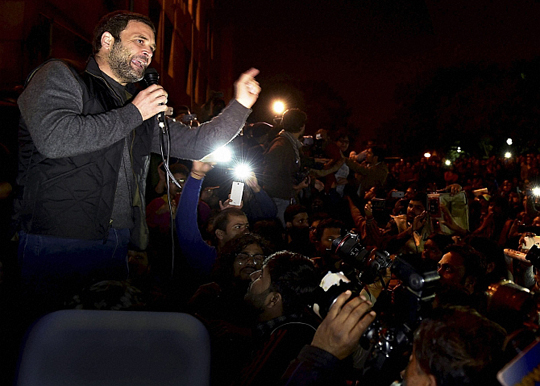
New Delhi, Feb 14: The protest against the arrest of Jawaharlal Nehru University (JNU) Students’ Union president Kanhaiya Kumar on charges of sedition turned into a political battle on Saturday.

rahul

Congress vice-president Rahul Gandhi’s visit to the campus in the evening along with some party colleagues, including Deputy Leader of the Opposition in the Rajya Sabha Anand Sharma, charged the already tense atmosphere in the campus.

Rahul was welcomed by some “members and supporters” of Akhil Bharatiya Vidyarthi Parishad (ABVP) with black flags.

Left party leaders, including CPM general-secretary Sitaram Yechury and CPI leader D Raja, were also present which triggered counter protests by ABVP members.

Delhi Chief Minister Arvind Kejriwal chose to highlight allegations that ABVP was behind the anti-India slogans against hanging of 2001 Parliament attack convict Afzal Guru. The chief minister has ordered a magisterial enquiry.

Earlier, seven students were taken into preventive custody. They were taken to Parliament Street police station and were released later in the evening.

Though the protest, held outside Indira Gandhi National Centre for the Arts, was thwarted, there were other protests during the day on the university campus.After Kumar’s arrest, students and some teachers have been holding protests demanding to know why students are being treated like “terrorists” and were being arrested from the campus.
Upset by the arrest and heavy police presence on the campus, the professors have also expressed concern over the “threat to democratic ethos”.

“JNU has always been a university where there has been a vibrant culture. Excessive police action is uncalled for and has worsened the situation,” the professors said in a statement.

The police, too, wrote a letter to vice-chancellor Jagadesh Kumar asking the University to produce five students who were involved in “anti-national” activities and told the varsity authorities to alert them if such activities take place in future.

Some former Army officers have also threatened to return their JNU degrees saying that they find it difficult to be associated with a university which has become a hub of anti-national activities.

Comments

Abu Muhammad
 - 
Sunday, 14 Feb 2016

Anti-Indian slogan should be condemned and punished. At the same time hoisting Pakistani flag by Sanghparivar, celebrating Gandhiji's murder, installing killers Godse statue & worship, disrespect to constitution, Arms training to Sanghparivar goons, waging war against secular India by openly declaring it as Hindu Rashtra, honouring assassins of Indira Gandhi, Sanghparivars open support and allegiance to British during Freedom struggle - ARE ALL THESE -ACTS OF PATRIOTISM? or 100% ANTI-NATIONAL?

NationalismBef…
 - 
Sunday, 14 Feb 2016

Exposes true face of Rahul G and Left leaders, shame on them for supporting students raising anti-India slogans.

Add new comment

  • Coastaldigest.com reserves the right to delete or block any comments.
  • Coastaldigset.com is not responsible for its readers’ comments.
  • Comments that are abusive, incendiary or irrelevant are strictly prohibited.
  • Please use a genuine email ID and provide your name to avoid reject.
News Network
May 7,2020

May 7: India is projected to record the highest number of births in the 9 months since COVID-19 was declared a pandemic in March, with more than 20 million babies expected to be born in the country between March and December, according to top UN body.

The United Nations Children's Fund (UNICEF) warned that pregnant mothers and babies born during the pandemic across the world were threatened by strained health systems and disruptions in services.

An estimated 116 million babies will be born under the shadow of COVID-19 pandemic, UNICEF said on Wednesday, ahead of Mother's Day, observed on May 10.

These babies are projected to be born up to 40 weeks after COVID-19 was recognised as a pandemic on March 11.

The highest numbers of births in the 9 months since the pandemic was declared are expected to occur in India, where 20.1 million babies are projected to be born between March 11 and December 16. Other countries with the expected highest numbers of births during this period are China (13.5 million), Nigeria (6.4 million), Pakistan (5 million) and Indonesia (4 million), it said.

"Most of these countries had high neonatal mortality rates even before the pandemic and may see these levels increase with COVID-19 conditions," UNICEF said.

It is estimated that there will be 24.1 million births in India for the January-December 2020 period.

UNICEF warned that COVID-19 containment measures can disrupt life-saving health services such as childbirth care, putting millions of pregnant mothers and their babies at great risk.

Even wealthier countries are affected by this crisis. In the US, the sixth-highest country in terms of the expected number of births, over 3.3 million babies are projected to be born between March 11 and December 16.

"New mothers and newborns will be greeted by harsh realities," UNICEF said, adding they include global containment measures such as lockdowns and curfews; health centres overwhelmed with response efforts; supply and equipment shortages; and a lack of sufficient skilled birth attendants as health workers, including midwives, are redeployed to treat COVID-19 patients.

"Millions of mothers all over the world embarked on a journey of parenthood in the world as it was. They now must prepare to bring a life into the world as it has become – a world where expecting mothers are afraid to go to health centres for fear of getting infected, or missing out on emergency care due to strained health services and lockdowns," UNICEF Executive Director Henrietta Fore said.

"It is hard to imagine how much the coronavirus pandemic has recast motherhood" Fore said.

UNICEF said its analysis was based on data from World Population Prospects 2019 of the UN Population Division.

An average full-term pregnancy typically lasts a complete 9 months, or 39 to 40 weeks. For the purposes of this estimate, the number of births for a 40-week period in 2020 was calculated.

The 40-week period of March 11 to December 16 is used in this estimate based upon the WHO's March 11 assessment that COVID-19 can be characterised as a pandemic.

UNICEF warned that although evidence suggests that pregnant mothers are not more affected by COVID-19 than others, countries need to ensure they still have access to antenatal, delivery and postnatal services.

Similarly, sick newborns need emergency services as they are at high risk of death. New families require support to start breastfeeding, and to get medicines, vaccines and nutrition to keep their babies healthy, it said.

"This is a particularly poignant Mother's Day, as many families have been forced apart during the coronavirus pandemic, but it is also a time for unity, a time to bring everyone together in solidarity. We can help save lives by making sure that every pregnant mother receives the support she needs to give birth safely in the months to come," Fore said.

Issuing an urgent appeal to governments and health care providers to save lives in the coming months, UNICEF said efforts must be made to help pregnant women receive antenatal checkups, skilled delivery care, postnatal care services, and care related to COVID-19 as needed.

Ensure health workers are provided with the necessary personal protective equipment and get priority testing and vaccination once a COVID-19 vaccine becomes available so that can deliver high quality care to all pregnant women and newborn babies during the pandemic, it said.

While it is not yet known whether the virus is transmitted from a mother to her baby during pregnancy and delivery, UNICEF advised all pregnant women to follow precautions to protect themselves from exposure to the virus.

Closely monitor themselves for symptoms of COVID-19 and seek advice from the nearest designated facility if they have concerns or experience symptoms. Pregnant women should also take the same precautions to avoid COVID -19 infection as other people: practice physical distancing, avoid physical gatherings and use online health services, it said.

UNICEF said even before COVID-19 pandemic, an estimated 2.8 million pregnant women and newborns died every year, or 1 every 11 seconds, mostly of preventable causes.

The agency called for immediate investment in health workers with the right training, who are equipped with the right medicines to ensure every mother and newborn is cared for by a safe pair of hands to prevent and treat complications during pregnancy, delivery and birth.


Comments

Add new comment

  • Coastaldigest.com reserves the right to delete or block any comments.
  • Coastaldigset.com is not responsible for its readers’ comments.
  • Comments that are abusive, incendiary or irrelevant are strictly prohibited.
  • Please use a genuine email ID and provide your name to avoid reject.
Agencies
June 30,2020

Seventy-seven per cent children below five years of age in Jammu and Kashmir were not able to access basic healthcare services like immunisation during the lockdown imposed to curb the spread of COVID-19, CRY said on Monday citing a study.

The 'Rapid Online Perception Study about the Effects of COVID-19 on Children' was conducted during the first and second phases of the lockdown based on responses of parents and primary caregivers from all across the country, including Jammu and Kashmir, the NGO said in a statement.

It said a total of 387 respondents from Jammu and Kashmir participated in the study.

"Seventy-seven per cent children of age 0-5 years were not able to access basic healthcare services such as immunisation during lockdown - necessarily imposed to curb the spread of COVID-19 pandemic in Jammu and Kashmir," Child Rights and You (CRY) said.

It said as immunisation programmes witnessed a major setback during the lockdown across the country, the results of the survey across 23 states and Union Territories found nearly 50 per cent of parents with children below five years of age unable to access immunisation services.

"Worryingly, the figure was considerably high in Jammu and Kashmir with 77.14 per cent children below five years unable to get immunisation services," it added.

According to the study, in Jammu and Kashmir, nearly 35 per cent of the respondents said their children did not receive medical help during the lockdown, resulting in difficulties to cope with their children's illnesses and health hazards.

The study also talks about more systemic arrangements and logistical preparedness to ensure that children with no or compromised digital reach are not deprived from their Right to Education.

With online classes introduced as a substitute of schools during the lockdown, access to education for children remained a major issue of concern, as many of them, especially the ones from marginalised and financially poorer backgrounds found it difficult without smartphones and internet access.

The survey's findings revealed that nationally only 41 per cent households with children of school-going age could access online classes on a regular basis.

"Almost 90 per cent parents and primary caregivers reported that the lockdown has increased the screen time of their child to great or some extent. About half of the households recorded an increase of children's exposure to online activities during lockdown," it said.

The NGO said around 76 per cent parents agreed that they could keep a watch of their children's online activity to some extent.

Comments

Add new comment

  • Coastaldigest.com reserves the right to delete or block any comments.
  • Coastaldigset.com is not responsible for its readers’ comments.
  • Comments that are abusive, incendiary or irrelevant are strictly prohibited.
  • Please use a genuine email ID and provide your name to avoid reject.
Agencies
July 31,2020

New Delhi, Jul 31: With the highest single-day spike of 55,079 COVID-19 cases in the last 24 hours, India's coronavirus tally breached the 16 lakh mark on Friday, informed the Union Ministry of Health and Family Welfare.

With this latest spike, the total cases in the country stand at 16,38,871. Among these cases 5,45,318 are active. A total of 10,57,806 patients have been cured/discharged/migrated.

779 deaths due to COVID-19 have been reported in the country in the last 24 hours, taking the death toll to 35,747.

As per the Union Health Ministry, Maharashtra has a total of 1,48,454 active cases and recorded 14,729 deaths due to COVID-19.
Tamil Nadu has a total of 57,962 active cases and 3,838 deaths in the state.

Delhi has a total of 10,743 active cases and 3,936 deaths.

The Indian Council of Medical Research on Friday informed that a total number of COVID-19 samples tested up to 30th July is 1,88,32,970 including 6,42,588 samples tested yesterday.

Comments

Add new comment

  • Coastaldigest.com reserves the right to delete or block any comments.
  • Coastaldigset.com is not responsible for its readers’ comments.
  • Comments that are abusive, incendiary or irrelevant are strictly prohibited.
  • Please use a genuine email ID and provide your name to avoid reject.