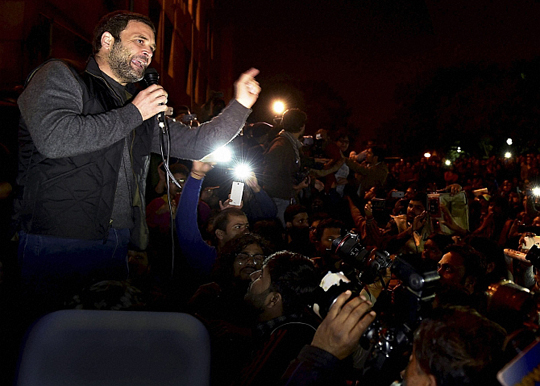
Rahul, Left leaders back JNU students' protest

February 14, 2016

New Delhi, Feb 14: The protest against the arrest of Jawaharlal Nehru University (JNU) Students’ Union president Kanhaiya Kumar on charges of sedition turned into a political battle on Saturday.

rahul

Congress vice-president Rahul Gandhi’s visit to the campus in the evening along with some party colleagues, including Deputy Leader of the Opposition in the Rajya Sabha Anand Sharma, charged the already tense atmosphere in the campus.

Rahul was welcomed by some “members and supporters” of Akhil Bharatiya Vidyarthi Parishad (ABVP) with black flags.

Left party leaders, including CPM general-secretary Sitaram Yechury and CPI leader D Raja, were also present which triggered counter protests by ABVP members.

Delhi Chief Minister Arvind Kejriwal chose to highlight allegations that ABVP was behind the anti-India slogans against hanging of 2001 Parliament attack convict Afzal Guru. The chief minister has ordered a magisterial enquiry.

Earlier, seven students were taken into preventive custody. They were taken to Parliament Street police station and were released later in the evening.

Though the protest, held outside Indira Gandhi National Centre for the Arts, was thwarted, there were other protests during the day on the university campus.After Kumar’s arrest, students and some teachers have been holding protests demanding to know why students are being treated like “terrorists” and were being arrested from the campus.
Upset by the arrest and heavy police presence on the campus, the professors have also expressed concern over the “threat to democratic ethos”.

“JNU has always been a university where there has been a vibrant culture. Excessive police action is uncalled for and has worsened the situation,” the professors said in a statement.

The police, too, wrote a letter to vice-chancellor Jagadesh Kumar asking the University to produce five students who were involved in “anti-national” activities and told the varsity authorities to alert them if such activities take place in future.

Some former Army officers have also threatened to return their JNU degrees saying that they find it difficult to be associated with a university which has become a hub of anti-national activities.

Comments

Abu Muhammad
 - 
Sunday, 14 Feb 2016

Anti-Indian slogan should be condemned and punished. At the same time hoisting Pakistani flag by Sanghparivar, celebrating Gandhiji's murder, installing killers Godse statue & worship, disrespect to constitution, Arms training to Sanghparivar goons, waging war against secular India by openly declaring it as Hindu Rashtra, honouring assassins of Indira Gandhi, Sanghparivars open support and allegiance to British during Freedom struggle - ARE ALL THESE -ACTS OF PATRIOTISM? or 100% ANTI-NATIONAL?

NationalismBef…
 - 
Sunday, 14 Feb 2016

Exposes true face of Rahul G and Left leaders, shame on them for supporting students raising anti-India slogans.

Add new comment

  • Coastaldigest.com reserves the right to delete or block any comments.
  • Coastaldigset.com is not responsible for its readers’ comments.
  • Comments that are abusive, incendiary or irrelevant are strictly prohibited.
  • Please use a genuine email ID and provide your name to avoid reject.
News Network
February 14,2020

New Delhi/Washington, Feb 14: India has offered to partially open up its poultry and dairy markets in a bid for a limited trade deal during US President Donald Trump's first official visit to the country this month, people familiar with the protracted talks say.

India, the world's largest milk-producing nation, has traditionally restricted dairy imports to protect the livelihoods of 80 million rural households involved in the industry.

But Prime Minister Narendra Modi is trying to pull all the stops for the US President's February 24-25 visit, aimed at rebuilding bonds between the world's largest democracies.

In 2019, President Trump suspended India's special trade designation that dated back to 1970s, after PM Modi put price caps on medical devices, such as cardiac stents and knee implants, and introduced new data localization requirements and e-commerce restrictions.

President Trump's trip to India has raised hopes that he would restore some of the country's US trade preferences, in exchange for tariff reductions and other concessions.

The United States is India's second-largest trade partner after China, and bilateral goods and services trade climbed to a record $142.6 billion in 2018. The United States had a $23.2 billion goods trade deficit in 2019 with India, its 9th largest trading partner in goods.

India has offered to allow imports of US chicken legs, turkey and produce such as blueberries and cherries, government sources said, and has offered to cut tariffs on chicken legs from 100 per cent to 25 per cent. US negotiators want that tariff cut to 10 per cent. The Modi government is also offering to allow some access to India's dairy market, but with a 5 per cent tariff and quotas, the sources said. But dairy imports would need a certificate they are not derived from animals that have consumed feeds that include internal organs, blood meal or tissues of ruminants.

New Delhi has also offered to lower its 50 per cent tariffs on very large motorcycles made by Harley-Davidson, a tax that was a particular irritant for President Trump, who has labelled India the "tariff king." The change would be largely symbolic because few such motorcycles are sold in India.

President Trump will be feted in PM Modi's home state of Gujarat, then hold talks in New Delhi and attend a reception that the hosts have promised will be bigger than the one organised for former president Barack Obama in 2015.

But it is far from clear whether India's offers will be enough to satisfy US Trade Representative Robert Lighthizer, who cancelled plans for a trip to India this week. Instead, he has held telephone talks with Commerce Minister Piyush Goyal.

The US dairy industry remained sceptical on Thursday that a viable deal is at hand.

"We're always looking for market access, but in terms of India, as of today I'm not aware of any real progress going on," said Michael Dykes, president of the International Dairy Foods Association and a member of USTR's agricultural trade policy advisory committee.

Mr Dykes said the US dairy industry was looking for access in viable commercial quantities.

A USTR spokesman and India's trade ministry did not respond to requests for comment.

A parliament panel is reviewing a draft data privacy law that imposes stringent controls over cross-border data flows and gives the government powers to seek user data from companies.

It is not clear whether it will be passed, or in what form, but the possibilities have unnerved US companies and could raise compliance requirements for Google, Amazon.com Inc, and Facebook.

The draft law is not part of the trade discussions, Indian officials say, because the issue is too difficult to resolve at the same time.

"The privacy and localization piece will be raised independently and in concert with the trade discussions," said a Washington-based source with knowledge of the US administration's thinking.

President Trump on Tuesday was non-committal about sealing a trade deal before his visit. "If we can make the right deal, we'll do it," he told reporters.

Two US sources said progress had been made on proposed alterations to the medical device price caps. India's new import tariffs on medical devices, walnuts, toys, electronics and other products on February 1 surprised US negotiators, however.

The new tariffs were aimed at China, which also makes medical devices, according to an Indian government source. "We have to protect our market and our companies," the source said.

Comments

Add new comment

  • Coastaldigest.com reserves the right to delete or block any comments.
  • Coastaldigset.com is not responsible for its readers’ comments.
  • Comments that are abusive, incendiary or irrelevant are strictly prohibited.
  • Please use a genuine email ID and provide your name to avoid reject.
News Network
June 18,2020

New Delhi, Jun 18: The border clash between Indian and Chinese soldiers in Ladakh broke the brittle quiet – and also the sense of security for anxious Chinese nationals in India who fear a backlash with anti-Chinese sentiment spiralling in the country.

With the high altitude violent face-off in eastern Ladakh’s Galwan Valley spurring hashtags such as “Boycott China” and “Teach Lesson to China” and leading to street protests, the undercurrents of tension were evident.

Wary of being identified, some said they had been reassured by their friends but were still apprehensive for themselves and their families.

"They (Chinese families) don''t want to speak to the media. They are not going out and are worried about their security and well being. Their families are also worried back home," Mohammed Saqib, secretary general of the India China Economic & Cultural Council, told PTI.

He added that his Chinese friends in India been calling him since they heard news about Monday night’s clashes in which 20 Indian soldiers were killed -- the worst military confrontation in five decades -- and expressed concern over growing anti-China sentiments.

A Chinese national from Beijing working in Gurgaon for a Chinese mobile firm initially refused to talk, saying he did not want to speak to the media and later shared his thoughts only on condition of anonymity.

"There is talk of border standoff and tensions, but we know Indians are very warm people and that is why I have told my family that all is fine here and they should not worry," he said.

Another Chinese national working in Gurgaon said he and his family are feeling the stress amid the spiralling conflict between India and China, but many friends have been reassuring him.

"They (Chinese in India) are under a lot of stress naturally. Such a conflict puts a lot of stress as they could bear the brunt and the same applies to Indians in China," B R Deepak, professor at the Centre for Chinese and South East Asian Studies of the Jawaharlal Nehru University said.

He said it was unfortunate that the border standoff derailed the commemorative programmes aimed at strengthening ties at a time the two countries were gearing to celebrate 70 years of establishment of diplomatic ties.

Experts also feel the border clash is likely to have a significant negative impact on the economic and people to people ties.

There are scores of Chinese in India working in various Chinese firms and also those who are studying in universities like JNU.

About 3,000 Chinese people, doing business or studying in big cities in India, were stranded in India at the start of the COVID-19 crisis, and about half of them returned to China before the lockdown began on March 25.

The Chinese Embassy in New Delhi announced on May 25 that they will arrange for flights to take back students, tourists and businesspersons to five Chinese cities, including Shanghai and Guangzhou.

"It will impact the psychology of the Chinese here. There are 2,000 Chinese firms in various sectors in India which are going to be impacted," Deepak said.

Future investments from the Chinese side could also be impacted, he said.

Moreover, as far as people-to-people contacts are concerned, the number of Chinese students choosing India as a preferred destination is likely to go down, Deepak said.

Alka Acharya, another China expert, said there are two kinds of impacts of such an incident -- short term and medium term.

Usually after the initial nationalistic reaction in the short term things tend to normalise in the medium term, but with such a border clash happening for the first time in decades clearly the resonance would be much more in both India and China, said Acharya, professor at the Centre for East Asian Studies, School of International Studies, in JNU.

“Due to the impact of the COVID-19 crisis on the economy, whether India can take a hardline in terms of economics towards China, is a tricky question,” she said.

In the immediate context, there may be a dip in economic ties with calls for boycott of Chinese goods and services, Acharya said.

The manner in which this crisis is resolved will affect how ties will be affected in the medium term, she said.

The headlines have added to the anxiety.

A group of ex-armymen gathered near the Chinese embassy to protest the killing of 20 Indian Army personnel in Ladakh’s Galwan Valley. And another group of around 10 protesters belonging to the Swadeshi Jagaran Manch protested near the Teen Murti roundabout in Central Delhi.

The anti-China sentiment prevalent among the common public is also finding a reflection in government policy with sources saying the Department of Telecom (DoT) is set to ask state-owned Bharat Sanchar Nigam Ltd (BSNL) not to use Chinese telecom gear in its 4G upgradation.

Trade bodies like CAIT are also calling for a boycott of Chinese products.

And Chinese handset maker Oppo cancelled the livestream launch of its flagship 5G smartphone in the country amid protests.

Monday night’s clashes between the Chinese and Indian troops in Galwan Valley significantly escalated the already volatile border standoff between the two countries.

The casualties on the Chinese side are not yet known. However, government sources, citing an American intelligence report, claimed the total number of soldiers killed and seriously wounded could be 35.


Comments

Add new comment

  • Coastaldigest.com reserves the right to delete or block any comments.
  • Coastaldigset.com is not responsible for its readers’ comments.
  • Comments that are abusive, incendiary or irrelevant are strictly prohibited.
  • Please use a genuine email ID and provide your name to avoid reject.
Agencies
March 26,2020

New Delhi, Mar 26: The government on Thursday announced a Rs 1.7 lakh crore stimulus that included free foodgrain and cooking gas to poor for three months, and cash doles to women and poor senior citizens as it looked to ease the economic impact of the nationwide lockdown.

While over 80 crore poor ration card holders will each get 5 kg of wheat or rice and one kg of preferred pulses free of cost every month for the next three months, 20.4 crore women having Jan Dhan bank accounts would get one-time cash help of Rs 1,500 spread over three months.

Over 8.3 crore poor women, who were handed out free cooking gas connections since 2016, will get free LPG refills for the next three months, while poor senior citizens, widows and disabled will get an ex-gratia cash of Rs 1,000.

"Since the lockdown has been in force (since Wednesday) and therefore we have come out with a package which will immediately take care of the concerns and welfare of poor and suffering workers and those who need immediate help," Finance Minister Nirmala Sitharaman said at a news conference here.

The package, she said, is being announced within 36 hours of the 21-day nationwide lockdown announced by the Prime Minister to protect the nation's 130 crore people from the fast-spreading coronavirus. "We do not want anyone to remain hungry."

She hinted at more announcements if a need arises.

"So, today's measures are very clearly aimed at reaching out with food and money that they need to have it in their hands. We will obviously think about other things. I will gradually address if there is more to attend," she said.

The package included advancing the payment of one-third of the Rs 6,000 a year pre-2019 general election cash dole scheme for farmers, government contributions to retirement funds for the next three months of small companies with 90 per cent of staff earning less than Rs 15,000, and a Rs 50 lakh insurance cover to healthcare workers.

For rural workers, the daily wage under the MNREGA employment guarantee programme has been increased to Rs 202 from Rs 182, benefiting 5 crore workers of about Rs 2,000 in all.

India joins countries -- from the US to Singapore -- that have pledged spending to contain the economic fallout of the pandemic that has infected almost 5 lakh people globally and left over 21,000 dead.

The pandemic has infected 649 persons in India and has killed 13 so far.

While the free food grains and pulses would cost Rs 45,000 crore, Rs 2,000 payment to 8.7 crore farmers under Pradhan Mantri Garib Kalyan Yojana will cost Rs 16,000 crore.

The cash to women Jan Dhan account holders will cost Rs 31,000 crore and another Rs 13,000 crore is estimated to be the expenditure for providing free cooking gas.

Sitharaman, however, evaded a reply to questions on how the government will finance the package given that the impact of the closure of businesses across the country will be felt over the next few months and would have a direct bearing on already strained tax collections.

She also did not say if the government will relax budget deficit targets or resort to additional borrowings to fund the programme.

The revised fiscal deficit - the gap between revenue and expenditure - has been put at 3.8 per cent of the GDP in the current fiscal. For the fiscal starting April, the government is targeting a 3.5 per cent fiscal deficit.

"Today's measures are very clearly aimed at reaching out to the poor," she said. "At this stage, I am more concerned about reaching out to those who need help."

With businesses closed during the lockdown, the government will contribute employees as well as employer's contribution to the provident fund for the next three months of companies with up to 100 employees with 90 per cent earning not more than Rs 15,000. The contribution will be a total of 24 per cent of eligible wages.

Also, workers will be allowed to draw a non-refundable advance of 75 per cent from credit in provident fund account or three months salary, whichever is lower, she said.

Sitharaman said the limit of collateral-free loans to 63 lakh women self-help groups is being doubled to Rs 20 lakh, impacting 7 crore households.

The free foodgrain and pulses are over-and-above the existing entitlement through the public distribution system (PDS). The ration card holders can take the foodgrain and pulses from the PDS in two installments, she added.

The government had previously relaxed timelines for meeting tax and other statutory filing requirements as well as allowed companies to divert their philanthropy or CSR funds to support the fight against coronavirus.

These measures and the ones announced on Thursday will be topped up by the expected announcement of interest rate cuts by the Reserve Bank of India (RBI) at its bi-monthly monetary policy review meet slated next week.

Commenting on the package, Anil Talreja, Partner, Deloitte India said the announcements are is expected to give reprieve to the mass sections of the population. "This is a good way to ensure that the poor and needy get what they deserve. It has ensured that the farmers, poor senior citizens, widows and specified sections of the society as well as people who are attached to the healthcare sectors get rewarded for their hard work and sacrifices".

Comments

Add new comment

  • Coastaldigest.com reserves the right to delete or block any comments.
  • Coastaldigset.com is not responsible for its readers’ comments.
  • Comments that are abusive, incendiary or irrelevant are strictly prohibited.
  • Please use a genuine email ID and provide your name to avoid reject.