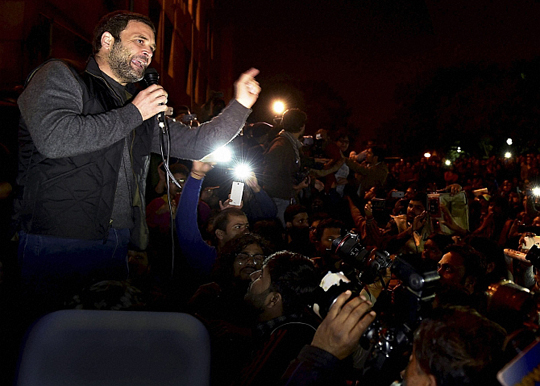
Rahul, Left leaders back JNU students' protest

February 14, 2016

New Delhi, Feb 14: The protest against the arrest of Jawaharlal Nehru University (JNU) Students’ Union president Kanhaiya Kumar on charges of sedition turned into a political battle on Saturday.

rahul

Congress vice-president Rahul Gandhi’s visit to the campus in the evening along with some party colleagues, including Deputy Leader of the Opposition in the Rajya Sabha Anand Sharma, charged the already tense atmosphere in the campus.

Rahul was welcomed by some “members and supporters” of Akhil Bharatiya Vidyarthi Parishad (ABVP) with black flags.

Left party leaders, including CPM general-secretary Sitaram Yechury and CPI leader D Raja, were also present which triggered counter protests by ABVP members.

Delhi Chief Minister Arvind Kejriwal chose to highlight allegations that ABVP was behind the anti-India slogans against hanging of 2001 Parliament attack convict Afzal Guru. The chief minister has ordered a magisterial enquiry.

Earlier, seven students were taken into preventive custody. They were taken to Parliament Street police station and were released later in the evening.

Though the protest, held outside Indira Gandhi National Centre for the Arts, was thwarted, there were other protests during the day on the university campus.After Kumar’s arrest, students and some teachers have been holding protests demanding to know why students are being treated like “terrorists” and were being arrested from the campus.
Upset by the arrest and heavy police presence on the campus, the professors have also expressed concern over the “threat to democratic ethos”.

“JNU has always been a university where there has been a vibrant culture. Excessive police action is uncalled for and has worsened the situation,” the professors said in a statement.

The police, too, wrote a letter to vice-chancellor Jagadesh Kumar asking the University to produce five students who were involved in “anti-national” activities and told the varsity authorities to alert them if such activities take place in future.

Some former Army officers have also threatened to return their JNU degrees saying that they find it difficult to be associated with a university which has become a hub of anti-national activities.

Comments

Abu Muhammad
 - 
Sunday, 14 Feb 2016

Anti-Indian slogan should be condemned and punished. At the same time hoisting Pakistani flag by Sanghparivar, celebrating Gandhiji's murder, installing killers Godse statue & worship, disrespect to constitution, Arms training to Sanghparivar goons, waging war against secular India by openly declaring it as Hindu Rashtra, honouring assassins of Indira Gandhi, Sanghparivars open support and allegiance to British during Freedom struggle - ARE ALL THESE -ACTS OF PATRIOTISM? or 100% ANTI-NATIONAL?

NationalismBef…
 - 
Sunday, 14 Feb 2016

Exposes true face of Rahul G and Left leaders, shame on them for supporting students raising anti-India slogans.

Add new comment

  • Coastaldigest.com reserves the right to delete or block any comments.
  • Coastaldigset.com is not responsible for its readers’ comments.
  • Comments that are abusive, incendiary or irrelevant are strictly prohibited.
  • Please use a genuine email ID and provide your name to avoid reject.
News Network
February 13,2020

New Delhi, Feb 13: Arvind Kejriwal wrote to Delhi Lieutenant Governor Anil Baijal on Wednesday, staking claim to form the government in the national capital, sources said, while hinting that the AAP might not invite senior leaders and chief ministers of other parties for the oath-taking ceremony.

The sources said it was the formal process by the AAP chief, who was elected as the legislature party leader earlier in the day, to stake claim for forming the new government.

Kejriwal, who returned to power in Delhi with a stunning poll victory on Tuesday, will take oath as chief minister for the third consecutive time on February 16.

While the oath-taking ceremony will be open to the public, the Aam Aadmi Party (AAP) was considering not inviting leaders and chief ministers of other parties as it did not wish to be seen as a "confrontationist" against the BJP-led Centre, the sources said.

They, however, added that the party was yet to take a decision on it.

The AAP has planned mobilisation of people for the mega event and all the newly-elected MLAs of the party have been asked to ensure huge participation from their constituencies.

"I request the people of Delhi to attend the oath-taking ceremony of the chief minister at the Ramlila Maidan in large numbers," senior AAP leader Manish Sisodia told reporters, adding that the ceremony will start at 10 am.

The AAP won 62 seats in the 70-member Delhi Assembly, while the Bharatiya Janata Party (BJP) bagged the remaining eight seats. The Congress drew a blank for the second consecutive time in the Delhi polls.

Comments

Add new comment

  • Coastaldigest.com reserves the right to delete or block any comments.
  • Coastaldigset.com is not responsible for its readers’ comments.
  • Comments that are abusive, incendiary or irrelevant are strictly prohibited.
  • Please use a genuine email ID and provide your name to avoid reject.
News Network
April 21,2020

New Delhi, Apr 21: The historic rout in oil markets that sent US crude prices plummeting to as much as minus USD 40 a barrel is unlikely to translate into any big reduction in petrol and diesel prices in India as domestic pricing is based on different benchmark, and refineries are already filled up to brim and cannot buy US crude just yet.

With storage capacity already overflowing amid coronavirus-induced demand collapse, traders rushed to to get rid of unwanted stocks triggering the collapse of US West Texas Intermediate (WTI) crude for May delivery.

Indian Oil Corp (IOC) Chairman Sanjiv Singh said the collapse was triggered by traders unable to take deliveries of crude they had previously booked because of a demand collapse. And so they paid the seller to keep oil in their storage.

"If you look at June futures, it is trading in positive territory... around USD 20 per barrel," he said.

Low oil prices may seem good in short-term but in the long run it will hurt the oil economy as producers will have no surplus to invest in exploration and production which will lead to a drop in production, he said.

He did not comment on retail fuel prices that have been static since March 16.

Oil companies have not changed rates despite a fall in international prices as they first adjusted them against the increase that was warranted from a Rs 3 per litre hike in excise duty and close to Re 1 per litre additional cost of switching over to cleaner BS-VI grade fuel from April 1.

Petrol in Delhi is priced at Rs 69.59 a litre and diesel comes for Rs 62.29 per litre.

"The negative price has no direct impact on India or Indian oil prices, as this has taken place due to crude oil produced and traded within the US. India's prices are driven partly by another benchmark, the Brent, which is still trading at USD 25/barrel. Therefore, the retail price of fuels in India are unlikely to fall," said Amit Bhandari, Fellow, Energy and Environment Studies, Gateway House.

Also, Indian refineries are already overflowing as fuel demand has evaporated due to the unprecedented nationwide lockdown imposed to curb spread of COVID-19. So, they can't rush to buy US crude.

The refineries have already cut operating rate to half because the fuel they produce has not been sold yet.

India imports 4 million barrels/day (1.4 billion barrels/year) of oil. The country has been benefitting from the falling prices of oil for the last five years, when oil dropped from a peak of USD 110/barrel to USD 50-60/barrel last year, enabling India to invest in public service programmes.

"However, the additional USD 30 fall of this week is good for India - but there is also a downside. If oil prices are too low, the economies of oil-rich gulf countries will be hurt, threatening the job prospects of the 8 million Indians working in the Gulf countries. India is the largest recipient of foreign remittances due to these workers – very low oil prices will hurt this cash stream," Bhandari said.

He said the negative price of oil shows how much oil oversupply exists in international markets today. "Global oil consumption has fallen due to the COVID-19 pandemic that traders are willing to pay customers to get rid of the barrels they can't store. The world does not have enough storage capacity, and dumping the oil is an environmental crime."

The first half of April saw Brent crude oil prices plummet 63.6 per cent to USD 26.9 per barrel. Prices of Western Texas Intermediate (WTI), the American oil, had also fallen similarly by 63.1 per cent.

But on April 20, WTI prices turned rapidly negative because traders on the Nymex exchange rushed to offload their May futures positions a day before expiry of contracts (on April 21).

Such WTI futures are traded on the Nymex exchange with contracts settled in physical crude oil. Problem is, those who had gone long are unable to find storage facilities for the oil and had to liquidate their contracts before expiry. This caused the plunge in WTI prices.

Contrast to this, June WTI Nymex futures prices is hovering around USD 21, while Brent for June delivery is at USD 25.

Miren Lodha, Director, CRISIL Research said the demand for crude oil was declining already because of economic slowdown when the COVID-19 pandemic-driven lockdowns crushed it further.

Consequently, oil demand is expected to contract by 8-10 million barrels per day (mbpd) in 2020 assuming demand recovery begins from the third quarter of the year, he said, adding if recovery doesn't happen by then, further demand destruction could occur.

On the supply side, producers reining in output following a strategic deal between OPEC members, Russia and the US.

Under this agreement, OPEC+ would reduce oil production by 9.7 mbpd for May and June, but gradually ease the curb to 7.7 mbpd between July and December 2020, and to 5.8 mbpd till April 2022 to stabilise prices.

"This is expected to reduce some surplus in the market by the end of 2020," Lodha said.

Crude oil demand is expected to decline by over 20 mbpd in April alone. Typically, monthly global demand is about 100 mbpd. Given this scenario, supply curbs would have limited influence.

Consequently, Brent oil prices is expected to be in the USD 25-30 range for the second quarter while increasing marginally in the last 2 quarters of 2020.

"The gigantic inventory build-ups and lack of storage facilities would also put pressure on prices," he said, adding overall Brent could average USD 30-35 in 2020, with a strong downward bias.

Comments

Add new comment

  • Coastaldigest.com reserves the right to delete or block any comments.
  • Coastaldigset.com is not responsible for its readers’ comments.
  • Comments that are abusive, incendiary or irrelevant are strictly prohibited.
  • Please use a genuine email ID and provide your name to avoid reject.
News Network
February 10,2020

New Delhi, Feb 10: Former finance minister P Chidambaram on Monday tore into the Modi government's handling of the economy, saying it was close to collapse and was been attended by "very incompetent doctors."

Initiating the debate on the Union Budget for 2020-21, he said rising unemployment and falling consumption was making India poorer.

The economy, he said, is facing demand constraints and is investment starved. The economy is facing fall in consumption and rising unemployment.

"Fear and uncertainty prevails in the country," he added.

He said the chief economic advisor to the BJP government for four years, Arvind Subramanian has stated that the economy is in the ICU. But "I would say the patient has been kept out of ICU and incompetent doctors are looking at the patient," Chidambaram said.

"It is dangerous to have a patient out of ICU and being looked upon by incompetent doctors. What is the point standing around and chanting slogan 'Sab ka saath, sab ka vishwas'," he said, adding every competent doctor the Modi government could ever identify has left the country.

His said a list of such people included former RBI governor Raghurman Rajan, former CEA Arvind Subramanian, former RBI governor Urjit Patel and former NITI Aayog vice chairman Arvind Panagariya.

"Who are your doctors, I want to know," he said, adding the government considers Congress as untouchable and doesn't think of any good about the rest of the opposition and so doesn't consult them.

Chidambaram charged that instead of putting money in the hands of people, the Modi government "put money in hands of 200 corporates" by way of corporate tax.

He said Finance Minister Nirmala Sitharaman in her 160- minute budget speech did not talk of the economy and its management.

"You are living in echo chambers. You want to hear your own voice," he said.

Listing problems with the Modi government, Chidambaram said it refuses to admits in mistakes, lives in denial and has predispositions.

The demonetisation of old 1000 and 500 rupee notes, as well as the hurried implementation of the Goods and Services Tax (GST), are "monumental blunders" that ruined the economy, he said, adding the Modi regime is predisposed to protectionism, a 'strong' rupee and is against bilateral and multilateral agreements.

"It is living in denial," he said, adding the economic growth has fallen for hereto unseen six consecutive quarters.

He wondered on the narrative Finance Minister Nirmala Sitharaman was trying to give after reading out a 160-minute budget speech with few pages left unread.

Her budget neither made any reference to the Economic Survey nor picked up a single idea from it, he said.

Chidambaram, who is credited with presenting a 'dream budget' more than two decades back, said the GDP growth has declined for six consecutive quarters, agriculture is growing by just 2 per cent, while consumer price inflation has risen from 1.9 per cent in January 2019 to 7.4 per cent in a matter of 11 months.

Also, food inflation is at 12.2 per cent. Bank credit is growing 8 per cent with non-food credit rising by 7-8 per cent and credit to industry by just 2.7 per cent. Credit to agriculture has declined from 18.3 per cent to 5.3 per cent and that for MSMEs from 6.7 per cent to 1.6 per cent.

Overall industrial index showed just 0.6 per cent growth. "Every major industry is either near zero or in negative zone," he said, adding thermal power plants are operating at just 55 per cent of the capacity as factories have either closed or are on the verge of closure.

"That gives you a good picture of the state of economy. You don't require MRI," he said. "You are in management for six years. How long can you blame previous managers."

He charged the government with burying unfavourable reports such as the labour survey that put unemployment at 45 -year high of 6.1 per cent at end of 2017-18. Also, consumer expenditure has falling to 3.7 per cent between 2011-12 and 2017-18.

Drilling holes in Budget numbers, he said the 2019-20 budget projected a nominal GDP growth of 12 per cent but ended with just 8.5 per cent. Fiscal deficit was targeted to be shrunk to 3.3 per cent of the GDP but ended by at 3.8 per cent and in the next fiscal it is being targeted at 3.5 per cent.

Revenue deficit was targeted at 2.3 per cent in fiscal ending March 31, 2020 but ended up at 2.4 per cent and in the next it will rise to 2.8 per cent, he said, adding capital expenditure in the next fiscal will shrink to 0.7 per cent from 1.4 per cent in the current.

Net tax revenue in the current fiscal was targeted at Rs 16.49 lakh crore but only Rs 9 lakh crore was collected in first nine months till December 2019 and "you want us to believe this will rise to Rs 15 lakh crore by March 2020," he said.

Similarly, expenditure in 2019-20 was pegged at Rs 27.86 lakh crore but only Rs 11.78 lakh crore spent during April- December and by March this is projected to rise to Rs 27 lakh crore.

"You have no money to spend... and these are masked by numbers," he said. "Numbers are not easily acceptable or believable."

Chidambaram said the government is facing shortfall in all forms of taxes - Rs 1.56 lakh crore on corporate tax, Rs 10,000 crore on personal income tax, Rs 30,000 crore on customs, Rs 52,000 crore on excise and Rs 51,000 crore on GST.

This despite "the extraordinary powers" and "all kinds of power" given to lower level tax officials, he said.

He read of list of heads under which allocation has fallen - food subsidy, agriculture, PM-Kisan, rural roads, mid-day meal scheme, ICDS, skill development, Ayushman Bharat, rural development and MGNEGA.


Comments

Add new comment

  • Coastaldigest.com reserves the right to delete or block any comments.
  • Coastaldigset.com is not responsible for its readers’ comments.
  • Comments that are abusive, incendiary or irrelevant are strictly prohibited.
  • Please use a genuine email ID and provide your name to avoid reject.