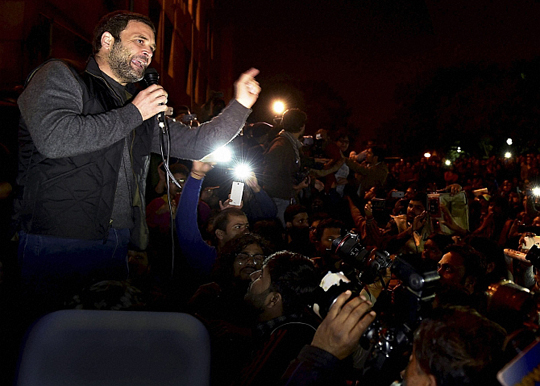
Rahul, Left leaders back JNU students' protest

February 14, 2016

New Delhi, Feb 14: The protest against the arrest of Jawaharlal Nehru University (JNU) Students’ Union president Kanhaiya Kumar on charges of sedition turned into a political battle on Saturday.

rahul

Congress vice-president Rahul Gandhi’s visit to the campus in the evening along with some party colleagues, including Deputy Leader of the Opposition in the Rajya Sabha Anand Sharma, charged the already tense atmosphere in the campus.

Rahul was welcomed by some “members and supporters” of Akhil Bharatiya Vidyarthi Parishad (ABVP) with black flags.

Left party leaders, including CPM general-secretary Sitaram Yechury and CPI leader D Raja, were also present which triggered counter protests by ABVP members.

Delhi Chief Minister Arvind Kejriwal chose to highlight allegations that ABVP was behind the anti-India slogans against hanging of 2001 Parliament attack convict Afzal Guru. The chief minister has ordered a magisterial enquiry.

Earlier, seven students were taken into preventive custody. They were taken to Parliament Street police station and were released later in the evening.

Though the protest, held outside Indira Gandhi National Centre for the Arts, was thwarted, there were other protests during the day on the university campus.After Kumar’s arrest, students and some teachers have been holding protests demanding to know why students are being treated like “terrorists” and were being arrested from the campus.
Upset by the arrest and heavy police presence on the campus, the professors have also expressed concern over the “threat to democratic ethos”.

“JNU has always been a university where there has been a vibrant culture. Excessive police action is uncalled for and has worsened the situation,” the professors said in a statement.

The police, too, wrote a letter to vice-chancellor Jagadesh Kumar asking the University to produce five students who were involved in “anti-national” activities and told the varsity authorities to alert them if such activities take place in future.

Some former Army officers have also threatened to return their JNU degrees saying that they find it difficult to be associated with a university which has become a hub of anti-national activities.

Comments

Abu Muhammad
 - 
Sunday, 14 Feb 2016

Anti-Indian slogan should be condemned and punished. At the same time hoisting Pakistani flag by Sanghparivar, celebrating Gandhiji's murder, installing killers Godse statue & worship, disrespect to constitution, Arms training to Sanghparivar goons, waging war against secular India by openly declaring it as Hindu Rashtra, honouring assassins of Indira Gandhi, Sanghparivars open support and allegiance to British during Freedom struggle - ARE ALL THESE -ACTS OF PATRIOTISM? or 100% ANTI-NATIONAL?

NationalismBef…
 - 
Sunday, 14 Feb 2016

Exposes true face of Rahul G and Left leaders, shame on them for supporting students raising anti-India slogans.

Add new comment

  • Coastaldigest.com reserves the right to delete or block any comments.
  • Coastaldigset.com is not responsible for its readers’ comments.
  • Comments that are abusive, incendiary or irrelevant are strictly prohibited.
  • Please use a genuine email ID and provide your name to avoid reject.
News Network
March 4,2020

New Delhi, Mar 4: The government on Wednesday permitted NRIs to own up to 100 per cent stake in disinvestment-bound Air India.

The decision comes at a time when the government is looking to sell 100 per cent stake sale in the national carrier.

Union minister Prakash Javadekar said the Cabinet has approved allowing Non-Residents Indians (NRIs) to hold up to 100 per cent stake in Air India.

Allowing 100 per cent investment by Non-Resident Indians (NRIs) in the carrier would also not be in violation of SOEC norms. NRI investments would be treated as domestic investments.

Under the Substantial Ownership and Effective Control (SOEC) framework, which is followed in the airline industry globally, a carrier that flies overseas from a particular country should be substantially owned by that country's government or its nationals.

Currently, NRIs can acquire only 49 per cent in Air India. Foreign Direct Investment (FDI) in the airline is also 49 per cent through the government approval route.

As per the existing norms, 100 per cent FDI is permitted in scheduled domestic carriers, subject to certain conditions, including that it would not be applicable for overseas airlines.

In the case of scheduled airlines, 49 per cent FDI is permitted through automatic approval route and any such investment beyond that level requires government nod.

On January 27, the government came out witha Preliminary Information Memorandum (PIM) for Air India disinvestment. It has proposed selling 100 per cent stake in Air India along with budget airline Air India Express and the national carrier's 50 per cent stake in AISATS, an equal joint venture with Singapore Airlines.

Under the latest disinvestment plan, the successful bidder would have to take over only debt worth Rs 23,286.5 crore while the liabilities would be decided depending on current assets at the time of closing of the transaction.

This is the second attempt by the government in as many years to divest Air India, which has been in the red for long.

Comments

Add new comment

  • Coastaldigest.com reserves the right to delete or block any comments.
  • Coastaldigset.com is not responsible for its readers’ comments.
  • Comments that are abusive, incendiary or irrelevant are strictly prohibited.
  • Please use a genuine email ID and provide your name to avoid reject.
News Network
January 23,2020

Mumbai, Jan 23: Rashmi Sahijwala never expected to start working at the age of 59, let alone join India’s gig economy—now she is part of an army of housewives turning their homes into “cloud kitchens” to feed time-starved millennials.

Asia’s third-largest economy is battling a slowdown so sharp it is creating a drag on global growth, the International Monetary Fund said Monday, but there are some bright spots.

The gig economy, aided by cheap mobile data and abundant labour, has flourished in India, opening up new markets across the vast nation.

Although Indian women have long battled for access to education and employment opportunities, the biggest hurdle for many is convincing conservative families to let them leave home.

But new apps like Curryful, Homefoodi, and Nanighar are tapping the skills of housewives to slice, dice and prepare meals for hungry urbanites from the comfort of their homes.

The so-called cloud kitchens—restaurants that have no physical presence and a delivery-only model—are rising in popularity as there is a boom in food delivery apps such as Swiggy and Zomato.

“We want to be the Uber of home-cooked food,” said Ben Mathew, who launched Curryful in 2018, convinced that housewives were a huge untapped resource.

His company—which employs five people for the app’s daily operations—works with 52 women and three men, and the 31-year-old web entrepreneur hopes to get one million female chefs on-board by 2022.

“We usually train them in processes of sanitisation, cooking, prep time and packaging... and then launch them on the platform,” Mathew told news agency.

One of the first housewives to join Curryful in November 2018 shortly after its launch, Sahijwala was initially apprehensive, despite having four decades of experience in the kitchen.

But backed by her children, including her son who gave her regular feedback about her proposed dishes, she took the plunge.

Since then, she’s undergone a crash course in how to run a business, from creating weekly menus to buying supplies from wholesale markets to cut costs.

The learning curve was steep and Sahijwala switched from cooking everything from scratch to preparing curries and batters for breads in advance to save time and limit leftovers.

She even bought a massive freezer to store fruits and vegetables despite her husband’s reservations about the cost.

“I told him that I am a professional now,” she told news agency.

‘Internet restaurants’

Kallol Banerjee, co-founder of Rebel Foods which runs 301 cloud kitchens backing up 2,200 “internet restaurants”, was among the first entrepreneurs to embrace the concept in 2012.

“We could do more brands from one kitchen and cater to different customer requirements at multiple price points,” Banerjee told AFP.

The chefs buy the ingredients, supply the cookware and pay the utility bills.

The apps—which make their money through charging commission, such as more than 18 percent per order for Curryful—offer training and supply the chefs with containers and bags to pack the food in.

Curryful chef Chand Vyas, 55, spent years trying to set up a lunch delivery business but finally gave up after failing to compete with dabbawalas, Mumbai’s famously efficient food porters.

Today Vyas works seven hours a day, five days a week in her kitchen, serving up a bevy of Indian vegetarian staples, from street food favourites to lentils and rice according to the app’s weekly set menus.

“I don’t understand marketing or how to run a business but I know how to cook. So, the current partnership helps me focus on just that while Curryful takes care of the rest,” Vyas told AFP.

She pockets up to $150 (Rs 10,000 approx) a month after accounting for the commissions and costs, but hopes to earn more as the orders increase.

In contrast, a chef at a bricks-and-mortar restaurant takes home a monthly wage of between $300 (Rs 20,000 approx) and $1,000 (Rs 70,000) approx for working six days a week.

With India’s cloud kitchen sector expected to reach $1.05 billion by 2023, according to data platform Inc42, other companies are also keen to get a slice of the action.

Swiggy, for example, has invested 2.5 billion rupees ($35.3 million) in opening 1,000 cloud kitchens across the nation.

Back in her Mumbai kitchen, Sahijwala is elated to have embarked on a career at an age when her contemporaries are eyeing retirement.

Over the past year, she has seen her profit grow to $200 (Rs 15,000 approx) a month, but more importantly, she said, “My passion has finally found an outlet.

“I am just glad life has given me this chance.”

Comments

Add new comment

  • Coastaldigest.com reserves the right to delete or block any comments.
  • Coastaldigset.com is not responsible for its readers’ comments.
  • Comments that are abusive, incendiary or irrelevant are strictly prohibited.
  • Please use a genuine email ID and provide your name to avoid reject.
Agencies
July 7,2020

New Delhi, Jul 7: The University Grants Commission (UGC) has issued revised guidelines regarding the conduct of terminal semesters and final year exams by Universities and educational institutions. It has been suggested that exams may be completed by September in online or offline modes.

Releasing a statement, the UGC said it accepted the recommendations suggested by the expert committee. "In continuation to earlier Guidelines issued on 29.04.2020 and based on the Report of the Expert Committee, the UGC Revised Guidelines on Examination and Academic Calendar for the Universities in view of COVID-19 Pandemic were also approved by the Commission in its emergent meeting held on 6th July 2020," the statement read.

The Commission further said that while it was important to safeguard principles of health, safety and equal opportunities, it was also very important to ensure academic credibility, career opportunities and future progress of students.

"The Commission approved the recommendations of the Expert Committee regarding the conduct of terminal semester(s)/ final year(s) examinations by the universities/ institutions to be completed by the end of September 2020 in offline (pen & paper online/ blended (online + offline) mode," it added.

The UGC also said that if required it would also issue relevant details related to admissions and academic calendar in the universities and colleges. It asked the students to adopt the latest guidelines and complete the terminal semester or final year exams accordingly. 

Comments

Add new comment

  • Coastaldigest.com reserves the right to delete or block any comments.
  • Coastaldigset.com is not responsible for its readers’ comments.
  • Comments that are abusive, incendiary or irrelevant are strictly prohibited.
  • Please use a genuine email ID and provide your name to avoid reject.