


Rahul, Left leaders back JNU students' protest

February 14, 2016

New Delhi, Feb 14: The protest against the arrest of Jawaharlal Nehru University (JNU) Students’ Union president Kanhaiya Kumar on charges of sedition turned into a political battle on Saturday.
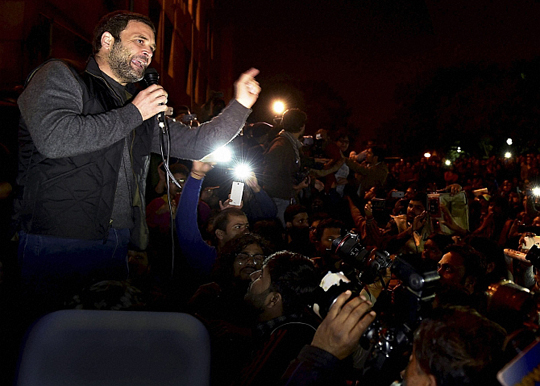
rahul

Congress vice-president Rahul Gandhi’s visit to the campus in the evening along with some party colleagues, including Deputy Leader of the Opposition in the Rajya Sabha Anand Sharma, charged the already tense atmosphere in the campus.

Rahul was welcomed by some “members and supporters” of Akhil Bharatiya Vidyarthi Parishad (ABVP) with black flags.

Left party leaders, including CPM general-secretary Sitaram Yechury and CPI leader D Raja, were also present which triggered counter protests by ABVP members.

Delhi Chief Minister Arvind Kejriwal chose to highlight allegations that ABVP was behind the anti-India slogans against hanging of 2001 Parliament attack convict Afzal Guru. The chief minister has ordered a magisterial enquiry.

Earlier, seven students were taken into preventive custody. They were taken to Parliament Street police station and were released later in the evening.

Though the protest, held outside Indira Gandhi National Centre for the Arts, was thwarted, there were other protests during the day on the university campus.After Kumar’s arrest, students and some teachers have been holding protests demanding to know why students are being treated like “terrorists” and were being arrested from the campus.
Upset by the arrest and heavy police presence on the campus, the professors have also expressed concern over the “threat to democratic ethos”.

“JNU has always been a university where there has been a vibrant culture. Excessive police action is uncalled for and has worsened the situation,” the professors said in a statement.

The police, too, wrote a letter to vice-chancellor Jagadesh Kumar asking the University to produce five students who were involved in “anti-national” activities and told the varsity authorities to alert them if such activities take place in future.

Some former Army officers have also threatened to return their JNU degrees saying that they find it difficult to be associated with a university which has become a hub of anti-national activities.

Comments

Abu Muhammad
 - 
Sunday, 14 Feb 2016

Anti-Indian slogan should be condemned and punished. At the same time hoisting Pakistani flag by Sanghparivar, celebrating Gandhiji's murder, installing killers Godse statue & worship, disrespect to constitution, Arms training to Sanghparivar goons, waging war against secular India by openly declaring it as Hindu Rashtra, honouring assassins of Indira Gandhi, Sanghparivars open support and allegiance to British during Freedom struggle - ARE ALL THESE -ACTS OF PATRIOTISM? or 100% ANTI-NATIONAL?

NationalismBef…
 - 
Sunday, 14 Feb 2016

Exposes true face of Rahul G and Left leaders, shame on them for supporting students raising anti-India slogans.

Add new comment

  • Coastaldigest.com reserves the right to delete or block any comments.
  • Coastaldigset.com is not responsible for its readers’ comments.
  • Comments that are abusive, incendiary or irrelevant are strictly prohibited.
  • Please use a genuine email ID and provide your name to avoid reject.
News Network
June 8,2020

New Delhi, Jun 8: Delhi Chief Minister Arvind Kejriwal has gone into self-quarantine after developing sore throat and fever, and will get himself tested for COVID-19 on Tuesday, officials said on Monday.

They said the chief minister, who is also a diabetic, was feeling unwell since Sunday afternoon.

"He has mild fever and sore throat since Sunday afternoon. As advised by doctors, the chief minister will undergo COVID-19 test on Tuesday morning," officials said.

Officials said the CM had attended a Cabinet meeting on Sunday morning and thereafter, he did not attend any meeting.

The chief minister has been holding most of his meetings via video conferencing from his official residence for past two days.

This come as the number of coronavirus cases in the national capital crossed the 28,000-mark with 1,282 fresh infections while the death toll climbed to 812 on Sunday, a health bulletin issued by the Delhi government said. According to the health bulletin, the total number of COVID-19 cases in Delhi rose to 28,936 with 1,282 fresh cases.

A total of 51 fatalities were reported on June 6, the bulletin said, adding that these lives were lost between May 8 and June 5. It, however, said the cumulative death figure refers to fatalities where the primary cause of death was found to be COVID-19, according to a report of the Death Audit Committee on the basis of the case-sheets received from various hospitals.

Comments

Add new comment

  • Coastaldigest.com reserves the right to delete or block any comments.
  • Coastaldigset.com is not responsible for its readers’ comments.
  • Comments that are abusive, incendiary or irrelevant are strictly prohibited.
  • Please use a genuine email ID and provide your name to avoid reject.
News Network
February 28,2020

Feb 28: The best economic tonic for the coronavirus shock is to contain its spread and worry about stimulus later, said Raghuram Rajan, former head of the Reserve Bank of India.

There’s little central banks can do, and while more government spending would help, the priority should be on convincing companies and households that the virus is under control, he said.

“People want to have a sense that there is a limit to the spread of this virus perhaps because of containment measures or because there is hope that some kind of viral solution can be found,” Rajan told Bloomberg Television’s Haidi Stroud Watts and Shery Ahn.

“At this point I would say the best thing that governments can do is to really fight the epidemic rather than worry about stimulus measures that comes later,” said Rajan, who is currently a professor at the Chicago Booth School of Business.

The spread of coronavirus is pushing the world economy toward its worst performance since the financial crisis more than a decade ago.

Bank of America Corp. economists warned clients Thursday that they now expect 2.8% global growth this year, the weakest since 2009.

“We have moved from extreme confidence in markets to extreme panic, all in the space of one week,” said Rajan, who previously was chief economist at the International Monetary Fund.

The virus outbreak will force companies to rethink supply chains and overseas production facilities, he said.

“I think we will see a lot of rethinking on this, coming on the back of the trade disruption, now we have this,” Rajan said. “Globalization in production is going to be hit quite badly.”

Comments

Add new comment

  • Coastaldigest.com reserves the right to delete or block any comments.
  • Coastaldigset.com is not responsible for its readers’ comments.
  • Comments that are abusive, incendiary or irrelevant are strictly prohibited.
  • Please use a genuine email ID and provide your name to avoid reject.
News Network
January 6,2020

Jan 6: India’s Finance Ministry has delivered a challenge to its revenue collectors: meet tax targets despite $20 billion of corporate tax cuts.

Through a video conference on Dec. 16, officials were exhorted to meet the direct tax mop-up target of 13.4 trillion rupees ($187 billion), a government official told reporters. Collection in the eight months to November grew at 5% from a year earlier, against the desired 17%.

The missive shows Prime Minister Narendra Modi’s urgent need to buoy public finances in a slowing economy where April-November tax collections were half the amount budgeted. Authorities withheld some payments to states and have capped ministries’ expenditure as the fiscal deficit ballooned beyond the target.

The government’s efforts to maintain its deficit goal goes against advice from some quarters, including central bank Governor Shaktikanta Das, who urged more spending to spur economic growth.

It’s uncertain though how much room Modi’s administration has to boost expenditure, given that it may already be borrowing as much as 540 billion rupees through state-run companies, a figure that isn’t reflected on the federal balance sheet. Uncertainty about public finances pushed up sovereign yields in November and December, compelling Das to announce unconventional policies to keep costs in check.

“This is not a time to conceal the fiscal deficit by off-budget borrowing or deferring payments,” said Indira Rajaraman, an economist and a former member of the Reserve Bank of India’s board. “If they were to stick to the target, that would be catastrophic because there is so much pump-priming that is needed right now.”

GDP grew 4.5% in the quarter ended September, the slowest pace in more than six years as both consumption and investments cooled in Asia’s third-largest economy. Only government spending supported the expansion, piling pressure on Modi to keep stimulating.

S&P Global Ratings warned in December it may downgrade India’s sovereign ratings if economic growth doesn’t recover. Government support seems to be waning now, with ministries asked to cap spending in the final quarter of the financial year at 25% of the amount budgeted rather than 33% allowed earlier. This new rule will hamstring sectors including agriculture, aviation and coal, where not even half of annual targets have been disbursed.

As the federal government runs short of money, it’s been delaying payouts to state administrations.

Private hospitals have threatened to suspend cash-less services to government employees over non-payment of dues, while a builder informed the stock exchange about delayed rental payments from no less than the tax office itself.

India is considering a litigation-settlement plan that will allow companies to exit lingering tax disputes by paying a portion of the money demanded by the government, the Economic Times newspaper reported Saturday.

The move will help improve the ease of doing business besides unlocking a part of the almost 8 trillion rupees ($111 billion) caught up in these disputes. The step, which is being considered as part of the annual budget, could also bridge India’s fiscal gap.

Finance Minister Nirmala Sitharaman has refused to comment on the deficit goal before the official budget presentation due Feb. 1.

A deviation from target, if any, “will need to be balanced with a credible consolidation plan further-out,” said Radhika Rao, an economist at DBS Group Holdings Ltd. in Singapore.

Comments

Add new comment

  • Coastaldigest.com reserves the right to delete or block any comments.
  • Coastaldigset.com is not responsible for its readers’ comments.
  • Comments that are abusive, incendiary or irrelevant are strictly prohibited.
  • Please use a genuine email ID and provide your name to avoid reject.