Rahul takes swipe at govt's legal help to Amit Shah's son

Agencies
October 17, 2017

New Delhi, Oct 17: Congress vice president Rahul Gandhi today took a dig at the BJP and the government over the latter extending legal help to party chief Amit Shah's son in a defamation case he has filed against a news website over a report about his financial dealings.

"State legal help for Shah-Zada! Why this, why this Kolaveri Da?," he tweeted.

He also tagged a news report entitled "Jay Amit Shah Attempts to Gag 'The Wire'", the news portal which had carried a report on a firm linked to the BJP chief's son seeing a huge jump in turnover after the saffron party came to power at the Centre in 2014.

Jay Shah has filed a criminal defamation case in a metropolitan court in Ahmedabad against the portal, its journalists and the company that runs it. Additional Solicitor General Tushar Mehta has been granted government permission to represent him in the case.

Gandhi and the Congress have mounted an all-out attack against Shah and Prime Minister Narendra Modi over Jay Shah's financial dealings. They have repeatedly questioned the prime minister's "silence" on the issue.

The Congress also demanded Shah's sacking and a probe by two Supreme Court judges into the entire episode.

Comments

Add new comment

  • Coastaldigest.com reserves the right to delete or block any comments.
  • Coastaldigset.com is not responsible for its readers’ comments.
  • Comments that are abusive, incendiary or irrelevant are strictly prohibited.
  • Please use a genuine email ID and provide your name to avoid reject.
News Network
May 23,2020

New Delhi, May 23: Carrying a sack full of belongings and a backpack on shoulders daily wager Mohammed Sunny and his friend Mohammed Danish are determined to reach home for Eid in Bihar's Araria district, facing all odds stacked up against them.

Shahjehanpur native Adesh Singh with his wife and three little children, who left their residence in south Delhi three days ago, are still scrambling to reach home, haggling with taxi drivers, to take them to their home town charging a reasonable fare.

This was among the many scenes of migrants' life on Friday at Delhi-Uttar Pradesh border touching Ghazipur in east Delhi who are struggling to make their way to their native places amid a COVID-19-induced lockdown across the country.

"We left home three days ago near Chhatarpur, we have walked and rested by roadsides, people gave us food on the way, so we survived. Now, we just want to reach home, we can't survive in Delhi," Manju Singh, wife of Adesh Singh told PTI as she waited at the UP Gate to get a taxi to cross the border on way to her home.

Their three children Alok (12), Ankesh (8) and Rupali (9), all wearing simple masks, were seen squatting on the roadside beside their luggage as their wearied parents, using cloths to cover their nose and mouth, bargained with taxi drivers to take them home, without charging much above the regular fare, saying they "did not have much cash left".

Police personnel could be seen asking many migrants who were marching on foot towards the inter-state border, to turn back.

Many did, but not Sunny and Danish, who feel if "Allah wants us to reach home, we surely will".

Both of them worked at a chemical plant in Delhi, and said, they have been "kicked out" after the lockdown was imposed, making their survival difficult in the national capital.

"We don't have money to pay rent now, or buy food, we have to go home now, what option do we have," Sunny said.

Danish alleged that the poor have been "abandoned" by the government and left in the lurch.

"The government has money to bring home Indians stranded abroad, but can't take home the Indians who have been toiling hard all these years. Is it fair to us," he asked.

"But, Inshallah, we will reach home if the Almighty wants us to, and will be joining our family for Eid, though it will hardly be a celebration this time. But, we want the comfort of being with our family at least," Sunny said.

Eid which marks the end of the holy Ramzan month, will be celebrated either on Sunday or Monday, depending on sighting of the moon.

Lakhs of migrant labourers stranded away from home in Delhi and other big cities have been attempting to reach home in the last two months, a large number of them walking on foot after they found no mode of conveyance.

The coronavirus death toll in Delhi has mounted to 208, while 660 fresh cases of COVID-19 infection reported on Friday, the highest single-day spike here, took the total in the city to 12,319.

Roshan Shrivastav (19), his nephew Shivam Shrivastav (19) and friend Prince Gupta (21), all hailing from Siwan in Bihar, were seen standing on a pavement after being told by the police to turn back from the barricade posted bear the Delhi-UP border.

"We live together in Baljeet Nagar in West Delhi, in a single room. I had come from Bihar after Holi, seeking a job, but then I got stuck in lockdown here without a job. Whatever money I had brought, and Rs 10,000 our parents had sent online, all has got exhausted in these three months," Roshan lamented.

"Our landlord has been very kind, and didn't even ask for any rent after the lockdown, but how long can we survive on charity. And, I don't like being dependent on someone, so we want to go home," he said.

Roshan said, he and Shivam, both also write and sing songs in Hindi and their native tongue Bhojpuri.

"We have written a few lines on lockdown crisis too -- 'Hum mazdooran ke ghar bhejwa da sarkar, nahin to ketna log hiyan par ho jai bimar' (please send us home or else many would fall sick here)," Shivam said, as he stood in scorching heat of May, carrying his leftover cash in pocket and hope in heart. 

Comments

Add new comment

  • Coastaldigest.com reserves the right to delete or block any comments.
  • Coastaldigset.com is not responsible for its readers’ comments.
  • Comments that are abusive, incendiary or irrelevant are strictly prohibited.
  • Please use a genuine email ID and provide your name to avoid reject.
Agencies
August 4,2020

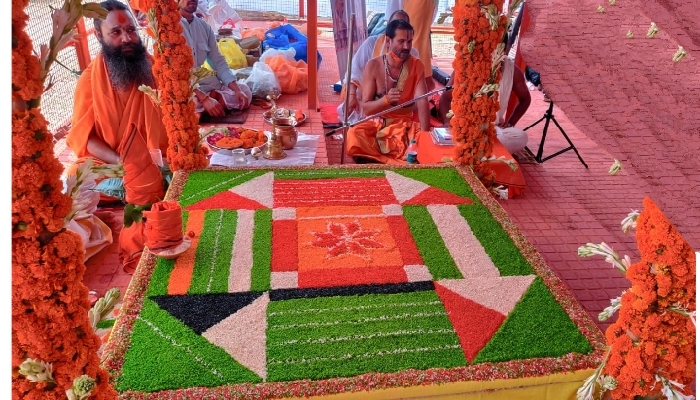
Ayodhya, Aug 4: Ramarchan puja begins at Ram Janmabhoomi site ahead of the foundation laying ceremony of Ram Temple in Ayodhya.
Ramarchan Puja is a prayer to invite all major gods and goddesses ahead of Lord Ram's arrival.

Mahesh Bhagchandka, one of the trustees of Ashok Singhal foundation as Yajman in the puja said, "This is being conducted at the temporary seat of Ramlalla. The pooja will be conducted in four phases."

Speaking about the third and fourth phases, he said: "In the third phase, Dashrath, father of Lord Ram with his wives will be worshipped and then all three brothers of Lord Ram - Laxman, Bharat and Shatrughan with their wives. Lord Hanuman ji will too be worshipped. Whereas in the fourth phase, Lord Ram will be worshipped."
Meanwhile, security has been heightened in Ayodhya ahead of the foundation laying ceremony.

Temples across the city is decorated with lights, diyas and flowers ahead of the grand event. Patna's Mahavir Mandir Trust is preparing over 1.25 lakh 'Raghupati Laddoos' for the occasion. Thes laddoos will be distributed as 'prasad' to devotees.

Uttar Pradesh Chief Minister Yogi Adityanath on Monday offered prayers at the Hanuman Garhi temple during his visit to Ayodhya to take stock of the preparations for the 'bhoomi pujan'.
He along with officials also visited 'Ram ki Paudi' to inspect the arrangements ahead of the foundation stone laying ceremony.

Prime Minister Narendra Modi is scheduled to lay the foundation stone of the Ram Temple in Ayodhya on August 5. 

Comments

Add new comment

  • Coastaldigest.com reserves the right to delete or block any comments.
  • Coastaldigset.com is not responsible for its readers’ comments.
  • Comments that are abusive, incendiary or irrelevant are strictly prohibited.
  • Please use a genuine email ID and provide your name to avoid reject.
Agencies
June 29,2020

From March through May, around 1 crore migrant workers fled India’s megacities, afraid to be unemployed, hungry and far from family during the world’s biggest anti-Covid-19 lockdown.

Now, as Asia’s third-largest economy slowly reopens, the effects of that massive relocation are rippling across the country. Urban industries don’t have enough workers to get back to capacity, and rural states worry that without the flow of remittances from the city, already poor families will be even worse off -- and a bigger strain on state coffers.

Meanwhile, migrant workers aren’t expected to return to the cities as long as the virus is spreading and work is uncertain. States are rolling out stimulus programs, but India’s economy is hurtling for its first contraction in more than 40 years, and without enough jobs, a volatile political climate gets more so.

“This will be a huge economic shock, especially for households of short-term, cyclical migrants, who tend to come from vulnerable, poor and low-caste and tribal backgrounds,” said Varun Aggarwal, a founder of India Migration Now, a research and advocacy group based in Mumbai.

In the first 15 days of India’s lockdown, domestic remittances dropped by 90%, according to Rishi Gupta, chief executive officer of Mumbai-based Fino Paytech Ltd., which operates the country’s biggest payments bank.

By the end of May, remittances were back to around 1750 rupees ($23), about half the pre-Covid average. Gupta’s not sure how soon it’ll fully recover. “Migrants are in no hurry to come back,” Gupta said. “They’re saying that they’re not thinking of going back at all.”

If workers stay in their home states long term, policymakers will have more than remittances to worry about. If consumption falls and the new surplus of labor drives wages down, Agarwal said, “there will also be a second-order shock to the local economy. Overall, not looking good.”

India announced a $277 billion stimulus package in May and followed it up with a $7 billion program aimed at creating jobs for 125 days for migrants in villages across 116 districts. Separately, local authorities are also looking for solutions.

Officials in Bihar have identified 2,500 acres of land that could be made available to investors, said Sushil Modi, deputy chief minister of Bihar, a state in east India. “We can use this crisis as an opportunity to speed up reforms,” he said.

The investors haven’t materialised yet, and in the meanwhile, state governments are relying on the national cash-for-work program that guarantees 100 days worth of wages per household.

Skilled workers don’t want to do manual labor offered through the program, and even if they did, says Amitabh Kundu of RIS, many think of it as beneath their station. “There will be an increase in social tensions,” he predicts. “Caste may again start playing a role. It’s absolute chaos.”

For skilled workers, initiatives vary:

* Uttar Pradesh, which received 3.2 million people, is compiling lists of skilled workers who need employment and trying to place them with local manufacturing and real estate industry associations. So far, the government says, it’s placed 300,000 people with construction and real estate firms.

* Bihar has placed returners in state-run infrastructure projects and hired others to stitch uniforms and make furniture for government-run schools, even as they waited in quarantine centres, said Pratyay Amrit, head of the state’s disaster management department.

* The eastern state of Odisha announced an urban wage employment program aimed at putting as many as 450,000 day labourers to work through September. Some 25,000 people have been employed, so far, under the scheme, G. Mathivathanan, principal secretary for housing and urban development said.

Attracting Investments

It’s not clear any of this will be enough to make a dent, says Ravi Srivastava, professor at New Delhi-based Institute of Human Development, adding that the states don’t have much of a track record on economic development.

“It was the failure of these states to improve governance and put development plans in place that led to the out-migration in the first place,” he said.

But officials and workers’ rights advocates see opportunity. Uttar Pradesh has established liaisons to encourage companies from the US, Japan and South Korea to establish manufacturing in the state. There and in Madhya Pradesh and Rajasthan, the government has made labour laws more friendly to employers, making it easier to hire and fire workers.

Modi, the minister from Bihar, said the migration may also give workers--historically a disenfranchised group--new power, particularly as urban centres struggle. “The way industries treated workers during the lockdown -- didn’t pay them, the living conditions were poor -- now these industries will realize the value of this force,” Modi said.

“In the days to come, labour will emerge as a force that can’t be ignored anymore,” he added. “That’s the new normal. We will work out how to ensure dignity, rights to our people who are going to work in other states.”

Bihar is due for elections by November, a vote that could be an early test of the mass migration’s political consequences. The state is currently governed by a coalition that includes Prime Minister Narendra Modi’s Bharatiya Janata Party. Amitabh Kundu, a fellow at the Research and Information System for Developing Countries, a New Delhi-based government think-tank, said migrant workers are likely to be angry voters.

“Chief ministers are telling these migrants that they will not have to go back for work,” he said. “But their capacity to do something miraculous in the next four to five months is doubtful. If they can retain even one-fourth of the migrants, I would call it a success.”


Comments

Add new comment

  • Coastaldigest.com reserves the right to delete or block any comments.
  • Coastaldigset.com is not responsible for its readers’ comments.
  • Comments that are abusive, incendiary or irrelevant are strictly prohibited.
  • Please use a genuine email ID and provide your name to avoid reject.