



Rain fury: Airport shut, Army assisting in rescue operations

December 2, 2015

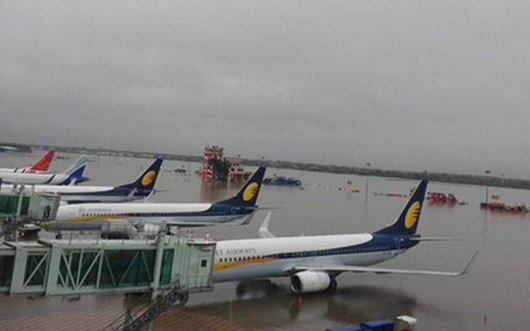
Chennai, Dec 2: Rain-ravaged Chennai was today crawling with air and road traffic severely hit as Army, Navy and NDRF teams stepped up rescue operations in worst-hit localities of the city that is also witnessing power outages.
02chennai3

The non-stop torrential rains pounding the city since last night showed some let up in the morning but the inundated streets left commuters stranded.

In view of the water logging, Chennai Airport authorities have shut operations till 6 AM tomorrow. All airlines, including Air India, have cancelled their operations from Chennai airport.

The Airports Authority of India has issued a NOTAM (Notice to Airmen) to all air operators in this regard, an AAI spokesperson said in New Delhi.

The spokesperson said Chennai airport authorities had initially shut operations till this morning but due to incessant rains it has now decided to extend it till 6 AM tomorrow.

Notice to Airmen (NOTAM) is a notice containing information concerning the establishment, condition, or change in any facility, service or procedure, among others, in airspace management.

Home Minister Rajnath Singh said in view of the situation, the Centre has deployed Army, Navy and NDRF teams in sufficient numbers.

"The Prime Minister has issued a memorandum and we have deployed our Central team there to assess the situation and make a report so that every possible help can also reach there," Singh said.

Two columns of army's Garrison Infantry Battalion have been pressed into service in Tambaram and Oorapakkam after the Tamil Nadu government sought military assistance.

The Navy has also been deployed to assist in the operations.

"More army personnel are coming to Chennai from Bengaluru," a Defence Public Relations official said.

Navy personnel have been deployed in Sadiapet area of Chennai to rescue people marooned in low-lying areas.

The NDRF is airlifting another 15 teams to the rain-battered state. While 10 teams are being airlifted from Bhubaneshwar to Tirupati, another five teams are being lifted from Delhi, NDRF DG O P Singh said.

Each team comprises 40 personnel.

The teams are also carrying 20 inflatable boats along with them for the rescue operations.

NDRF DIG and commanding officer have been stationed in Chennai to take stock of the operations, he said.

Singh said that he is also in constant touch with the Relief Commissioner of Tamil Nadu.
Defence Minister Manohar Parrikar said more forces will be deployed to tackle the situation.

However, "we are facing difficulty in bringing them (forces) there as the airport is also not operating," he said.

The rains that have virtually broken a 100-year-old record with one day's rainfall covering a month's average have flooded areas in Vadapalani, Valasaravakkam and Nandamvakkam as nearby lakes overflowed into the city.

The situation has worsened in suburban areas of Tambaram and Mudichur after the Chembarakam lake overflowed and an unprecedented 26,000 cusecs of water was released flooding the downstream areas. These areas had already suffered heavily during the earlier spells of rains.

A large part of the road near Madhya Kailash temple in the heart of the city in an area that connects the IT corridor has caved in resulting in a huge crater and disrupting traffic.

Even in hitherto unaffected areas, people have complained that water entered their homes and roads flooded with surging waters. Several areas in the city went without power as supply was cut as a safety precaution.

DG MeT Department Laxman Singh Rathore said, "Extremely heavy rainfall has been occurring for sometime and today Tamil Nadu has witnessed 35 cm of rainfall that has created havoc.

"Its intensity, however, will decrease in the next 48 hours and further by 72 hours but it is likely to continue for five-seven days," he said.

DMK MP Kanimozhi demanded that the Centre should declare it as a national disaster as it is not only Chennai that is affected but also coastal areas of Tamil Nadu.

"The rain is unrelenting and more rains have been predicted in another few more days. I really don't understand how state government can handle the situation. We need more resources, more help and everything has to be rushed quickly. We need whatever support Centre can give to the state government," she said.

Meanwhile, Spicejet has cancelled all its flights till tomorrow, while Jet Airways has cancelled all its flights to and from Chennai for today.

Budget carrier IndiGo has announced cancellation of all flights from Chennai.

"Due to heavy rains causing water logging on the Chennai runway all the inbound and outbound flights to and fro Chennai have been cancelled," Indigo tweeted

Comments

Add new comment

  • Coastaldigest.com reserves the right to delete or block any comments.
  • Coastaldigset.com is not responsible for its readers’ comments.
  • Comments that are abusive, incendiary or irrelevant are strictly prohibited.
  • Please use a genuine email ID and provide your name to avoid reject.
News Network
February 19,2020

Feb 19: Pay increases across India’s organized sector will probably grow at the slowest pace since 2009 this year, according to a survey from Aon Plc.

Companies will increase average pay by 9.1% in 2020, down from 9.3% in 2019 and 9.5% the previous year, Aon said in a report published Tuesday. The small increase reflects a deep slowdown in Asia’s third-largest economy, where growing pessimism about job prospects have led many to cut down on consumption -- the main driver to growth.

India still leads the Asia-Pacific region in pay rises, but that is mainly due to higher inflation and a “war for key talent and niche skills,” Aon said.

“There is a general air of caution about the economy as we enter into 2020,” Tzeitel Fernandes, partner for rewards solutions at Aon, told reporters in New Delhi. “Low GDP projection and weak consumer sentiment are the reasons behind our lowest ever prediction.”

E-commerce companies and start-ups will probably get the biggest salary increases, projected at an above-average 10%, while financial institutions will hand out 8.5%. Unsurprisingly, the auto sector witnessed the biggest drop in growth -- down to 8.3% from 10.1% in 2018, according to Aon. The survey covered more than 1,000 companies across over 20 industries.

Comments

Add new comment

  • Coastaldigest.com reserves the right to delete or block any comments.
  • Coastaldigset.com is not responsible for its readers’ comments.
  • Comments that are abusive, incendiary or irrelevant are strictly prohibited.
  • Please use a genuine email ID and provide your name to avoid reject.
News Network
January 13,2020

Jan 13: For the first time in years, the government of India’s Prime Minister Narendra Modi is playing defense. Protests have sprung up across the country against an amendment to India’s laws — which came into effect on Friday — that makes it easier for members of some religions to become citizens of India. The government claims this is simply an attempt to protect religious minorities in the Muslim-majority countries that border India; but protesters see it as the first step toward a formal repudiation of India’s constitutionally guaranteed secularism — and one that must be resisted.

Modi was re-elected prime minister last year with an enhanced majority; his hold over the country’s politics is absolute. The formal opposition is weak, discredited and disorganized. Yet, somehow, the anti-Citizenship Act protests have taken hold. No political party is behind them; they are generally arranged by student unions, neighborhood associations and the like.

Yet this aspect of their character is precisely what will worry Modi and his right-hand man, Home Minister Amit Shah. They know how to mock and delegitimize opposition parties with ruthless efficiency. Yet creating a narrative that paints large, flag-waving crowds as traitors is not quite that easy.

For that is how these protests look: large groups of young people, many carrying witty signs and the national flag. They meet and read the preamble to India’s Constitution, into which the promise of secularism was written in the 1970’s.

They carry photographs of the Constitution’s drafter, the Columbia University-trained economist and lawyer B. R. Ambedkar. These are not the mobs the government wanted. They hoped for angry Muslims rampaging through the streets of India’s cities, whom they could point to and say: “See? We must protect you from them.” But, in spite of sometimes brutal repression, the protests have largely been nonviolent.

One, in Shaheen Bagh in a Muslim-dominated sector of New Delhi, began simply as a set of local women in a square, armed with hot tea and blankets against the chill Delhi winter. It has now become the focal point of a very different sort of resistance than what the government expected. Nothing could cure the delusions of India’s Hindu middle class, trained to see India’s Muslims as dangerous threats, as effectively as a group of otherwise clearly apolitical women sipping sweet tea and sharing their fears and food with anyone who will listen.

Modi was re-elected less than a year ago; what could have changed in India since then? Not much, I suspect, in most places that voted for him and his party — particularly the vast rural hinterland of northern India. But urban India was also possibly never quite as content as electoral results suggested. India’s growth dipped below 5% in recent quarters; demand has crashed, and uncertainty about the future is widespread. Worse, the government’s response to the protests was clearly ill-judged. University campuses were attacked, in one case by the police and later by masked men almost certainly connected to the ruling party.

Protesters were harassed and detained with little cause. The courts seemed uninterested. And, slowly, anger began to grow on social media — not just on Twitter, but also on Instagram, previously the preserve of pretty bowls of salad. Instagram is the one social medium over which Modi’s party does not have a stranglehold; and it is where these protests, with their photogenic signs and flags, have found a natural home. As a result, people across urban India who would never previously have gone to a demonstration or a political rally have been slowly politicized.

India is, in fact, becoming more like a normal democracy. “Normal,” that is, for the 2020’s. Liberal democracies across the world are politically divided, often between more liberal urban centers and coasts, and angrier, “left-behind” hinterlands. Modi’s political secret was that he was that rare populist who could unite both the hopeful cities and the resentful countryside. Yet this once magic formula seems to have become ineffective. Five of India’s six largest cities are not ruled by Modi’s Bharatiya Janata Party in any case — the financial hub of Mumbai changed hands recently. The BJP has set its sights on winning state elections in Delhi in a few weeks. Which way the capital’s voters will go is uncertain. But that itself is revealing — last year, Modi swept all seven parliamentary seats in Delhi.

In the end, the Citizenship Amendment Act is now law, the BJP might manage to win Delhi, and the protests might die down as the days get unmanageably hot and state repression increases. But urban India has put Modi on notice. His days of being India’s unifier are over: From now on, like all the other populists, he will have to keep one eye on the streets of his country’s cities.

Comments

Add new comment

  • Coastaldigest.com reserves the right to delete or block any comments.
  • Coastaldigset.com is not responsible for its readers’ comments.
  • Comments that are abusive, incendiary or irrelevant are strictly prohibited.
  • Please use a genuine email ID and provide your name to avoid reject.
News Network
May 29,2020

New Delhi, May 29: Union Home Minister Amit Shah on Friday met Prime Minister Narendra Modi and informed him about the views of all chief ministers on the extension of the ongoing nationwide lockdown beyond May 31, officials said.

During the meeting, Shah briefed Modi about the suggestions and the feedback he received from the chief ministers during his telephonic conversations on Thursday, a government official said.

The nationwide curbs were first announced by Prime Minister Narendra Modi on March 24 for 21 days in a bid to contain the spread of novel coronavirus. It was first extended till May 3 and then again till May 17. The lockdown was further extended till May 31.

The home minister's telephonic conversations with the chief ministers came just three days before the end of the fourth phase of the lockdown.

During his talks with the chief ministers, Shah sought to know the areas of concern of the states and the sectors they want to open up further from June 1, the official said.

Interestingly, till now, it was Modi who had interacted with all chief ministers through video conference before the extension of each phase of the coronavirus-induced lockdown and sought their views.

This was for the first time that the home minister spoke to the chief ministers individually before the end of another phase of the lockdown.

Shah was present in all the conferences of chief ministers along with the prime minister. It is understood that the majority of the chief ministers wanted the lockdown to continue in some form but also favoured opening up of the economic activities and gradual return of the normal life, another official said.

The central government is expected to announce its decision on the lockdown within the next two days.

The number of COVID-19 cases in India has climbed to 1,65,799 on Friday, making it the world's ninth worst-hit country by the coronavirus pandemic.

The Health Ministry said the death toll due to COVID-19 rose to 4,706 in the country. While extending the fourth phase of the lockdown till May 31, the central government had announced the continuation of the prohibition on the opening of schools, colleges and malls but allowed the opening of shops and markets.

It said hotels, restaurants, cinema halls, malls, swimming pools, gyms will remain shut even as all social, political, religious functions, and places of worship will remain closed till May 31.

The government, however, allowed limited operations of the train and domestic flights. The Indian Railways is also running special trains since May 1 for transportation of migrant workers from different parts of the country to their native states.

Comments

Add new comment

  • Coastaldigest.com reserves the right to delete or block any comments.
  • Coastaldigset.com is not responsible for its readers’ comments.
  • Comments that are abusive, incendiary or irrelevant are strictly prohibited.
  • Please use a genuine email ID and provide your name to avoid reject.