Rains continue to lash Mangaluru, other parts of Karnataka

[email protected] (CD Network)
May 13, 2016

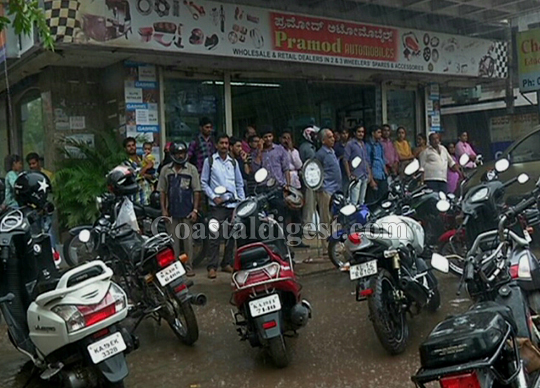
Mangaluru, May 12: Moderate to heavy rains coupled with lighting and thunders continued to lash Mangaluru and other parts of Dakashina Kannada district for the second consecutive day on Thursday.

rain

The pre-monsoon showers have brought a great relief to the people in coastal Karnataka.

The rains accompanied with lightning and thunder lashed Belthangady, Sullia and Puttur taluks too. Though power supply was disrupted in many areas, the rains have brought hope of water reaching Thumbe dam, which supplies drinking water to Mangaluru.

According to a press release issued by mayor on Wednesday, the water-level at Thumbe dam is enough only for a day.

Other parts of Karnataka

Several districts in Karnataka state also continued to receive good rainfall on Thursday.

Stray incidents of rain-related damages have been reported from various parts of the state. Heavy rains lashed Belagavi city and the surrounding villages in Belagavi taluk and at M K Hubli town and the surrounding villages in Bailhongal taluk for about an hour on Thursday evening. Downpour also provided respite from scorching heat, bringing down day-time temperatures.

Rains combined with winds and thunders resulted in crop loss and roof tiles of a few houses blew away at M K Hubli, causing huge losses.

Cloudy environs prevailed in Belagavi taluk since noon and the skies opened up in the evening for about an hour. Strong winds and thunders accompanied the downpour. City and most of the villages received heavy rains bringing the temperature down. There were no reports of damages related to rainfall.

At M K Hubli, a woman suffered injuries after the roof tiles of a few houses blew away in the heavy downpour that was accompanied by winds. Banana plantains cultivated by farmers in M K Hubli and the surrounding areas were damaged.

Mundgod, Yellapur, Sirsi and Siddapur taluks in Uttar Kannada district received good rainfall on Thursday.

Banana plantations cultivated on at least 50 acres of land have been destroyed in the rains, accompanied by gusty winds.

Various taluk places in the district, including Shivamogga city, received moderate rainfall, accompanied by thunder and lightning. Sagar, Bhadravathi, Hosanagar and Thirthahalli taluks have received good rainfall.

Lighting claims a life

A daily wage labourer lost her life and three others suffered injuries after lightning struck them on Thursday in Chikkamagaluru.

The deceased, Rathnamma (52), was a resident of Sintikere village in Arsikere taluk. The injured are Ratna, Sharada and Basamma, all from the same village. All of them were working in a coffee plantation and were taking shelter under a tree after lunch when the lightning struck them. The rains lashed for about an hour in Mudigere and surrounding areas too.


rainm 1

rainm 2

rainm 3

rainm 4

rainm 5

rainm 6

rainm 7

rainm 8

rainm 9

rainm 10

rainm 11

rainm 12

rainm 13

rainm 14

rainm 15

rainm 16

Comments

Mohan K S
 - 
Friday, 13 May 2016

wow enjoyed alot, now we are facing heavy heat here, 12.59pm

Gowrav
 - 
Friday, 13 May 2016

missed it, will be coming to mangalore next month. rainy season in mangalore is just awesome.

Chinthamani
 - 
Friday, 13 May 2016

finally water crises came to an end i suppose.

gyan
 - 
Friday, 13 May 2016

wow love the mangalore rain.

Shiva
 - 
Friday, 13 May 2016

wow cold shower. thanks to mother rain,

Add new comment

  • Coastaldigest.com reserves the right to delete or block any comments.
  • Coastaldigset.com is not responsible for its readers’ comments.
  • Comments that are abusive, incendiary or irrelevant are strictly prohibited.
  • Please use a genuine email ID and provide your name to avoid reject.
Wafa Sultana
April 4,2020

Over the last couple of days when the world was occupied with unifying efforts to fight the deadly Covid19 pandemic, sections of Indian media provided viewers a familiar scapegoat – the Indian Muslims – who are often stereotyped as a community being constantly at loggerheads with the citizenry and the State. Biased media channels were quick to resort to blaming the entire Muslim community for the spread of the disease in the country, thanks to an ill-timed Tablighi Jamaat gathering at its international headquarters in Delhi’s Nizamuddin. Unsurprisingly, the opprobrium was also marked by a sudden spike in WhatsApp forwards of videos with people wearing skullcaps licking spoons and performing Sufi breathing rituals, suggesting some sort of wild conspiracy on the part of the community to spread the virus.  Some media channels were quick to formulate, hypothesize and provide loose definitions of a newly discovered form of Jihad i.e. ‘Corona Jihad ’ thereby vilifying the Islamic faith and its followers.

While the investigation on the culpability of the organizers of the Nizamuddin event is still ongoing, there is enough information to suggest that the meeting was held before any lockdown was in force, and the problem began when there was no way of getting people out once the curfew was announced. Be that as it may, there is little doubt that organizing a meet of such a scale when there is a global pandemic smacks of gross misjudgment, and definitely the organizers should be held accountable if laws or public orders were defied. Attendees who attempt to defy quarantine measures must be dealt with strictly. However, what is alarming is that the focus and narrative have now shifted from the unfortunate event at Nizamuddin to the Tablighi Jamaat itself.

For those not familiar with the Tablighi Jamaat, the organization was founded in 1926 in Mewat by scholar Maulana Mohammad Ilyas. The Jamaat’s main objective was to get Muslim youth to learn and practice pristine Islam shorn of external influences. This is achieved through individuals dedicating time for moral and spiritual upliftment secluded from the rest of the world for a brief period of time. There is no formal membership process. More senior and experienced participants typically travel from one mosque to other delivering talks on religious topics, inviting local youth to attend and then volunteer for a spiritual retreat for a fixed number of days to a mosque in a nearby town or village to present the message to their co-religionists. Contrary to ongoing Islamophobic rhetoric, the movement does not actively proselytize. The focus is rather on getting Muslims to learn the teachings and practices of Islam.  This grassroots India-based movement has now grown to almost all countries with substantial Muslim populations. Its annual meets, or ‘ijtemas’ are among the largest Islamic congregations in the world after the annual Haj. One of the reasons for its popularity and wide network in the subcontinent and wordwide is the fact that it has eschewed the need for scholarly intervention, focusing on peer learning of fundamental beliefs and practice rather than high-falutin ideological debates. The Tablighi Jamaat also distinguishes itself from other Islamic movements through its strictly apolitical nature, with a focus on individual self-improvement rather than political mobilization. Hardships and difficulty in the world are expected to be face through ‘sabr’ (patience) and ‘dua’ (supplication),  than through quest for political power or influence. In terms of ideology, it is very much based on mainstream Sunni Islamic principles derived from the Deobandi school.

So, why is all this background important in the current context? While biased media entities have expectedly brought out their Islamophobic paraphernalia out for full display, more neutral commentators have tried to paint the Tablighi Jamaat as a fringe group and have tried to distance it from 'mainstream Muslims'. While the intent is no doubt innocent, this is a trap we must not fall into. This narrative, unfortunately, is also gaining ground due to apathy some Muslims have for the group, accusing it of being “disconnected from the realities of the world”. Unlike other Muslim organizations and movements, the Tablighi Jamat, by virtue of its political indifference, does not boast of high-profile advocates and savvy spokespersons who can defend it in mainstream or social media.  The use of adjectives such as 'outdated' and 'orthodox' by liberal columnists to describe the Jamaat feeds into the malignant attempt to change the narrative from the control of the spread of the pandemic due to the Nizamuddin gathering to 'raison d'etre' of the organization itself.

A large mainstream religious group like the Tablighi Jamaat with nearly a hundred-year history, normally considered to be peaceful, apolitical and minding its own business is now suddenly being villainized owing to unfortunate circumstances. Biased media reactions filled with disgust and hate seem to feed the Indian public conscience with a danngerous misconception - to be a nominal Muslim is okay but being a practicing one is not.  For those committed to the truth and fighting the spread of Islamophobia, the temptation to throw the entire Tablighi Jamaat under the bus must be resisted.

The writer is a lawyer and research scholar at Qatar University. Her research interests include Islamic law and politics.

Comments

zahoorahmed
 - 
Saturday, 4 Apr 2020

great article! provides a great perspective on tableeg jamat

Add new comment

  • Coastaldigest.com reserves the right to delete or block any comments.
  • Coastaldigset.com is not responsible for its readers’ comments.
  • Comments that are abusive, incendiary or irrelevant are strictly prohibited.
  • Please use a genuine email ID and provide your name to avoid reject.
News Network
March 15,2020

While it makes perfect sense for IT employees to work from remote locations via video conferencing and collaboration tools seamlessly - especially in the case of tech giants like Google or Microsoft -- workers from the non-IT companies and small and medium enterprises (SMBs) are the worst-hit in India as most of them have little or no clue about how these messaging and collaboration tools work amid the coronavirus pandemic.

Small companies -- from corporate to education verticals -- are scrambling to get their act together as new coronavirus threat has reached their premises, prompting them to send employees home who have age-old laptops, poor network and connectivity with no UPS backups and little knowledge about how to handle group chat and collaboration software like Zoom, Google Hangouts Meet, Microsoft Teams and Flock etc.

Instead of halting operations, however, businesses can choose to shift towards remote working methods with teaching non-IT staff on how to use the latest digital software to connect and work, say industry experts.

The training will take some time and may hamper productivity in the short run but is a win-win situation for the non-tech companies in the long run, in case any such global emergency arises in the future.

According to a latest report by Gartner, 54 per cent of HR leaders have cited that poor technology and/or infrastructure for remote working is the biggest barrier to effective remote working.

Sandy Shen, Senior Director Analyst, Gartner, says that with COVID-19 disrupting the business landscape, CIOs should relook at the digital fulfillment of market demand.

"The value of digital channels, products and operations is immediately obvious to companies everywhere right now. This is a wake-up call for organisations that have placed too much focus on daily operational needs at the expense of investing in digital business and long-term resilience," warned Shen.

Businesses that can shift technology capacity and investments to digital platforms will mitigate the impact of the outbreak and keep their companies running smoothly now, and over the long term.

"Videoconferencing, messaging, collaboration tools and document sharing are just a few examples of technologies that facilitate remote work. Additional bandwidth and network capacity may also be needed, given the increasing number of users and volume of communications," informed Shen.

The IT industry's apex body Nasscom has asked the government to relax norms for a month to allow work-from-home for technology and back-office employees as a measure to deal with the spread of Covid-19 in India.

Networking giant Cisco said that it has seen "significant growth" in the usage of its web conferencing and video-conferencing service Webex in India.

According to Muneer Ahmad, Business Head, ViewSonic India, due to COVID-19 pandemic, the corporate and educational sector is severely getting affected in the country.

"ViewSonic IFP has a cloud-based software which help teachers and corporates to connect through video conferencing to multiple people at the same time and can split the screen into six screens. It can also connect with various tools like Skype, Cisco WebEx, Zoom, Google Hangouts and GoToMeeting," Ahmad told IANS.

Co-working sector has also taken a hit and the industry is looking at several measures to tackle it -- from ensuring supply of juices rich in Vitamin C to supply of disinfectants and giving work from home facilities.

"The scheduled visits of the clients at our co-working offices have been postponed. Few of our clients have cancelled their outstation meetings and have now started audio/video conferencing for virtual meetings," said Nakul Mathur, MD, Avanta India.

According to reports, India has approximately 1,000 co-working locations (as of September 2019) and is the second-largest market for the co-working industry after China.

As India's first licensed B2B Virtual Network Operator, CloudConnect Communications offers a collaborative platform that allows companies to overcome the COVID-19 threat while maintaining seamless business continuity and optimum employee productivity.

"We offer a secure, robust, reliable, scalable and trackable mobile-first unified communication infrastructure that aids remote teleworking so that businesses can continue operating even under any unforeseen circumstances," said Gokul Tandon, Executive Chairman, CloudConnect Communications.

Comments

Add new comment

  • Coastaldigest.com reserves the right to delete or block any comments.
  • Coastaldigset.com is not responsible for its readers’ comments.
  • Comments that are abusive, incendiary or irrelevant are strictly prohibited.
  • Please use a genuine email ID and provide your name to avoid reject.
News Network
March 12,2020

Bhopal, Mar 12: Madhya Pradesh Congress on Thursday alleged that two of its ministers who had gone to Bengaluru to meet the rebel party legislators were assaulted.

"Two of our ministers Jitu Patwari and Lakhan Singh had gone to Bengaluru. They were assaulted, we have info that our ministers have been arrested," Madhya Pradesh Congress leader said during a press conference.

Congress further warned that if the police don't take action, the party will take it to the court.

Some of the rebel MLAs had said in a video on Wednesday that they were in Bengaluru out of their own will.

The rebel MLAs have been staying in Bengaluru over the past few days.

Comments

Add new comment

  • Coastaldigest.com reserves the right to delete or block any comments.
  • Coastaldigset.com is not responsible for its readers’ comments.
  • Comments that are abusive, incendiary or irrelevant are strictly prohibited.
  • Please use a genuine email ID and provide your name to avoid reject.