Rains wreak havoc in Makkah, Hail

[email protected] (Arab News)
May 10, 2014

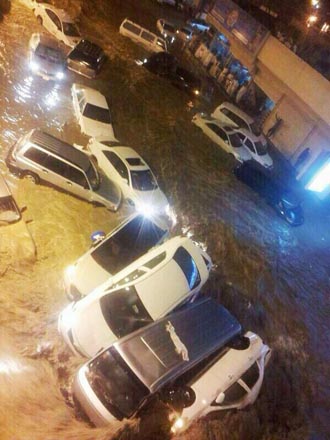
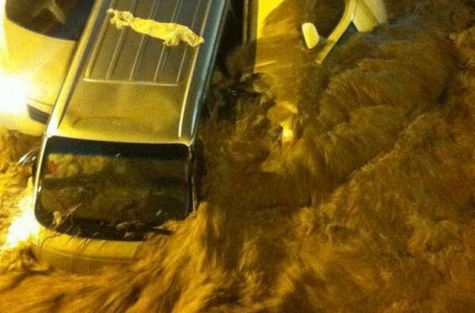
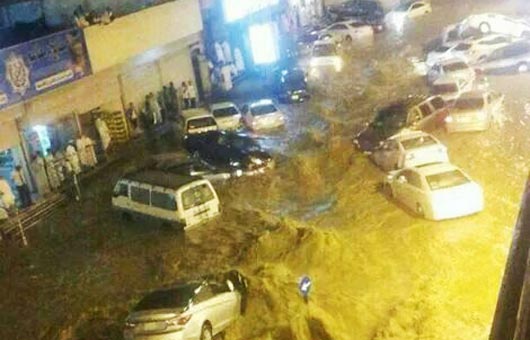
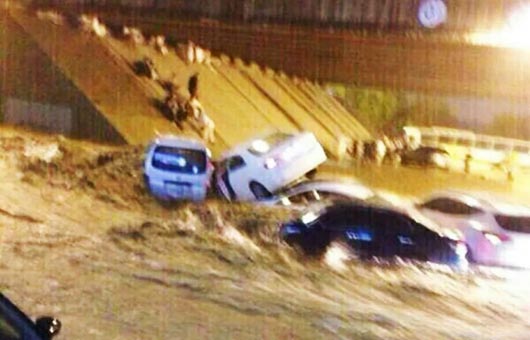
Makkah_HailMakkah/Hail, May 10: Floods caused by torrential rain swept through parts of Makkah and Hail on Thursday killing two people and injuring several others.

The flooding also caused power cuts and damaged hundreds of cars across Makkah neighborhoods, according to eyewitnesses.

Thousands of Umrah pilgrims were stranded inside the Grand Mosque after Maghrib, many only able to reach their accommodation after midnight, according to eyewitnesses. Worshippers prayed Isha in the heavy rain.

The Civil Defense in Hail said five brothers driving in a four-wheel-drive vehicle tried to cross the flooded Al-Khafj Valley. The force of the water overturned their vehicle.

Maj. Nafea bin Alian Al-Makhalafa, media spokesperson of the Civil Defense in Hail, said that one brother had rescued three of his brothers. The fifth brother was trapped inside the vehicle and drowned.

Brig. Col. Saleh Al-Alyani, spokesperson for the Civil Defense in Makkah, said an African expatriate died in Mansour district when a tree fell on him. The police are investigating, he said.

Al-Alyani said the organization's operations room received 1,356 emergency calls, mostly about cars caught up in the floods, falling trees and power cuts. A special operations room has been set up in Makkah to monitor the situation and coordinate relief and evacuation efforts, he said.

The Civil Defense deployed helicopters, 23 patrols and 16 rescue teams with heavy machinery for emergency operations. It also sent 32 officers and six staff members on motorbikes to the Grand Mosque to assist pilgrims.

The Saudi Electricity Company said its engineers and technicians were monitoring the situation in Makkah.

Mohammed Abdul Raheem, a pilgrim, said. “It was extremely pleasurable to perform Tawaf amid the heavy rain and thunder.”

The courtyards of the Grand Mosque were deserted. This included the area popular with pilgrims outside King Abdulaziz Gate. There was not a single person sitting or sleeping there, said Mohammed Akbar Abubaker, who works and lives opposite the Grand Mosque in Makkah. He told Arab News that the rainfall was unusual for this time of the year.

Part of the roof of a leading hypermarket inside the Makkah Mall collapsed but no one was hurt, according to eyewitness Mohammed Hammed. He told Arab News that his friend's car was swept away by floodwaters at Souk Hijaz shopping mall on Jeddah Road.

The flooding also damaged hundreds of cars in other parts of Makkah including Sharayah, Aziziyah, Misfalah, and Otaibiah, according to residents of these areas who spoke over the phone.

The Jeddah-Makkah Expressway was briefly closed on Thursday night because of the flooding. The highway to Riyadh near Hada Mountain remained closed on Friday as a precautionary measure.

The Civil Defense warned that there was a possibility of more rain, thunder and lightning across Makkah, Jeddah and Hail, and urged the public to be alert.
Rainy_makkh_1

Rainy_makkh_1

Rainy_makkh_1

Comments

Mckenzie
 - 
Monday, 9 May 2016

So sites with excellent quality content become valuable to search engines.
They do their level best to make a site attractive and beautiful.

Many organisations are finding that they have a better
outcome when they employ a service to perform
their London web design as well as Facebook development and social media UK options.

My site :: NetEvolution.co.uk: https://www.netevolution.co.uk/project/avenue-estates/

Add new comment

  • Coastaldigest.com reserves the right to delete or block any comments.
  • Coastaldigset.com is not responsible for its readers’ comments.
  • Comments that are abusive, incendiary or irrelevant are strictly prohibited.
  • Please use a genuine email ID and provide your name to avoid reject.
News Network
March 10,2020

Belagavi, Mar 10: Around 6,000 chickens were buried alive by some poultry farm owners here as the rate of flesh in the market dropped even below the cost price due to Coronavirus scare.

The poultry farm who buried the chickens on Monday evening belonged to Lolasuru village in Gokak Taluk of the district.

One of the owners, Nazir Makandar, said that there was no demand for chicken because of threat of Coronavirus.

Comments

Gajagamini
 - 
Tuesday, 10 Mar 2020

we are ready to destroy food but wont allow poor to eat it

Add new comment

  • Coastaldigest.com reserves the right to delete or block any comments.
  • Coastaldigset.com is not responsible for its readers’ comments.
  • Comments that are abusive, incendiary or irrelevant are strictly prohibited.
  • Please use a genuine email ID and provide your name to avoid reject.
Wafa Sultana
April 4,2020

Over the last couple of days when the world was occupied with unifying efforts to fight the deadly Covid19 pandemic, sections of Indian media provided viewers a familiar scapegoat – the Indian Muslims – who are often stereotyped as a community being constantly at loggerheads with the citizenry and the State. Biased media channels were quick to resort to blaming the entire Muslim community for the spread of the disease in the country, thanks to an ill-timed Tablighi Jamaat gathering at its international headquarters in Delhi’s Nizamuddin. Unsurprisingly, the opprobrium was also marked by a sudden spike in WhatsApp forwards of videos with people wearing skullcaps licking spoons and performing Sufi breathing rituals, suggesting some sort of wild conspiracy on the part of the community to spread the virus.  Some media channels were quick to formulate, hypothesize and provide loose definitions of a newly discovered form of Jihad i.e. ‘Corona Jihad ’ thereby vilifying the Islamic faith and its followers.

While the investigation on the culpability of the organizers of the Nizamuddin event is still ongoing, there is enough information to suggest that the meeting was held before any lockdown was in force, and the problem began when there was no way of getting people out once the curfew was announced. Be that as it may, there is little doubt that organizing a meet of such a scale when there is a global pandemic smacks of gross misjudgment, and definitely the organizers should be held accountable if laws or public orders were defied. Attendees who attempt to defy quarantine measures must be dealt with strictly. However, what is alarming is that the focus and narrative have now shifted from the unfortunate event at Nizamuddin to the Tablighi Jamaat itself.

For those not familiar with the Tablighi Jamaat, the organization was founded in 1926 in Mewat by scholar Maulana Mohammad Ilyas. The Jamaat’s main objective was to get Muslim youth to learn and practice pristine Islam shorn of external influences. This is achieved through individuals dedicating time for moral and spiritual upliftment secluded from the rest of the world for a brief period of time. There is no formal membership process. More senior and experienced participants typically travel from one mosque to other delivering talks on religious topics, inviting local youth to attend and then volunteer for a spiritual retreat for a fixed number of days to a mosque in a nearby town or village to present the message to their co-religionists. Contrary to ongoing Islamophobic rhetoric, the movement does not actively proselytize. The focus is rather on getting Muslims to learn the teachings and practices of Islam.  This grassroots India-based movement has now grown to almost all countries with substantial Muslim populations. Its annual meets, or ‘ijtemas’ are among the largest Islamic congregations in the world after the annual Haj. One of the reasons for its popularity and wide network in the subcontinent and wordwide is the fact that it has eschewed the need for scholarly intervention, focusing on peer learning of fundamental beliefs and practice rather than high-falutin ideological debates. The Tablighi Jamaat also distinguishes itself from other Islamic movements through its strictly apolitical nature, with a focus on individual self-improvement rather than political mobilization. Hardships and difficulty in the world are expected to be face through ‘sabr’ (patience) and ‘dua’ (supplication),  than through quest for political power or influence. In terms of ideology, it is very much based on mainstream Sunni Islamic principles derived from the Deobandi school.

So, why is all this background important in the current context? While biased media entities have expectedly brought out their Islamophobic paraphernalia out for full display, more neutral commentators have tried to paint the Tablighi Jamaat as a fringe group and have tried to distance it from 'mainstream Muslims'. While the intent is no doubt innocent, this is a trap we must not fall into. This narrative, unfortunately, is also gaining ground due to apathy some Muslims have for the group, accusing it of being “disconnected from the realities of the world”. Unlike other Muslim organizations and movements, the Tablighi Jamat, by virtue of its political indifference, does not boast of high-profile advocates and savvy spokespersons who can defend it in mainstream or social media.  The use of adjectives such as 'outdated' and 'orthodox' by liberal columnists to describe the Jamaat feeds into the malignant attempt to change the narrative from the control of the spread of the pandemic due to the Nizamuddin gathering to 'raison d'etre' of the organization itself.

A large mainstream religious group like the Tablighi Jamaat with nearly a hundred-year history, normally considered to be peaceful, apolitical and minding its own business is now suddenly being villainized owing to unfortunate circumstances. Biased media reactions filled with disgust and hate seem to feed the Indian public conscience with a danngerous misconception - to be a nominal Muslim is okay but being a practicing one is not.  For those committed to the truth and fighting the spread of Islamophobia, the temptation to throw the entire Tablighi Jamaat under the bus must be resisted.

The writer is a lawyer and research scholar at Qatar University. Her research interests include Islamic law and politics.

Comments

zahoorahmed
 - 
Saturday, 4 Apr 2020

great article! provides a great perspective on tableeg jamat

Add new comment

  • Coastaldigest.com reserves the right to delete or block any comments.
  • Coastaldigset.com is not responsible for its readers’ comments.
  • Comments that are abusive, incendiary or irrelevant are strictly prohibited.
  • Please use a genuine email ID and provide your name to avoid reject.
News Network
May 24,2020

Bengaluru, May 24: Karnataka Tourism Minister CT Ravi said that coronavirus lockdown has severely marred the tourism industry in the state and the government will revive it in a phased manner.

"It would be beneficial if hotels are opened keeping in mind few restrictions. At present, the tourism industry has fallen flat making it very difficult to promote tourism in the state," Ravi said.

"Our department has planned to promote tourism in a phased manner. In the first phase, we would focus on native tourism; then in the second phase, we will promote inter-district travel; in the third phase, we will put weight behind inter-state tourism and in the fourth phase, we would be promoting international travel and tourism," he added.

Karnataka's COVID-19 count surges to 1,958 with 216 new cases of the virus reported in the last 24 hours, said the Health Department in a bulletin on Saturday.

Out of the total number of cases, 1,307 patients are active cases and 608 patients have been discharged. The total number of fatalities due to COVID-19 in the state has risen to 42.

Comments

Add new comment

  • Coastaldigest.com reserves the right to delete or block any comments.
  • Coastaldigset.com is not responsible for its readers’ comments.
  • Comments that are abusive, incendiary or irrelevant are strictly prohibited.
  • Please use a genuine email ID and provide your name to avoid reject.