


Ramanath Rai called Poojary “Ra***maga”: Harikrishna Bantwal

CD Network | Sumedha V
June 28, 2017

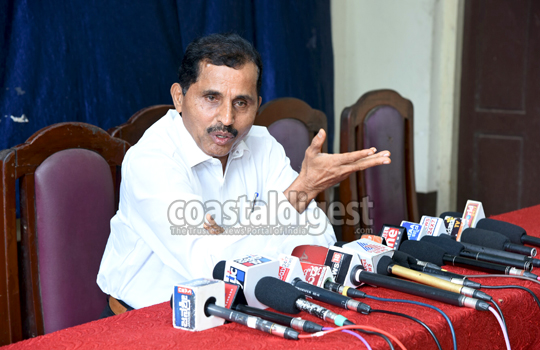
Mangaluru, Jun 28: Expelled Congress leader Harikrishna Bantwal has accused Dakshina Kannada district in-charge minister B Ramanath Rai of abusing Congress veteran B Janardhana Poojary in public and igniting communal clashes in Bantwal for political gains.
harishkrishna

Speaking to media persons in the city on Wednesday, Mr Bantwal, “revealed” that Mr Rai had used Tulu Nadu’s extreme derogatory words like “‘ra***maga’ and ‘nayisoo***maga’” against Mr Poojary in a fully crowded wedding hall nearly five months ago.

“MR Rai had attended a certain Rajesh’s wedding in Surathkal Buntara Bhavana on February 6, 2017. Local Congress leaders Arun Coelho and Tejaswi Raj too were present there. Mr Rai asked them where Mr Poojary was using the above mentioned words and further abused him in Tulu,” he said.

Interestingly, Mr Bantwal revealed the five month old incident for the first time a day after Harish Kumar, a leader of Billava community was made the president of Dakshina Kannada district Congress Committee. The appointment was seen as an apparent attempt by the Congress to woo Billavas in the coastal district in the wake of community stalwart Janardhana Poojary’s dissidence with the party leaders.

Lashing out at the Bunt stalwart, Mr Bantwal said that Mr Rai owes his political position today to Mr Poojary. “Back in 1985, when Mr Rai was nobody in the party, he secured the ticket to contest from Bantwal constituency because of Mr Poojary,” he said.

“Billawas and Bunts are the majority and strengths of this region. They cannot be without each other. We do not believe in seeing them as different communities. But some people always get caste into politics”, he said.

He also said that national leaders like Indira Gandhi, Rajiv Gandhi, Atal Bihari Vajpayee, A K Anthony always praised Mr Poojary and called him an honest politician, but Rai never valued him.

Justifying Mr Poojary’s recent outburst against his own party men in the state, Mr Bantwal said: “This is a democracy. People are allowed to criticize others.”

“Though Mr Poojary often criticized the chief minister, the former never used any unconstitutional or derogatory words against anyone”, he added. Calling Mr Rai an unfaithful and ungrateful, he said that Dakshina Kannada doesn’t need a politician like Mr Rai.

Mr Bantwal went on to say that being a follower of Sri Narayana Guru, he believed in being true to his religion, but also being an Indian first. “Nobody likes to fight. Some greedy politicians like Mr Rai create communal clashes for vote bank. Transferring police officers won’t solve problems in Bantwal. It is Mr Rai who needs to be stripped off his power to restore peace here”, he said.

Mr Bantwal also accused Mr Rai of always being on the side of ‘note and vote’. He called him a ‘modern day Shishupala’ and said that ‘Krishna’ had waited long enough and cannot hold it in anymore, it is time to show Mr Rai’s true colors to the people who voted him to power.

Comments

Chidu
 - 
Wednesday, 28 Jun 2017

Ra*** maga means what? Raayara Maga?

ahmed
 - 
Thursday, 29 Jun 2017

Ra***maga means Raithana maga tats all

Add new comment

  • Coastaldigest.com reserves the right to delete or block any comments.
  • Coastaldigset.com is not responsible for its readers’ comments.
  • Comments that are abusive, incendiary or irrelevant are strictly prohibited.
  • Please use a genuine email ID and provide your name to avoid reject.
News Network
June 12,2020

Bengaluru, June 12: The Karnataka government has withdrawn its notification that allowed factories to extend working hours up to 10 hours a day and 60 hours a week, with immediate effect.

The extension of work hours was from eight hours a day and 48 hours a week. On May 22, the government had exempted all the factories registered under the Factories Act, from the provisions of Section 51 (weekly hours) and Section 54 (daily hours), till August 21 subject to certain conditions.

"Whereas, having examined the provisions further, the Government of Karnataka now intends to withdraw the said notification," the state government in a fresh notification dated June 11 said.

It said, "Therefore, in exercise of the powers conferred under Section 5 of Factories Act, 1948 (Act No. 63 of 1948), the Government of Karnataka hereby withdraws the Notification dated 22-05-2020 with immediate effect."

According to the Karnataka Employers' Association, a petition was filed in the High Cour challenging the May 22 notification as "illegal, arbitrary and in violation" of Section 5 of the Factories Act which permits exemption from any of the provisions of the Factories Act only in case of Public Emergencies'.

During the course of hearing on June 11 an observation was made by the High Court, that it may have to quash the notification unless the government clarifies as to what is the 'Public Emergency' involved to enhance the working hours by exempting some provisions of the Factories Act, it said.

The court further observed that the government should make a submission on June 12 in this behalf. However, the government withdrew the notification on June 11 itself. Recently states like Rajasthan and Uttar Pradesh too had retracted after permitting extending work hours.

Comments

Add new comment

  • Coastaldigest.com reserves the right to delete or block any comments.
  • Coastaldigset.com is not responsible for its readers’ comments.
  • Comments that are abusive, incendiary or irrelevant are strictly prohibited.
  • Please use a genuine email ID and provide your name to avoid reject.
News Network
February 23,2020

The euphoria over the claim that around 3,000 tonnes of gold reserves, worth Rs 12 trillion, have been discovered in Uttar Pradesh’s Sonbhadra district could not last even 24 hours, with the Geological Survey of India (GSI) clarifying on Saturday there had been no such discovery.

The GSI, headquartered in Kolkata, rebutted the claims of the Uttar Pradesh Directorate of Geology and Mining (UPDGM), and said “miscommunication” must have led to the wrong reporting of facts.

M Sridhar, director general of the GSI, said nobody in the agency gave any such data. He said 52,806 tonnes of gold ore was found in Sonbhadra district during the exploration work in 1998-2000. From this reserve, only 160 kg of gold can be extracted.

“There must have been some miscommunication of facts because of which the gold ore deposits have been overestimated. We have written a letter to Uttar Pradesh (UPDGM), stating the facts. The GSI has not estimated such kind of vast resource of gold deposits in Sonbhadra,” Sridhar said.

ALSO READ: 2,900-tonne gold mine found in Sonbhadra, 4 times that of India's reserves

The UPDGM had said on Friday that gold deposits were found in Son Pahadi and Hardi areas of the district. Sridhar said while gold ore was found in the area during the GSI’s exploration work in 1998-2000, it had told the state government about the discovery in November last year.

Under the new regulation, which came into effect from 2015, the GSI has to inform the state government when ore deposits are discovered. Earlier, no such action was mandatory. In its report, the GSI estimated that only 3.03 gm of gold can be extracted from a tonne of ore. It also clarified that even the extraction amount was tentative and could not be established for certain.

Moreover, Sridhar said the deposits were spread across only 0.5 sq km in forest land, which made the mining of ore economically unviable. “When there are several mines nearby, we can club it into a block and then it makes sense to mine the ore. But in this case, the deposits are too small to make it viable for any company to mine it,” he said. The GSI usually prioritises its exploration work based on the needs of the Centre. While strategic minerals like tin, cobalt, lithium, beryllium, germanium, gallium, indium, tantalum, niobium, selenium, and bismuth are atop the list in GSI exploration, gold is another commodity on its priority list.

According to the World Gold Council, India has reserves of 630 tonnes of gold.

Comments

Add new comment

  • Coastaldigest.com reserves the right to delete or block any comments.
  • Coastaldigset.com is not responsible for its readers’ comments.
  • Comments that are abusive, incendiary or irrelevant are strictly prohibited.
  • Please use a genuine email ID and provide your name to avoid reject.
Agencies
May 8,2020

Washington D.C., May 8: The prime time for brain development in a child's life is the first year, where the infant spends most of the time asleep. It is the time when neural connections form and sensory memories are encoded.

However, when sleep is disrupted, as occurs more often among children with autism, brain development may be affected, too.

New research led by the University of Washington finds that sleep problems in a baby's first 12 months may not only precede an autism diagnosis but also may be associated with altered growth trajectory in a key part of the brain, the hippocampus.

The study, which was published in the American Journal of Psychiatry, researchers report that in a sample of more than 400 taken of 6- to 12-month-old infants, those who were later diagnosed with autism were more likely to have had difficulty falling asleep.

It also states that this sleep difficulty was associated with altered growth trajectories in the hippocampus.

"The hippocampus is critical for learning and memory, and changes in the size of the hippocampus have been associated with poor sleep in adults and older children.

As many as 80 per cent of the children with autism spectrum disorder have sleep problems," said Annette Estes, director of the UW Autism Center and senior author of the study.

"In our clinical experience, parents have a lot of concerns about their children's sleep, and in our work on early autism intervention, we observed that sleep problems were holding children and families back," added Estes, who is also a UW professor of speech and hearing sciences.

"It could be that altered sleep is part-and-parcel of autism for some children. One clue is that behavioural interventions to improve sleep don't work for all children with autism, even when their parents are doing everything just right. This suggests that there may be a biological component to sleep problems for some children with autism," said Estes.

To consider links among sleep, brain development, and autism, researchers at the IBIS Network looked at MRI scans of 432 infants, surveyed parents about sleep patterns, and measured cognitive functioning using a standardized assessment.

At the outset of the study, infants were classified according to their risk for developing autism: Those who were at higher risk of developing autism -- about two-thirds of the study sample -- had an older sibling who had already been diagnosed.

Infant siblings of children with autism have a 20 per cent chance of developing autism spectrum disorder -- a much higher risk than children in the general population.

In the current study, 127 of the 432 infants were identified as "low risk" at the time the MRI scans were taken because they had no family history of autism.

They later evaluated all the participants at 24 months of age to determine whether they had developed autism. Of the roughly 300 children originally considered "high familial risk," 71 were diagnosed with autism spectrum disorder at that age.

Problems with sleep were more common among the infants later diagnosed with an autism spectrum disorder, as were larger hippocampi. No other subcortical brain structures were affected, including the amygdala, which is responsible for certain emotions and aspects of memory, or the thalamus, a signal transmitter from the spinal cord to the cerebral cortex.

The authors note that while parents reported more sleep difficulties among infants who developed autism compared to those who did not, the differences were very subtle and only observed when looking at group averages across hundreds of infants.

Sleep patterns in the first years of life change rapidly as infants transition from sleeping around the clock to a more adult-like sleep/wake cycle. Until further research is completed, Estes said, it is not possible to interpret challenges with sleep as an early sign of increased risk for autism.

Comments

Add new comment

  • Coastaldigest.com reserves the right to delete or block any comments.
  • Coastaldigset.com is not responsible for its readers’ comments.
  • Comments that are abusive, incendiary or irrelevant are strictly prohibited.
  • Please use a genuine email ID and provide your name to avoid reject.