Ramanujan symbolises talent of people of India: Netanyahu

Agencies
July 5, 2017

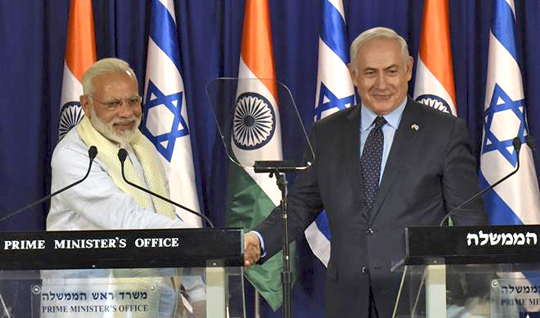
Jerusalem, Jul 5: Renowned Indian mathematician Srinivasa Ramanujan symbolises the talent of people of India, Israeli Prime Minister Benjamin Netanyahu said, emphasising that the two countries believe in the partnership of talent.

benjaman

Expressing his admiration for Ramanujan, Netanyahu said he was one of the greatest mathematicians of all times.

"We have a great admiration for people of India. I told you about my late uncle professor, who was a mathematician at the Israel Institute of Technology. He told me many times about his admiration for the great Indian mathematician Ramanujan," Netanyahu said in a statement along with Prime Minister Narendra Modi.

"He was perhaps the greatest mathematician in many centuries. And this symbolises the talent of people of India, as we know we have talent in Israel. We believe in this partnership of talent," he added.

Ramanujan, who died at an early age of 32, has contributed to mathematical analysis, including infinite series and continued fractions.

The Israeli prime minister said he and Modi both seek a better future for the people of the two countries.

"It requires a lot of work, it won't happen overnight but prime minister Modi and I want this to happen," he said.

Modi, the first Indian prime minister to visit the Jewish nation, received a warm welcome in Israel yesterday.

His three-day visit is aimed at commemorating 25 years of establishment of diplomatic ties between the two countries and will also see discussions between him and his Israeli counterpart Netanyahu to explore ways to enhance cooperation in key strategic areas.

Comments

Viren Kotian
 - 
Saturday, 8 Jul 2017

This is drama. Nothing has happened to him.

Add new comment

  • Coastaldigest.com reserves the right to delete or block any comments.
  • Coastaldigset.com is not responsible for its readers’ comments.
  • Comments that are abusive, incendiary or irrelevant are strictly prohibited.
  • Please use a genuine email ID and provide your name to avoid reject.
Agencies
February 5,2020

New Delhi, Feb 5: Over five crore farmers were yet to get the third instalment of money under the Centre's ambitious PM-Kisan scheme, aimed at providing direct support of Rs 6,000 annually to them, according to the latest Ministry of Agriculture and Farmers' Welfare data.

The total amount of the scheme, which came into effect on December 1, 2018, is to be paid in three equal instalments of Rs 2,000 every four months.

The data showed about 2.51 crore farmers have not got even the second instalment and 5.16 crore of them were yet to get the third instalment.

Over 9 crore farmers have registered themselves under the scheme between December 2018 and November 2019, it said.

Of these, 7.62 crore or 84 per cent of farmers have received the first instalment.

The money through the second instalment was given to nearly 6.5 crore farmers and the amount under the third instalment was given to 3.85 crore beneficiaries, according to the data received in response to an RTI query filed by this PTI journalist.

The agriculture ministry, in its response, gave three sets of data mentioning the benefits given to farmers under the scheme between December 2018 and November 2019.

It said 4.74 crore farmers were registered between December 2018 and March 2019.

Of them, 4.22 crore received the first instalment, 4.02 crore the second and 3.85 crore the third.

There was no mention why nearly 50 lakh, 70 lakh and 90 lakh registered farmers during this period did not get the first, second and third instalment respectively.

There was no registered beneficiary in West Bengal and Sikkim, hence no amount was disbursed during this period, according to the data.

Giving details of the 3.08 crore farmers registered between April and July last year, it said 2.66 crore and 2.47 crore beneficiaries have got their first and second instalments respectively.

The RTI reply did no mention why around 40 lakh and 61 lakh registered farmers during this period did not get their first and second instalment respectively.

"The beneficiaries are eligible for the instalment for the period in which he/she gets registered and subsequent periods, thereafter. Therefore, the third instalment is not due for the beneficiaries registered in the period April 2019-July 2019," the ministry said.

There was no registered beneficiary during this period in West Bengal, Punjab and Chandigarh and therefore nobody was paid first and second instalments.

The ministry said around 1.19 crore beneficiaries were registered between August and November 30, 2019, of these nearly 73.66 lakh farmers have been given the first instalment.

There was no mention of payment of first instalment to over 45 lakh eligible beneficiaries during the period.

"The beneficiaries are eligible for the instalment for the period in which he/she gets registered and subsequent periods, thereafter. Therefore, the second and third instalments are not due for the beneficiaries registered in the period August 2019 to November 2019," it said.

The ministry was asked to provide the total number of farmers, state-wise, and the amount received by them under the Pradhan Mantri Kisan Samman Nidhi or PM-Kisan scheme.

"PM-Kisan Samman Nidhi scheme has been implemented from December 1, 2018. It is stated that PM-Kisan is a continuous and ongoing scheme, in which the financial benefits are transferred to the bank accounts of the identified beneficiaries as and when their correct and verified data is uploaded by the concerned states/union territories on PM-Kisan web portal," the ministry said in the RTI response vide its letter dated December 26, 2019.

The data of beneficiaries so uploaded by them undergoes a multi-level verification, including by banks, and only then the amount is released to the beneficiary, it said, adding that www.pmkisan.gov.in website can be accessed to get more details on the operational guidelines of the scheme.

According to the data updated on the website on February 3, around 8.82 crore farmers have been registered and 8.41 crore have received the first installment, 7.56 crore the second instalment, 6.19 crore the third and 3.03 crore have received the fourth installment.

In Assam, out of 16.97 lakh farmers registered during this period, 14.02 lakh got the first instalment, 13.72 lakh received the second and 9.87 lakh the third.

Of the 42.34 lakh registered beneficiaries in Maharashtra, 36.98 lakh got the first instalment, 31.53 lakh the second and 27.67 lakh got the third instalment.

As many as 23.83 lakh farmers in Kerala received their first instalment, 18.79 lakh got the second and 18.43 lakh the third. A total of 26.13 lakh beneficiaries were registered in the state between December 2018 and March 2019.

There was no beneficiary registered during the period from West Bengal, which has refused to implement the scheme, according to the ministry's response.

In Uttar Pradesh, nearly 9.57 lakh out of 19.64 lakh farmers have got the first instalment. In Gujarat, nearly 1.22 lakh out of 1.98 lakh registered farmers got the first instalment.

Around 9.78 lakh farmers out of the 17.18 lakh registered beneficiaries have received the first instalment in Madhya Pradesh. In Odisha, only 5,507 farmers out of 5.6 lakh registered farmers have got the first instalment, the ministry said.

None of the 7,326 farmers registered in Sikkim was paid the first instalment, according to the ministry's reply. In Delhi, 1,447 farmers out of 1,734 have got the first instalment.


Comments

Add new comment

  • Coastaldigest.com reserves the right to delete or block any comments.
  • Coastaldigset.com is not responsible for its readers’ comments.
  • Comments that are abusive, incendiary or irrelevant are strictly prohibited.
  • Please use a genuine email ID and provide your name to avoid reject.
Agencies
February 29,2020

New Delhi, Feb 29: Former RBI governor Raghuram Rajan has said slowdown in growth is due to the current government focussing more on meeting its political and social agenda rather than paying attention to the economy.

India can still reverse its slowing economic growth by paying attention to key issues, he said. "It's a sad story, I think most recently, it is politics," Rajan said in response to a question on what was stopping India's growth which remains below potential.

In an interview to Bloomberg TV, Rajan said unfortunately the current government after a massive election win has "focussed more on fulfilling its political and social agenda rather than paying attention to the economic growth".

"Unfortunately, this drift has continued a pace of slowing growth, which was precipitated initially by some actions the government took such as the demonetisation and a poorly rolled out Goods and Services Tax (GST) reform," Rajan said.

India's GDP growth hit nearly 7-year low of 4.7 per cent in the December quarter, as per official data released on Friday.

The GDP growth for the quarter is the lowest since January-March of 2012-13.

In the interview, which was telecast before the official numbers were released, Rajan said India has not paid sufficient attention to cleaning up the financial sector and unfortunately, that is leading to the slowing growth.

"These are things that they can change if attention is paid to them and appropriate actions are taken," Rajan, Professor of Finance at University of Chicago Booth School of Business, said.

On being asked about the spread of the coronavirus globally and its impact, he said there will certainly be some legacy issues in terms of business rethinking in the global supply chain.

"If it is disrupted anywhere, the entire supply chain is held ransom and companies are going to start rethinking that should we actually have these really spread out global supply chain or to bring them back closer home and how much diversification should we have. Should we have multiple production sites across the world rather than have it focussed primarily in Asia," he said.

Comments

Add new comment

  • Coastaldigest.com reserves the right to delete or block any comments.
  • Coastaldigset.com is not responsible for its readers’ comments.
  • Comments that are abusive, incendiary or irrelevant are strictly prohibited.
  • Please use a genuine email ID and provide your name to avoid reject.
Agencies
April 23,2020

New Delhi, Apr 23: The nationwide lockdown in India which started about a month ago has impacted nearly 40 million internal migrants, the World Bank has said.

The lockdown in India has impacted the livelihoods of a large proportion of the country's nearly 40 million internal migrants. Around 50,000 60,000 moved from urban centers to rural areas of origin in the span of a few days, the bank said in a report released on Wednesday.

According to the report -- 'COVID-19 Crisis Through a Migration Lens' -- the magnitude of internal migration is about two-and-a-half times that of international migration.

Lockdowns, loss of employment, and social distancing prompted a chaotic and painful process of mass return for internal migrants in India and many countries in Latin America, it said.

Thus, the COVID-19 containment measures might have contributed to spreading the epidemic, the report said.

Governments need to address the challenges facing internal migrants by including them in health services and cash transfer and other social programmes, and protecting them from discrimination, it said.

World Bank said that coronavirus crisis has affected both international and internal migration in the South Asia region.

As the early phases of the crisis unfolded, many international migrants, especially from the Gulf countries, returned to countries such as India, Pakistan, and Bangladesh until travel restrictions halted these flows.

Some migrants had to be evacuated by governments, such as those of China and Iran, it said.

Before the coronavirus crisis, migrant outflows from the region were robust, the report said.

The number of recorded, primarily low-skilled emigrants from India and Pakistan rose in 2019 relative to the prior year but is expected to decline in 2020 due to the pandemic and oil price declines impacting the Gulf countries.

In India, the number of low-skilled emigrants seeking mandatory clearance for emigration rose slightly by eight percent to 368,048 in 2019.

In Pakistan, the number of emigrants jumped 63 per cent to 6,25,203 in 2019, largely due to a doubling of emigration to Saudi Arabia, it said.

According to the bank, migration flows are likely to fall, but the stock of international migrants may not decrease immediately, since migrants cannot return to their countries due to travel bans and disruption to transportation services.

In 2019, there were around 272 million international migrants.

The rate of voluntary return migration is likely to fall, except in the case of a few cross-border migration corridors in the South (such as Venezuela-Colombia, Nepal-India, Zimbabwe South Africa, Myanmar-Thailand), it said.

Migrant workers tend to be vulnerable to the loss of employment and wages during an economic crisis in their host country, more so than native-born workers.

Lockdowns in labour camps and dormitories can also increase the risk of contagion among migrant workers.

Many migrants have been stranded due to the suspension of transport services. Some host countries have granted visa extensions and temporary amnesty to migrant workers, and some have suspended the involuntary return of migrants, it said.

Observing that government policy responses to the COVID-19 crisis have largely excluded migrants and their families back home, the World Bank said there is a strong case for including migrants in the near-term health strategies of all countries, given the externalities associated with the health status of an entire population in the face of a highly contagious pandemic.

The Bank said governments would do well to consider short, medium and long-term interventions to support stranded migrants, remittance infrastructure, loss of subsistence income for families back home, and access to health, housing, education, and jobs for migrant workers in host/transit countries and their families back home.

The pandemic has also highlighted the global shortage of health professionals and an urgent need for global cooperation and long-term investments in medical training, it said.

Comments

Add new comment

  • Coastaldigest.com reserves the right to delete or block any comments.
  • Coastaldigset.com is not responsible for its readers’ comments.
  • Comments that are abusive, incendiary or irrelevant are strictly prohibited.
  • Please use a genuine email ID and provide your name to avoid reject.