Ramanujan symbolises talent of people of India: Netanyahu

Agencies
July 5, 2017

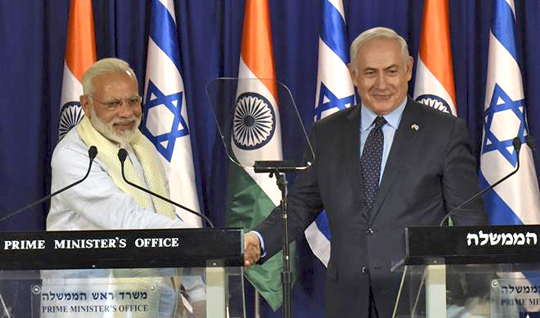
Jerusalem, Jul 5: Renowned Indian mathematician Srinivasa Ramanujan symbolises the talent of people of India, Israeli Prime Minister Benjamin Netanyahu said, emphasising that the two countries believe in the partnership of talent.

benjaman

Expressing his admiration for Ramanujan, Netanyahu said he was one of the greatest mathematicians of all times.

"We have a great admiration for people of India. I told you about my late uncle professor, who was a mathematician at the Israel Institute of Technology. He told me many times about his admiration for the great Indian mathematician Ramanujan," Netanyahu said in a statement along with Prime Minister Narendra Modi.

"He was perhaps the greatest mathematician in many centuries. And this symbolises the talent of people of India, as we know we have talent in Israel. We believe in this partnership of talent," he added.

Ramanujan, who died at an early age of 32, has contributed to mathematical analysis, including infinite series and continued fractions.

The Israeli prime minister said he and Modi both seek a better future for the people of the two countries.

"It requires a lot of work, it won't happen overnight but prime minister Modi and I want this to happen," he said.

Modi, the first Indian prime minister to visit the Jewish nation, received a warm welcome in Israel yesterday.

His three-day visit is aimed at commemorating 25 years of establishment of diplomatic ties between the two countries and will also see discussions between him and his Israeli counterpart Netanyahu to explore ways to enhance cooperation in key strategic areas.

Comments

Viren Kotian
 - 
Saturday, 8 Jul 2017

This is drama. Nothing has happened to him.

Add new comment

  • Coastaldigest.com reserves the right to delete or block any comments.
  • Coastaldigset.com is not responsible for its readers’ comments.
  • Comments that are abusive, incendiary or irrelevant are strictly prohibited.
  • Please use a genuine email ID and provide your name to avoid reject.
News Network
April 21,2020

New Delhi, Apr 21: The historic rout in oil markets that sent US crude prices plummeting to as much as minus USD 40 a barrel is unlikely to translate into any big reduction in petrol and diesel prices in India as domestic pricing is based on different benchmark, and refineries are already filled up to brim and cannot buy US crude just yet.

With storage capacity already overflowing amid coronavirus-induced demand collapse, traders rushed to to get rid of unwanted stocks triggering the collapse of US West Texas Intermediate (WTI) crude for May delivery.

Indian Oil Corp (IOC) Chairman Sanjiv Singh said the collapse was triggered by traders unable to take deliveries of crude they had previously booked because of a demand collapse. And so they paid the seller to keep oil in their storage.

"If you look at June futures, it is trading in positive territory... around USD 20 per barrel," he said.

Low oil prices may seem good in short-term but in the long run it will hurt the oil economy as producers will have no surplus to invest in exploration and production which will lead to a drop in production, he said.

He did not comment on retail fuel prices that have been static since March 16.

Oil companies have not changed rates despite a fall in international prices as they first adjusted them against the increase that was warranted from a Rs 3 per litre hike in excise duty and close to Re 1 per litre additional cost of switching over to cleaner BS-VI grade fuel from April 1.

Petrol in Delhi is priced at Rs 69.59 a litre and diesel comes for Rs 62.29 per litre.

"The negative price has no direct impact on India or Indian oil prices, as this has taken place due to crude oil produced and traded within the US. India's prices are driven partly by another benchmark, the Brent, which is still trading at USD 25/barrel. Therefore, the retail price of fuels in India are unlikely to fall," said Amit Bhandari, Fellow, Energy and Environment Studies, Gateway House.

Also, Indian refineries are already overflowing as fuel demand has evaporated due to the unprecedented nationwide lockdown imposed to curb spread of COVID-19. So, they can't rush to buy US crude.

The refineries have already cut operating rate to half because the fuel they produce has not been sold yet.

India imports 4 million barrels/day (1.4 billion barrels/year) of oil. The country has been benefitting from the falling prices of oil for the last five years, when oil dropped from a peak of USD 110/barrel to USD 50-60/barrel last year, enabling India to invest in public service programmes.

"However, the additional USD 30 fall of this week is good for India - but there is also a downside. If oil prices are too low, the economies of oil-rich gulf countries will be hurt, threatening the job prospects of the 8 million Indians working in the Gulf countries. India is the largest recipient of foreign remittances due to these workers – very low oil prices will hurt this cash stream," Bhandari said.

He said the negative price of oil shows how much oil oversupply exists in international markets today. "Global oil consumption has fallen due to the COVID-19 pandemic that traders are willing to pay customers to get rid of the barrels they can't store. The world does not have enough storage capacity, and dumping the oil is an environmental crime."

The first half of April saw Brent crude oil prices plummet 63.6 per cent to USD 26.9 per barrel. Prices of Western Texas Intermediate (WTI), the American oil, had also fallen similarly by 63.1 per cent.

But on April 20, WTI prices turned rapidly negative because traders on the Nymex exchange rushed to offload their May futures positions a day before expiry of contracts (on April 21).

Such WTI futures are traded on the Nymex exchange with contracts settled in physical crude oil. Problem is, those who had gone long are unable to find storage facilities for the oil and had to liquidate their contracts before expiry. This caused the plunge in WTI prices.

Contrast to this, June WTI Nymex futures prices is hovering around USD 21, while Brent for June delivery is at USD 25.

Miren Lodha, Director, CRISIL Research said the demand for crude oil was declining already because of economic slowdown when the COVID-19 pandemic-driven lockdowns crushed it further.

Consequently, oil demand is expected to contract by 8-10 million barrels per day (mbpd) in 2020 assuming demand recovery begins from the third quarter of the year, he said, adding if recovery doesn't happen by then, further demand destruction could occur.

On the supply side, producers reining in output following a strategic deal between OPEC members, Russia and the US.

Under this agreement, OPEC+ would reduce oil production by 9.7 mbpd for May and June, but gradually ease the curb to 7.7 mbpd between July and December 2020, and to 5.8 mbpd till April 2022 to stabilise prices.

"This is expected to reduce some surplus in the market by the end of 2020," Lodha said.

Crude oil demand is expected to decline by over 20 mbpd in April alone. Typically, monthly global demand is about 100 mbpd. Given this scenario, supply curbs would have limited influence.

Consequently, Brent oil prices is expected to be in the USD 25-30 range for the second quarter while increasing marginally in the last 2 quarters of 2020.

"The gigantic inventory build-ups and lack of storage facilities would also put pressure on prices," he said, adding overall Brent could average USD 30-35 in 2020, with a strong downward bias.


Comments

Add new comment

  • Coastaldigest.com reserves the right to delete or block any comments.
  • Coastaldigset.com is not responsible for its readers’ comments.
  • Comments that are abusive, incendiary or irrelevant are strictly prohibited.
  • Please use a genuine email ID and provide your name to avoid reject.
News Network
May 15,2020

New Delhi, May 15: A group of doctors from the AIIMS, Raipur has recommended restrictions on the use of mobile phones in healthcare institutions amid the COVID-19 pandemic, warning that such devices can be a potential carrier of the virus and lead to infection among healthcare workers.

In a commentary published in the BMJ Global Health journal, the doctors stated that mobile phone surfaces are a peculiar 'high-risk' surface, which can directly come in contact with the face or mouth, even if hands are properly washed and one study indicates that some healthcare workers use phones every 15 minutes to two hours.

Though there have been many significant guidelines from various health organisations like the WHO and CDC focusing on prevention and control of disease, the commentary highlighted "there is no mention of or focus on mobile phones in these guidelines, including the WHO infection control and prevention guidelines, which recommends the use of handwashing".

In healthcare facilities, phones are used to communicate with other health care workers, look up recent medical guidelines, research drug interactions, understand adverse events and side effects, conduct telemedicine appointments and track patients among others, stated the document.

The document has been authored by Dr Vineet Kumar Pathak, Dr Sunil Kumar Panigrahi, Dr M Mohan Kumar, Dr Utsav Raj and Dr Karpaga Priya P from the Department of Community and Family Medicine.

"In their tendency to come in direct contact with the face, nose or eyes in healthcare settings, mobile phones are perhaps second only to masks, caps or goggles," the authors said.

"However, they are neither disposable nor washable like these other three, thus warranting disinfection. Mobile phones can effectively negate hand hygiene... There is growing evidence that mobile phones are a potential vector for pathogenic organisms," they said.

It is the need of the hour to address proper hygienic use of mobile phones in healthcare settings. In a study in India, almost 100 per cent of health workers of a tertiary care hospital used mobile phones in the hospital, but only 10 per cent of them had at any time wiped their mobile phones clean, the commentary published on April 22 said.

"The safest thing to do is to consider your phone as an extension of your hand, so remember you are transferring whatever is on your phone to your hand," Dr Pathak said.

Amidst the ongoing pandemic, two biggest mobile phone companies have uploaded their user support guidelines, saying that 70 pc isopropyl alcohol or Clorox Disinfecting Wipes can be used to gently wipe the exterior surface of phones in switched-off mode.

However, in doing so, the use of bleach or entry of moisture through any of the openings must be avoided, and any harsh chemical may damage the oleophobic screen, leading to damage in the touch screen sensitivity of the phone, the article stated.

Mobile phones are one of the most highly touched surfaces according to the Centers for Disease Control and Prevention (CDC), along with counters, tabletops, doorknobs, bathroom fixtures, toilets, keyboards, tablets and bedside tables.

The doctors recommended restriction on mobile phone usage in healthcare settings like hospital wards, ICUs and operation theatres, while advocating the use of headphones to prevent contact with the face while talking.

There should be no sharing of mobile phones, headphones or headsets of any kind. In addition, where available, the use of interdepartmental intercom facility may be promoted.

"Although hand hygiene and mobile phone use by a person are not mutually exclusive, it is high time to acknowledge the potential role of mobile phones in disease transmission cascade and to take evidence-based appropriate actions. This is especially important, given the ongoing COVID-19 pandemic," the authors said.

They said it is necessary for government agencies and the WHO to generate public awareness and to formulate suitable information, education and communication material on mobile phone hygiene, especially in healthcare settings.

AIIMS, New Delhi, Resident Doctors' Association (RDA) General Secretary, Dr Srinivas Rajkumar T said even outside health care settings, people should pay special attention to the usage of mobile phones as they carry them to all places.

"Phone and computer peripherals like keyboard, mouse, etc. should be covered with transparent plastic covers which can be cleaned without interfering with their function. Cleaning hands by soap or alcohol-based hand sanitizer before and after contact with phone and between contact with other surfaces can decrease the risk of potential transmission.

"Using a handsfree headset, dedicated operator/assistant per ward handling the communication via common line in hospitals while on duty can enable communication without compromising safety," Dr Srinivas said.

Comments

Add new comment

  • Coastaldigest.com reserves the right to delete or block any comments.
  • Coastaldigset.com is not responsible for its readers’ comments.
  • Comments that are abusive, incendiary or irrelevant are strictly prohibited.
  • Please use a genuine email ID and provide your name to avoid reject.
News Network
March 9,2020

New Delhi, Mar 9: A war of words broke out between the BJP and the Congress on Sunday over the Yes Bank crisis with the ruling party seeking to link it with the Gandhi family, while the opposition wondered if the prime minister and finance minister were "complicit" as the bank's loan book grew manifold.

Posting on Twitter a clip of a news channel report that Rana Kapoor, the arrested Yes Bank founder, had bought a painting from Congress leader Priyanka Gandhi Vadra, BJP's information and technology wing in-charge Amit Malviya alleged that every financial crime in India has "deep links" with the Gandhis.

The Congress dismissed the charge "fake" and called it a "diversionary" tactic.

It said Priyanka Gandhi had sold an M F Hussain painting of her father Rajiv Gandhi to Kapoor for Rs 2 crore, and the entire amount was disclosed in her income tax return of 2010.

Malviya tweeted, "Every financial crime in India has deep link with the Gandhis. Mallya used to send flight upgrade tickets to Sonia Gandhi. Had access to MMS (Manmohan Singh) and PC (P Chidambaram). Is absconding. Rahul inaugurated Nirav Modi’s bridal jewellery collection, he defaulted. Rana bought Priyanka Vadra’s paintings."

Congress' chief spokesperson Randeep Surjewala asked how does an M F Hussain painting of Rajiv Gandhi sold 10 years ago by Priyanka Gandhi to Yes Bank owner Rana Kapoor and disclosed in her tax returns connect with unprecedented giving of loans of Rs 2,00,000 crore in five years of the Modi government.

"More so, when (Kapoor's) proximity to BJP leaders is well known," he said.

Rubbishing the BJP's allegation, Congress spokesperson Abhishek Manu Singhvi at a press conference said it was a "diversionary" tactic by the government.

He noted that the bank's loan book rose from Rs 55,633 crore in March 2014, the year Narendra Modi became prime minister, to Rs 2,41,499 crore in March 2019.

"Why did the loan book rise by 100 per cent in two years after demonetisation i.e from Rs 98,210 cr in March 2016 to Rs 2,03,534 ar in March 2018? Were PM and FM sleeping, ignorant or complicit?" he asked.

The entire amount Priyanka Gandhi had received was in cheque and was fully disclosed in the income tax return, Singhvi said.

Surjewala, taking to Twitter, said instead of diverting from the real issue of people's money sinking into a bad bank, should not the government answer questions like how did loans given by Yes Bank rise from Rs 55,633 crore in March 2014 to Rs 2,41,499 crore in March 2019, an increase of almost Rs 2,00,000 crore in fiver years of the Modi government.

Why did the loans given by Yes Bank rise by a whopping 100 per cent in just two years after demonetisation, he asked.

Surjewala also questioned why did the prime minister address a conference sponsored by Yes Bank on March 6 despite the RBI moratorium.

"Why did the Haryana BJP government deposit over Rs 1,000 crore in Yes Bank a month ago, knowing that it was sinking? Is this figure Rs 3,000 cr? Did Fadnavis government in Maharashtra make similar deposits?" Surjewala asked.

"Of course, the government's media proxies won't dare to ask these questions. But the nation wants to know!" he said in a series of tweets.

Kapoor, 62, was arrested by the Enforcement Directorate in Mumbai after charges of alleged financial irregularities and mismanagement in the bank's operations surfaced and the RBI and Union government initiated action to control its affairs.

Comments

Add new comment

  • Coastaldigest.com reserves the right to delete or block any comments.
  • Coastaldigset.com is not responsible for its readers’ comments.
  • Comments that are abusive, incendiary or irrelevant are strictly prohibited.
  • Please use a genuine email ID and provide your name to avoid reject.