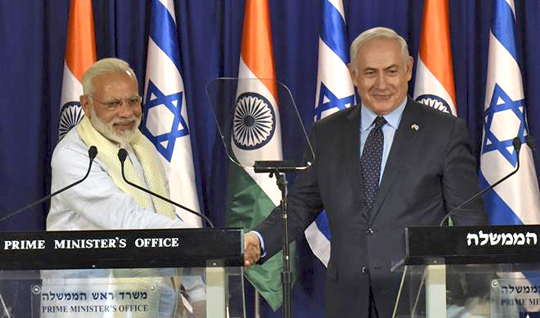
Ramanujan symbolises talent of people of India: Netanyahu

Agencies
July 5, 2017

Jerusalem, Jul 5: Renowned Indian mathematician Srinivasa Ramanujan symbolises the talent of people of India, Israeli Prime Minister Benjamin Netanyahu said, emphasising that the two countries believe in the partnership of talent.

benjaman

Expressing his admiration for Ramanujan, Netanyahu said he was one of the greatest mathematicians of all times.

"We have a great admiration for people of India. I told you about my late uncle professor, who was a mathematician at the Israel Institute of Technology. He told me many times about his admiration for the great Indian mathematician Ramanujan," Netanyahu said in a statement along with Prime Minister Narendra Modi.

"He was perhaps the greatest mathematician in many centuries. And this symbolises the talent of people of India, as we know we have talent in Israel. We believe in this partnership of talent," he added.

Ramanujan, who died at an early age of 32, has contributed to mathematical analysis, including infinite series and continued fractions.

The Israeli prime minister said he and Modi both seek a better future for the people of the two countries.

"It requires a lot of work, it won't happen overnight but prime minister Modi and I want this to happen," he said.

Modi, the first Indian prime minister to visit the Jewish nation, received a warm welcome in Israel yesterday.

His three-day visit is aimed at commemorating 25 years of establishment of diplomatic ties between the two countries and will also see discussions between him and his Israeli counterpart Netanyahu to explore ways to enhance cooperation in key strategic areas.

Comments

Viren Kotian
 - 
Saturday, 8 Jul 2017

This is drama. Nothing has happened to him.

Add new comment

  • Coastaldigest.com reserves the right to delete or block any comments.
  • Coastaldigset.com is not responsible for its readers’ comments.
  • Comments that are abusive, incendiary or irrelevant are strictly prohibited.
  • Please use a genuine email ID and provide your name to avoid reject.
Agencies
April 14,2020

Mumbai, Apr 14: Activist and scholar Anand Teltumbde was arrested by the National Investigation Agency (NIA) on Tuesday after he surrendered before it in connection with the Elgar Parishad-Maoist links case.

Teltumbde surrendered at the NIA office at Cumbala Hill in south Mumbai following the Supreme Court's directives.

He was subsequently arrested by the NIA and shall be produced before a court here shortly, an official said.

Earlier, the scholar reached the NIA office in the afternoon along with his wife Rama Teltumbde and brother-in- law and Dalit leader Prakash Ambedkar.

Anand Teltumbde is the grandson-in-law of Dalit icon Dr B R Ambedkar, whose 129th birth anniversary is being observed on Tuesday.

Civil rights activist Gautam Navlakha, a co-accused in the case, also surrendered before the NIA in Delhi. His anticipatory bail plea was also rejected by the apex court.

According to the official, Navlakha will be produced before the court in Mumbai through video conference.

The Supreme Court on March 17 this year rejected the pre-arrest bail pleas of Anand Teltumbde and Gautam Navlakha, and directed them to surrender before the investigating agency.

Teltumbde, Navlakha and nine other civil liberties activists have been booked under the stringent provisions of Unlawful Activities Prevention Act (UAPA) for having alleged Maoist links and conspiring the overthrow the government.

The apex court while rejecting Teltumbde and Navlakha's bail pleas on March 17, directed them to surrender before the prosecuting agency withing a period of three weeks.

The duo later sought extension of the time.

On April 9, the Supreme Court extended the time by one week by way of last chance.

The activists were booked initially by Pune Police following violence that erupted at Koregaon-Bhima there.

According to police, the activists made inflammatory speeches and provocative statements at the Elgar Parishad meet held in Pune on December 31, 2017, which triggered violence the next day.

The police also said these activists were active members of banned Maoist groups.

The case was later transferred to NIA. Teltumbde and Navlakha were given interim protection by the Bombay High Court while their pre-arrest bail pleas were being heard.

After the high court rejected their applications, the duo approached the Supreme Court.

Comments

Add new comment

  • Coastaldigest.com reserves the right to delete or block any comments.
  • Coastaldigset.com is not responsible for its readers’ comments.
  • Comments that are abusive, incendiary or irrelevant are strictly prohibited.
  • Please use a genuine email ID and provide your name to avoid reject.
News Network
January 13,2020

New Delhi, Jan 13: The Delhi High Court on Monday sought response of the city police, Delhi government, WhatsApp Inc, Google Inc and Apple Inc on a plea of three JNU professors to preserve data, CCTV footage and other evidence relating to the January 5 violence on the varsity campus.

The Delhi Police informed the court that it has asked the JNU administration to preserve and hand over CCTV footage of the violence.

Justice Brijesh Sethi listed the matter for further hearing on Tuesday.

The court was told by Delhi government Standing Counsel (criminal) Rahul Mehra that the police has not yet received any response from the university administration.

The counsel said police has also written to WhatsApp to preserve data of two groups "Unity Against Left" and "Friends of RSS" including messages, pictures and videos and phone numbers of members, related to JNU violence incident.

The petition was filed by JNU professors Ameet Parameswaran, Atul Sood and Shukla Vinayak Sawant seeking necessary directions to the Delhi Police Commissioner and Delhi government.

The petition also sought direction to the Delhi Police to retrieve all CCTV footage of JNU campus.

Comments

Add new comment

  • Coastaldigest.com reserves the right to delete or block any comments.
  • Coastaldigset.com is not responsible for its readers’ comments.
  • Comments that are abusive, incendiary or irrelevant are strictly prohibited.
  • Please use a genuine email ID and provide your name to avoid reject.
News Network
January 12,2020

New Delhi, Jan 12: As many as 109 children were sexually abused every day in India in 2018, according to the data by the National Crime Records Bureau, which showed a 22 per cent jump in such cases from the previous year.

According to the recently released NCRB data, 32,608 cases were reported in 2017 while 39,827 cases were reported in 2018 under the Protection of Children from Sexual Offences Act (POCSO).

POCSO Act, 2012 is a comprehensive law to provide for the protection of children from offences of sexual assault, sexual harassment and pornography. It requires special treatment of cases relating to child sexual abuse such as setting-up of special courts, special prosecutors, and support persons for child victims.

As many as 21,605 child rapes were recorded in 2018 which included 21,401 rapes of girls and 204 of boys, the data showed.

The highest number of child rapes were recorded in Maharashtra at 2,832 followed by Uttar Pradesh at 2023 and Tamil Nadu at 1457, the data showed.

Overall crimes against children has increased steeply over six times in the decade over 2008-2018, from 22,500 cases recorded in 2008 to 1,41,764 cases in 2018, according to the NCRB data from 2008 and 2018.

In 2017, 1,29,032 cases of crime against children were recorded.

Priti Mahara, Director of Policy Research and Advocacy at CRY – Child Rights and You (CRY) said, that while on the one hand, the increasing numbers of crimes against children are extremely alarming, it also suggests an increasing trend in reporting which is a positive sign as it reflects people's faith in the system.

"It also provides a direction in which government interventions must be made and evidence needs to be created. While some major efforts have been taken to ensure child protection, a lot more is needed to see expected results on the ground," Mahara said.

In percentage terms, major crime against children during 2018 were kidnapping and abduction which accounted for 44.2 per cent followed by cases under POCSO, which accounted for 34.7 per cent, the data showed.

A total of 67,134 children (19,784 male,47,191 female and 159 transgender) were reported missing in 2018. During the year 2018, a total of 71,176 children (22,239 male, 48,787 female and 150 transgender) were traced, the NCRB data said.

As many as 781 cases of use of child for pornography or storing child pornography material was also recorded in 2018, more than double that of  2017 when 331 such cases were recorded, the data showed.

The state-wise segregation of crimes against children reveals Uttar Pradesh, Madhya Pradesh, Maharashtra, Delhi and Bihar accounted for 51 per cent of all crimes in the country, the data said.

While Uttar Pradesh tops the list with 19,936 recorded crimes against children (14 per cent of total crimes), Madhya Pradesh and Maharashtra are the close second and third with 18,992 and 18,892 crimes registered respectively.

The report also showed that cases of sexual harassment in shelter homes against women and children reportedly increased by 30 per cent, from 544 cases recorded in 2017 to 707 cases in 2018.

Mahara suggested that financial investments must be adequately increased with a focus on prevention of crimes against children and the identification of vulnerable children and families.

"Strengthening community-level child protection system is also a key to prevention. While there is growing evidence of the precarious lives that children in India are leading, it is essential that this evidence is used to effectively inform policy and programme initiatives," she said.

As many as 501 incidences were also recorded under The Prohibition of Child Marriage Act, a 26 per cent jump from 2017 when 395 cases were reported under the Act.


Comments

Add new comment

  • Coastaldigest.com reserves the right to delete or block any comments.
  • Coastaldigset.com is not responsible for its readers’ comments.
  • Comments that are abusive, incendiary or irrelevant are strictly prohibited.
  • Please use a genuine email ID and provide your name to avoid reject.