Ramanujan symbolises talent of people of India: Netanyahu

Agencies
July 5, 2017

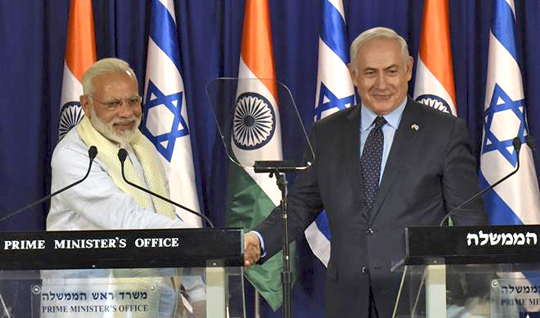
Jerusalem, Jul 5: Renowned Indian mathematician Srinivasa Ramanujan symbolises the talent of people of India, Israeli Prime Minister Benjamin Netanyahu said, emphasising that the two countries believe in the partnership of talent.

benjaman

Expressing his admiration for Ramanujan, Netanyahu said he was one of the greatest mathematicians of all times.

"We have a great admiration for people of India. I told you about my late uncle professor, who was a mathematician at the Israel Institute of Technology. He told me many times about his admiration for the great Indian mathematician Ramanujan," Netanyahu said in a statement along with Prime Minister Narendra Modi.

"He was perhaps the greatest mathematician in many centuries. And this symbolises the talent of people of India, as we know we have talent in Israel. We believe in this partnership of talent," he added.

Ramanujan, who died at an early age of 32, has contributed to mathematical analysis, including infinite series and continued fractions.

The Israeli prime minister said he and Modi both seek a better future for the people of the two countries.

"It requires a lot of work, it won't happen overnight but prime minister Modi and I want this to happen," he said.

Modi, the first Indian prime minister to visit the Jewish nation, received a warm welcome in Israel yesterday.

His three-day visit is aimed at commemorating 25 years of establishment of diplomatic ties between the two countries and will also see discussions between him and his Israeli counterpart Netanyahu to explore ways to enhance cooperation in key strategic areas.

Comments

Viren Kotian
 - 
Saturday, 8 Jul 2017

This is drama. Nothing has happened to him.

Add new comment

  • Coastaldigest.com reserves the right to delete or block any comments.
  • Coastaldigset.com is not responsible for its readers’ comments.
  • Comments that are abusive, incendiary or irrelevant are strictly prohibited.
  • Please use a genuine email ID and provide your name to avoid reject.
News Network
February 4,2020

Feb 4: Amid the agitations against Citizenship Amendment Act, National register of Citizens and National Population Registration across the country, Prime Minister Narendra Modi on Monday said that there is a "political design" behind all these protests including in Delhi's Jamia and Shaheen Bagh to ruin the harmony of the nation.

"Be it Seelampur, Jamia or Shaheen Bagh, protests held over the past several days regarding the Citizenship Amendment Bill. Is this just a coincidence? No. This is an experiment," said Prime Minister Narendra Modi in his first election rally for Delhi polls at Karkardooma.

"There is a political design behind all these protests including Jamia and Shaheen Bagh. These protests are a conspiracy to divide India. These protests are going to ruin the harmony of the nation," he asserted.

Lambasting the opposition parties including Congress and Aam Aadmi Party for supporting the ongoing protests, he said: "But AAP and Congress are provoking people. Constitution and tricolor are being kept in front and attention is being diverted from the real conspiracy."

"These people were doubting the ability of our forces during surgical strikes. Do citizens of Delhi want such people in power? These people are saving those who want to break India into pieces," he added.

People have been protesting at Jamia and Shaheen Bagh against CAA, NRC and NPR. Members of the Opposition have deemed CAA "discriminatory and anti-Constitution" while the Centre has maintained that the new law has no effect on Indian citizens.

Recently, two firing incidents took place near Jamia Millia Islamia University.On Sunday night, the firing incident was reported near gate number five at the university following which people including some students of the varsity gathered outside the Jamia Nagar police station. They returned from the Jamia Nagar police station after their complaint was registered.

Earlier, a student sustained injuries after a young man fired at the protestors near Jamia.

Comments

abdullah
 - 
Tuesday, 4 Feb 2020

Once again incorrect statement and only to divert people attention.  Every one knows who is ruining image of our nation.   this govt has completely failed in all aspects and trying to survive by misguiding the citizens.  Economy is reaching zero and GDP is coming down day by day, Banks and industries on getting closed. youths are unemployed due to no chance.   However, Govt is giving false statement that nothing to worry and our economy if growing.   this govt has brought black bills of CAA and MPR only to divide the society and keep them engaged and forget the falling economy.   If this situation continues, our nation will be one of the poorest countries in the world.   This govt is trying to sell all Govt hold units like Railway, Insurance, etc to private companies only to help the industrialists and to get commission from them.    LIC was running in profit till 4 to 5 years back, but now its running in loss.   Huge amount of money from LIC is taken by Govt to hide the downfall of economy.   Only God can save our country from the hands of present looters + decoits.  

Add new comment

  • Coastaldigest.com reserves the right to delete or block any comments.
  • Coastaldigset.com is not responsible for its readers’ comments.
  • Comments that are abusive, incendiary or irrelevant are strictly prohibited.
  • Please use a genuine email ID and provide your name to avoid reject.
Agencies
July 23,2020

Gwalior, Jul 23: As India's daily infections of coronavirus keep rising, the country is fighting a pandemic which is getting bigger by the day.

A vaccine, according to the World Health Organization, may not be coming until early 2021 despite good progress on the font. There is also, so far, no definitive cure for the virus, yet.

Madhya Pradesh Assembly Protem Speaker and Bharatiya Janata Party(BJP) leader Rameshwar Sharma, however, feels that the end of the coronavirus pandemic will begin with the start of the construction work for Ram Temple in Ayodhya.

"He (Lord Ram) had reincarnated for the welfare of mankind and to kill demons at that time. As soon as the construction of Ram Temple begins the destruction of the COVID pandemic will begin too," said Sharma, reports ANI.

"Not only India, but the entire world is suffering due to coronavirus. We are not only maintaining social distancing but also remembering our holy figures. The Supreme Court has ordered that Ram Temple will be built," he further added.

The treasurer of Shri Ram Janmabhoomi Tirtha Kshetra Trust, Swami Govind Dev Giri had said that Prime Minister Narendra Modi will lay the foundation stone of Ram Temple on August 5.

He said that social-distancing norms would be ensured at the program, and not more than 200 people will be attending the ceremony.

"The Prime Minister will visit Hanuman Garhi, Ram Lalla Temple, plant a tree and later do the 'bhoomi pujan'," he told ANI.

Ram Mandir trust spokesperson Nritya Gopal Das said five silver bricks will be placed inside the sanctum sanctorum during the ceremony.

The bricks are believed to symbolise five planets as per the Hindu mythology, he said, adding that the design and the architecture of the temple is the same as the one proposed.

According to the trust sources, Home Minister Amit Shah, Defence Minister Rajnath Singh, RSS chief Mohan Bhagwat , Maharashtra Chief Minister Udhav Thackeray and Bihar CM Nitish Kumar are also on the list of invitees.

India so far has recorded 1.19 million coronavirus positive cases, and 28,732 deaths.

Comments

Ahmed Ali Kulai
 - 
Thursday, 23 Jul 2020

Dear Sir,


Who stopped the construction... Start quickly and stop the virus


SC has already given the judgment in favor of you - then why delay???

Add new comment

  • Coastaldigest.com reserves the right to delete or block any comments.
  • Coastaldigset.com is not responsible for its readers’ comments.
  • Comments that are abusive, incendiary or irrelevant are strictly prohibited.
  • Please use a genuine email ID and provide your name to avoid reject.
Agencies
May 27,2020

New Delhi, May 27: India’s fourth recession since Independence, first since liberalisation, and perhaps the worst to date is here, according to rating agency, Crisil.

CRISIL sees the Indian economy shrinking 5 per cent in fiscal 2021 (on-year), because of the Covid-19 pandemic. The first quarter will suffer a staggering 25 per cent contraction.

About 10 per cent of gross domestic product (GDP) in real terms could be permanently lost. "So going back to the growth rates seen before the pandemic is unlikely in the next three fiscals", Crisil said.

Crisil has revised its earlier forecast downwards. "Earlier, on April 28, we had slashed our prediction to 1.8 per cent growth from 3.5 per cent growth. Things have only gone downhill since", it said.

While we expect non-agricultural GDP to contract 6 per cent, agriculture could cushion the blow by growing at 2.5 per cent.

In the past 69 years, India has seen a recession only thrice as per available data in fiscals 1958, 1966 and 1980. The reason was the same each time a monsoon shock that hit agriculture, then a sizeable part of the economy.

"The recession staring at us today is different," it added. For one, agriculture could soften the blow this time by growing near its trend rate, assuming a normal monsoon. Two, the pandemic-induced lockdowns have affected most non-agriculture sectors. And three, the global disruption has upended whatever opportunities India had on the exports front.

Economic conditions have slid precipitously since the April-end forecast of 1.8 per cent GDP growth for fiscal 2021 (baseline), Crisil said.

On the lockdown extension, it said that the government has extended the lockdown four times to deal with the rising number of cases, curtailing economic activity severely (lockdown 4.0 is ending on May 31).

The first quarter of this fiscal will be the worst affected. June is unlikely to see major relaxations as the Covid-19 affliction curve is yet to flatten in India.

"Not only will the first quarter be a washout for the non-agricultural economy, services such as education, and travel and tourism among others, could continue to see a big hit in the quarters to come. Jobs and incomes will see extended losses as these sectors are large employers," Crisil said.

CRISIL also foresees economic activity in states with high Covid-19 cases to suffer prolonged disruption as restrictions could continue longer.

A rough estimate based on a sample of eight states, which contribute over half of India's GDP, shows that their 'red zones' (as per lockdown 3.0) contributed 42 per cent to the state GDP on average regardless of the share of such red zones.

On average, the orange zones contribute 46 per cent, while the green zones where activity is allowed to be close to normal contribute only 12 per cent to state GDP.

The economic costs are higher than earlier expectations, according to Crisil. The economic costs now beginning to show up in the hard numbers are far worse than initial expectations.

Industrial production for March fell by over 16%. The purchasing managers indices for the manufacturing and services sectors were at 27.4 and 5.4, respectively, in April, implying extraordinary contraction. That compares with 51.8 and 49.3, respectively, in March.

Exports contracted 60.3 per cent in April, and new telecom subscribers declined 35 per cent, while railway freight movement plunged 35 per cent on-year.

"Indeed, given one of the most stringent lockdowns in the world, April could well be the worst performing month for India this fiscal," it said.

Added to that is the economic package without enough muscle. The government recently announced a Rs 20.9 lakh crore economic relief package to support the economy. The package has some short-term measures to cushion the economy, but sets its sights majorly on reforms, most of which will have payoffs only over the medium term.

"We estimate the fiscal cost of this package at 1.2 per cent of GDP, which is lower than what we had assumed in our earlier estimate (when we foresaw a growth in GDP)," it said.

"We believe a catch-up to the pre-crisis trend level of GDP growth will not be possible in the next three fiscals despite policy support. Under the base case, we estimate a 10 per cent permanent loss to real GDP (from the decadal-trend level), assuming average growth of about 7 per cent between fiscals 2022 and 2024," Crisil said.

Interestingly, after the Global Financial Crisis (GFC), a sharp growth spurt helped catch up with the trend within two years. GDP grew 8.2 per cent on average in the two fiscals following the GFC. Massive fiscal spending, monetary easing and swift global recovery played a role in a V-shaped recovery.

To catch-up would require average GDP growth to surge to 11 per cent over the next three fiscals, something that has never happened before.

The research said that successive lockdowns have a non-linear and multiplicative effect on the economy a two-month lockdown will be more than twice as debilitating as a one-month imposition, as buffers keep eroding.

Partial relaxations continue to be a hindrance to supply chains, transportation and logistics. Hence, unless the entire supply chain is unlocked, the impact of improved economic activity will be subdued.

Therefore, despite the stringency of lockdown easing a tad in the third and the fourth phases, their negative impact on GDP is expected to massively outweigh the benefits from mild fiscal support and low crude oil prices, especially in the April-June quarter. "Consequently, we expect the current quarter's GDP to shrink 25 per cent on-year," it said.

Counting lockdown 4.0, Indians have had 68 days of confinement. S&P Global estimates that one month of lockdown shaves 3 per cent off annual GDP on average across Asia-Pacific.

Since India's lockdown has been the most stringent in Asia, the impact on economic growth will be correspondingly larger.

Google's Community Mobility Reports show a sharp fall in movement of people to places of recreation, retail shops, public transport and workplace travel. While data for May shows some improvement in India, mobility trends are much below the average or baseline, and lower compared with countries such as the US, South Korea, Brazil and Indonesia.


Comments

Add new comment

  • Coastaldigest.com reserves the right to delete or block any comments.
  • Coastaldigset.com is not responsible for its readers’ comments.
  • Comments that are abusive, incendiary or irrelevant are strictly prohibited.
  • Please use a genuine email ID and provide your name to avoid reject.