Ramanujan symbolises talent of people of India: Netanyahu

Agencies
July 5, 2017

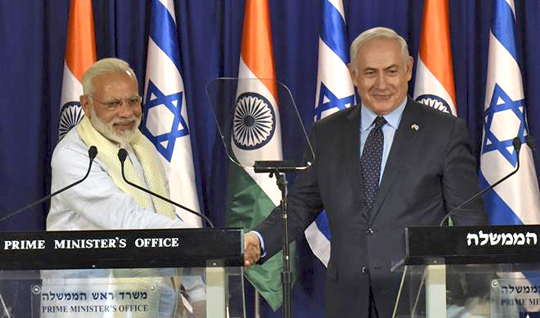
Jerusalem, Jul 5: Renowned Indian mathematician Srinivasa Ramanujan symbolises the talent of people of India, Israeli Prime Minister Benjamin Netanyahu said, emphasising that the two countries believe in the partnership of talent.

benjaman

Expressing his admiration for Ramanujan, Netanyahu said he was one of the greatest mathematicians of all times.

"We have a great admiration for people of India. I told you about my late uncle professor, who was a mathematician at the Israel Institute of Technology. He told me many times about his admiration for the great Indian mathematician Ramanujan," Netanyahu said in a statement along with Prime Minister Narendra Modi.

"He was perhaps the greatest mathematician in many centuries. And this symbolises the talent of people of India, as we know we have talent in Israel. We believe in this partnership of talent," he added.

Ramanujan, who died at an early age of 32, has contributed to mathematical analysis, including infinite series and continued fractions.

The Israeli prime minister said he and Modi both seek a better future for the people of the two countries.

"It requires a lot of work, it won't happen overnight but prime minister Modi and I want this to happen," he said.

Modi, the first Indian prime minister to visit the Jewish nation, received a warm welcome in Israel yesterday.

His three-day visit is aimed at commemorating 25 years of establishment of diplomatic ties between the two countries and will also see discussions between him and his Israeli counterpart Netanyahu to explore ways to enhance cooperation in key strategic areas.

Comments

Viren Kotian
 - 
Saturday, 8 Jul 2017

This is drama. Nothing has happened to him.

Add new comment

  • Coastaldigest.com reserves the right to delete or block any comments.
  • Coastaldigset.com is not responsible for its readers’ comments.
  • Comments that are abusive, incendiary or irrelevant are strictly prohibited.
  • Please use a genuine email ID and provide your name to avoid reject.
Agencies
February 10,2020

New Delhi, Fevb 10: Of the countries most at risk of importing coronavirus cases, India ranks 17th, researchers have found on the basis of a mathematical model for the expected global spread of the virus that originated in China's Wuhan area in December 2019.

So far, India has reported three coronavirus positive cases -- all from Kerala.

Among the airports in India, the Indira Gandhi International Airport in New Delhi is most at risk, followed by airports in Mumbai, Kolkata, Bengaluru, Chennai, Hyderabad and Kochi, according to the model.

The new model for predicting global novel coronavirus cases has been developed by researchers from Humboldt University and Robert Koch Institute in Germany.

"The spread of the virus on an international scale is dominated by air travel," said the study.

"Wuhan, the seventh largest city in China with 11 million residents, was the relevant major domestic air transportation hub with many connecting international flights before the city was effectively quarantined on January 23, 2020, and the Wuhan airport was closed. By then the virus had already spread to other Chinese provinces as well as other countries," it added.

The researchers said that it is possible to estimate how likely it is that the virus spreads to other areas by looking at air travel passenger numbers.

"The busier a flight route, the more probable it is that an infected passenger travels this route. Using these probabilistic concepts, we calculate the relative import risk to other airports. When calculating the import risk, we also take into account connecting flights and travel routes that involve multiple destinations," said the study.

The top 10 countries and regions at risk of importing coronavirus cases are: Thailand, Japan, South Korea, Hong Kong, Taiwan, USA, Vietnam, Malaysia, Singapore and Cambodia, according to the model.

While Thailand's national import risk is 2.1%, it is 0.2% for India, found the research.

The foundation of the model is the worldwide air transportation network (WAN) that connects approximately 4,000 airports with more than 25,000 direct connections.

The model accounts for both, the current distribution of confirmed cases in mainland China as well as airport closures that were implemented as a mitigation strategy.

This network theoretic model is based on the concept of effective distance and is an extension of a model introduced in the 2013 paper "The Hidden Geometry of Complex, Network-Driven Contagion Phenomena" published in the journal Science.

The current outbreak of the 2019-nCoV virus started in Wuhan city, Hubei province, China. While the first cases were reported as early as December 8, 2019, the outbreak gained global attention on December 31, 2019, when the World Health Organization was alerted to "several cases of pneumonia" by an unknown virus.

The new virus was soon identified as a novel coronavirus and named 2019-nCOV. It belongs to the family of viruses that include the common cold and viruses such as SARS and MERS. On January 20, 2020, it was confirmed that the coronavirus can be transmitted between humans, greatly increasing the risk of a global spread.

The death toll due to the novel coronavirus outbreak in China has increased to 811 on Sunday, surpassing that of the Severe Acute Respiratory Syndrome (SARS) epidemic in 2003.

Although about 20 countries have confirmed cases, China has accounted for about 99 per cent of those infected. The first foreign victims of the virus both died on Saturday in Wuhan.

Comments

Add new comment

  • Coastaldigest.com reserves the right to delete or block any comments.
  • Coastaldigset.com is not responsible for its readers’ comments.
  • Comments that are abusive, incendiary or irrelevant are strictly prohibited.
  • Please use a genuine email ID and provide your name to avoid reject.
News Network
July 2,2020

Lucknow, Jul 2: After a video showing health workers allegedly tossing bodies of coronavirus victims in a large pit in Karnataka, BSP President Mayawati on Wednesday stated that the incident is the "height of cruelty and insult to humanity".
The former UP Chief Minister demanded that the guilty must be punished.

"The tragedy that the bodies of COVID-19 victims being thrown into trenches in Ballari, Karnataka is the height of cruelty and an insult to humanity. Though incidents related to inhuman cruelty with corona patients are rampant but guilty of Ballari must be punished by the state government," Mayawati said in a tweet.

Also, in another tweet, she asked the Central government to extend the Pradhan Mantri Garib Kalyan Anna Yojana till the end of the coronavirus pandemic.

"In order to check ignominy of starvation on account of long unprecedented hardship & unemployment due to coronavirus and the subsequent nationwide lockdown, the PM Garib Kalyan Anna Yojna must continue not till November but till the end of the pandemic, this is the demand of BSP," she tweeted. 

Comments

Add new comment

  • Coastaldigest.com reserves the right to delete or block any comments.
  • Coastaldigset.com is not responsible for its readers’ comments.
  • Comments that are abusive, incendiary or irrelevant are strictly prohibited.
  • Please use a genuine email ID and provide your name to avoid reject.
News Network
March 2,2020

New Delhi, Mar 2: As communal violence spiked in north-east Delhi earlier this week, Hindu, Muslim and Sikh residents of a colony came together and stood guard against frenzied mobs which ran riot in nearby areas vandalising homes, shops and torching cars.

They have not let their guard down even as the situation is limping back to normalcy following four days of violence that has claimed at least 42 lives and left over 200 injured.

The B-Block colony in Yamuna Vihar has a Hindu-dominated Bahjanpura on one side and Muslim populated Ghonda on the other.

People from all faiths in the locality sit outside their homes at night and deal with any suspected outsider, Arib, a dentist in his 30s, said.

"It is the sloganeering by mobs that causes panic in the dead of night. Such slogans are from both sides and we hear groups of people moving forward towards our area.

"This is where we let the Muslim locals deal with Muslim groups and Hindu residents deal with Hindu groups coming from outside," he said.

Businessmen, doctors and people working at government offices stuck together as violence reached its crest on Monday and Tuesday, and have been guarding the locality round the clock.

Earlier, the locals had claimed inadequate police deployment in the area, but were satisfied as patrolling by security personnel increased in the last two days.

Charanjeet Singh, a Sikh who owns a transport firm, said residents have ensured that not too many people gather to guard the colony at night. It has been decided not use sticks or rods, an idea which seems to have worked in maintaining peace, he said.

"I was 10 years old when we came to this locality from Uttar Pradesh's Meerut in 1982. There were riots in 1984 and tension in 2002, but even then our area remained peaceful. We have always been united and that is the way we have helped each other," Singh, who is now in his 50s, told PTI.

Faisal, a businessman in his 30s, said after two days of major violence, there was palpable tension in the area. "Nobody could sleep in the neighbourhood even on Wednesday and Thursday when the situation was brought under control," he said.

Faisal said around 4 am on Wednesday, three to four miscreants had torched a car, but were chased away by vigilant residents. They raised an alarm and others gathered, saving other vehicles parked nearby from being damaged, he added.

On the idea of not keeping sticks while guarding B-Block, Singh said, "Violence begets violence, crowd begets crowd. We thought if somebody would see sticks or rods in our hands from a distance and large crowds standing guard, it is likely they would want to come prepared. This could fuel violence."

"Now, if there is some young man returning late in the night, we identify if he belongs to our area. If not, we normally inform him about the situation and guide him to his destination, if required," he added.

Seventy-year-old V K Sharma said people in his colony never had any trouble with each other, as he blamed "outside elements" for the violence in north-east Delhi.

"Some people have some problem with symbols. If they find a particular religion's symbol on a shop, home or a car, they vandalise it.

"This is on both sides, Hindus as well as Muslims. But not all people in all religion are like that. There are good people who outnumber these handful people involved in violence," he said.

The violence happened for two days but it would take months for fear to subside, Sharma said, as he took out his two granddaughters, aged nine and two, out for ice cream.

"I cannot reduce the tension outside my home, but at least I can make these kids feel good by reducing their craving for ice cream,” he added.

Colony resident Shiv Kumar, a property consultant, and Wasim, a government official, said they too were members of this voluntary guards' team of the colony which stays up at night to fend off miscreants.


Comments

Add new comment

  • Coastaldigest.com reserves the right to delete or block any comments.
  • Coastaldigset.com is not responsible for its readers’ comments.
  • Comments that are abusive, incendiary or irrelevant are strictly prohibited.
  • Please use a genuine email ID and provide your name to avoid reject.