Ramanujan symbolises talent of people of India: Netanyahu

Agencies
July 5, 2017

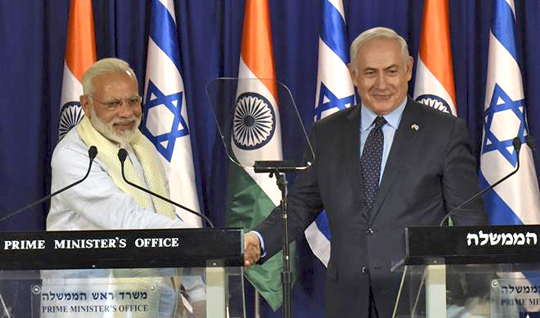
Jerusalem, Jul 5: Renowned Indian mathematician Srinivasa Ramanujan symbolises the talent of people of India, Israeli Prime Minister Benjamin Netanyahu said, emphasising that the two countries believe in the partnership of talent.

benjaman

Expressing his admiration for Ramanujan, Netanyahu said he was one of the greatest mathematicians of all times.

"We have a great admiration for people of India. I told you about my late uncle professor, who was a mathematician at the Israel Institute of Technology. He told me many times about his admiration for the great Indian mathematician Ramanujan," Netanyahu said in a statement along with Prime Minister Narendra Modi.

"He was perhaps the greatest mathematician in many centuries. And this symbolises the talent of people of India, as we know we have talent in Israel. We believe in this partnership of talent," he added.

Ramanujan, who died at an early age of 32, has contributed to mathematical analysis, including infinite series and continued fractions.

The Israeli prime minister said he and Modi both seek a better future for the people of the two countries.

"It requires a lot of work, it won't happen overnight but prime minister Modi and I want this to happen," he said.

Modi, the first Indian prime minister to visit the Jewish nation, received a warm welcome in Israel yesterday.

His three-day visit is aimed at commemorating 25 years of establishment of diplomatic ties between the two countries and will also see discussions between him and his Israeli counterpart Netanyahu to explore ways to enhance cooperation in key strategic areas.

Comments

Viren Kotian
 - 
Saturday, 8 Jul 2017

This is drama. Nothing has happened to him.

Add new comment

  • Coastaldigest.com reserves the right to delete or block any comments.
  • Coastaldigset.com is not responsible for its readers’ comments.
  • Comments that are abusive, incendiary or irrelevant are strictly prohibited.
  • Please use a genuine email ID and provide your name to avoid reject.
May 18,2020

New Delhi, May 18: Very severe cyclonic storm ‘Amphan’, over central parts of South Bay of Bengal, has intensified into extremely severe cyclonic storm, the India Meteorological Department (IMD) said on Monday. The weather department has warned that ‘Amphan’ may turn into a “super cyclonic storm’.

According to experts, North Odisha coast will face the maximum impact of cyclone Amphan when it makes landfall.

“Wind speed expected to be 110-120 kmph, gusting up to 130 kmph. Balasore, Bhadrak, Jajpur, Mayurbhanj dist can be affected on 20 May (when it makes landfall), IMD Bhubaneswar scientist Umashankar Das told news agency ANI.

The IMD has said that ‘Amphan’ will cross West Bengal - Bangladesh coasts between Digha (WB) and Hatiya island - in the afternoon/evening of May 20 as very severe cyclonic storm.

Earlier, the IMD had warned that ‘Amphan’, over central parts of South Bay of Bengal, will intensify into an extremely severe cyclonic storm on Monday.

“Very Severe Cyclonic Storm (VSCS) ‘AMPHAN’ over central parts of South Bay of Bengal near latitude 12.5°N and longitude 86.4°E, about 870 km nearly south of Paradip (Odisha). To intensify further into an Extremely Severe Cyclonic Storm (ESCS) in the next six hours,” the IMD said in a tweet on Monday.

National Disaster Response Force (NDRF) has sent its 10 teams to Odisha and seven teams to West Bengal in view of the approaching Cyclone Amphan, news agency reported.

Comments

Add new comment

  • Coastaldigest.com reserves the right to delete or block any comments.
  • Coastaldigset.com is not responsible for its readers’ comments.
  • Comments that are abusive, incendiary or irrelevant are strictly prohibited.
  • Please use a genuine email ID and provide your name to avoid reject.
News Network
February 2,2020

Feb 2: Prime Minister Narendra Modi’s second budget in seven months disappointed investors who were hoping for big-bang stimulus to revive growth in Asia’s third-largest economy.

The fiscal plan -- delivered by Finance Minister Nirmala Sitharaman on Saturday -- proposed tax cuts for individuals and wider deficit targets but failed to provide specific steps to fix a struggling financial sector, improve infrastructure and create jobs. Stocks slumped as a proposal to scrap the dividend distribution tax for companies failed to impress investors.

"Far from being a game changer, the budget provides little in terms of short-term growth stimulus,” said Priyanka Kishore, head of India and South East Asia economics at Oxford Economics Ltd. in Singapore. “While income tax cuts will provide some relief on the consumption front, the multiplier effect is low and the overall stance of the budget is not expansionary."

India has gone from being the world’s fastest-growing major economy three years ago, expanding at 8%, to posting its weakest performance in more than a decade this fiscal year, estimated at 5%.

While the government has taken a number of steps in recent months to spur growth, they’ve fallen short of spurring demand in the consumption-driven economy. Saturday’s budget just added to the glum sentiment.

Okay Budget

“It’s an okay budget but not firing on all cylinders that the market was hoping for,” said Andrew Holland, chief executive officer at Avendus Capital Alternate Strategies in Mumbai.

The government had limited scope for a large stimulus given a huge shortfall in revenues in the current year. The slippage induced Sitharaman to invoke a never-used provision in fiscal laws, allowing the government to exceed the budget gap by 0.5 percentage points. The result: the deficit for the year ending March was widened to 3.8% of gross domestic product from a planned 3.3%.

On Friday, India’s chief economic adviser Krishnamurthy Subramanian said reviving economic growth was an “urgent priority” and deficit goals could be relaxed to achieve that. The adviser’s Economic Survey estimated growth will rebound to 6%-6.5% in the year starting April.

The fiscal gap will narrow to 3.5% next year, as the government budgeted for gross market borrowing to rise marginally to 7.8 trillion rupees from 7.1 trillion rupees in the current year. A plan to earn 2.1 trillion rupees by selling state-owned assets in the year starting April will also help plug the deficit.

Total spending in the coming fiscal year will increase to 30.4 trillion rupees, representing a 13% increase from the current year’s budget, according to latest data.

Key highlights from the budget:

* Tax on annual income up to 1.25 million rupees pared, with riders

* Dividend distribution tax to be levied on investors, instead of companies

* Farm sector budget raised 28%, transport infrastructure gets 7% more

* Spending on education raised 5%

* Fertilizer subsidy cut 10%

Analysts said the muted spending plan to keep the deficit in check will lead to more downside risks to growth in the coming months.

“It is very doubtful that the increase in expenditure will push demand much,” Chakravarthy Rangarajan, former governor at the Reserve Bank of India told BloombergQuint, adding that achieving next year’s budget deficit goal of 3.5% of GDP was doubtful.

With the government sticking to a conservative fiscal path, the focus will now turn to central bank, which is set to review monetary policy on Feb. 6. Given inflation has surged to a five-year high of 7.35%, the RBI is unlikely to lower interest rates.

What Bloomberg’s Economists Say:

The burden of recovery now falls solely on the Reserve Bank of India. With inflation breaching RBI’s target at present, any rate cuts by the central bank are likely to be delayed and contingent upon inflation falling below the upper end of its 2%-6% target range.

-- Abhishek Gupta, India economist

Governor Shaktikanta Das may instead focus on unconventional policy tools such as the Federal Reserve-style Operation Twist -- buying long-end debt while selling short-tenor bonds -- to keep borrowing costs down.

Comments

Add new comment

  • Coastaldigest.com reserves the right to delete or block any comments.
  • Coastaldigset.com is not responsible for its readers’ comments.
  • Comments that are abusive, incendiary or irrelevant are strictly prohibited.
  • Please use a genuine email ID and provide your name to avoid reject.
Agencies
June 6,2020

United Nations, Jun 6: The coronavirus disease has not "exploded" in India, but the risk of that happening remains as the country moves towards unlocking its nationwide lockdown that was imposed in March to contain the Covid-19, according to a top WHO expert.

WHO Health Emergencies Programme Executive Director Michael Ryan on Friday said the doubling time of the coronavirus cases in India is about three weeks at this stage.

“So the direction of travel of the epidemic is not exponential but it is still growing,” he said, adding that the impact of the pandemic is different in different parts of India and varies between urban and rural settings.

“In South Asia, not just in India but in Bangladesh and...in Pakistan, other countries in South Asia, with large dense populations, the disease has not exploded. But there is always the risk of that happening,” Ryan said in Geneva.

He stressed that as the disease generates and creates a foothold in communities, it can accelerate at any time as has been seen in a number of settings.

Ryan noted that measures taken in India such as the nationwide lockdown have had an impact in slowing transmission but the risk of an increase in cases looms as the country opens up.

“The measures taken in India certainly had an impact in dampening transmission and as India, as in other large countries, open up and as people begin to move again, there's always a risk of the disease bouncing back up,” he said.

He added that there are specific issues in India regarding the large amount of migration, the dense populations in the urban environment and the fact that many workers have no choice but to go to work every day.

India went past Italy to become the sixth worst-hit nation by the COVID-19 pandemic.

India saw a record single-day jump of 9,887 coronavirus cases and 294 deaths on Saturday, pushing the nationwide infection tally to 2,36,657 and the death toll to 6,642, according to the health ministry.

The lockdown in India, was first clamped on March 25 and spanned for 21 days, while the second phase of the curbs began on April 15 and stretched for 19 days till May 3. The third phase of the lockdown was in effect for 14 days and ended on May 17. The fourth phase ended on May 31.

The country had registered 512 coronavirus infection cases till March 24.

The nation-wide lockdown in containment zones will continue till June 30 in India but extensive relaxations in a phased manner from June 8 are listed in the Union home ministry's fresh guidelines on tackling the Covid-19 pandemic issued last week.

WHO Chief Scientist Soumya Swaminathan said the over 200,000 current coronavirus cases in India, a country of over 1.3 billion people, "look big but for a country of this size, it's still modest.”

She stressed that it is important for India to keep track of the growth rate, the doubling time of the virus and to make sure that that number doesn't get worse.

She said that India is a “heterogeneous and huge country” with very densely populated cities and much lower density in some rural areas and varying health systems in different states and these offer challenges to the control of Covid-19.

Swaminathan added that as the lockdown and restrictions are lifted, it must be ensured that all precautions are taken by people.

“We've been making this point repeatedly that really if you want behaviour change at a large level, people need to understand the rationale for asking them to do certain things (such as) wearing masks,” she said.

In many urban areas in India, it's impossible to maintain physical distancing, she said adding that it then becomes very important for people to wear appropriate face coverings when they are out, in office settings, in public transport and educational institutions.

“As some states are thinking about opening, every institution, organisation, industry and sector needs to think about what are the measures that need to be put in place before you can allow a functioning and it may never be back to normal.”

She said that in many professions working from home can be encouraged but in several jobs, people have to go to work and in such cases measures must be put in place that allow people to protect themselves and others.

“I think communication and behaviour change is a very large part of this whole exercise,” she added.


Comments

Add new comment

  • Coastaldigest.com reserves the right to delete or block any comments.
  • Coastaldigset.com is not responsible for its readers’ comments.
  • Comments that are abusive, incendiary or irrelevant are strictly prohibited.
  • Please use a genuine email ID and provide your name to avoid reject.