Ramanujan symbolises talent of people of India: Netanyahu

Agencies
July 5, 2017

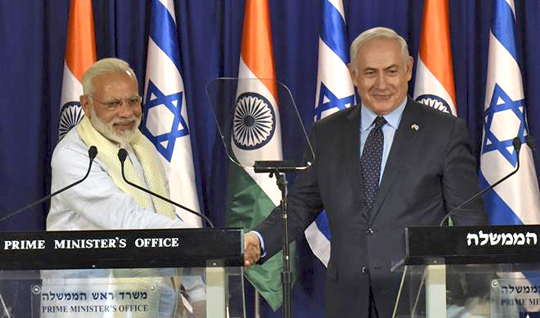
Jerusalem, Jul 5: Renowned Indian mathematician Srinivasa Ramanujan symbolises the talent of people of India, Israeli Prime Minister Benjamin Netanyahu said, emphasising that the two countries believe in the partnership of talent.

benjaman

Expressing his admiration for Ramanujan, Netanyahu said he was one of the greatest mathematicians of all times.

"We have a great admiration for people of India. I told you about my late uncle professor, who was a mathematician at the Israel Institute of Technology. He told me many times about his admiration for the great Indian mathematician Ramanujan," Netanyahu said in a statement along with Prime Minister Narendra Modi.

"He was perhaps the greatest mathematician in many centuries. And this symbolises the talent of people of India, as we know we have talent in Israel. We believe in this partnership of talent," he added.

Ramanujan, who died at an early age of 32, has contributed to mathematical analysis, including infinite series and continued fractions.

The Israeli prime minister said he and Modi both seek a better future for the people of the two countries.

"It requires a lot of work, it won't happen overnight but prime minister Modi and I want this to happen," he said.

Modi, the first Indian prime minister to visit the Jewish nation, received a warm welcome in Israel yesterday.

His three-day visit is aimed at commemorating 25 years of establishment of diplomatic ties between the two countries and will also see discussions between him and his Israeli counterpart Netanyahu to explore ways to enhance cooperation in key strategic areas.

Comments

Viren Kotian
 - 
Saturday, 8 Jul 2017

This is drama. Nothing has happened to him.

Add new comment

  • Coastaldigest.com reserves the right to delete or block any comments.
  • Coastaldigset.com is not responsible for its readers’ comments.
  • Comments that are abusive, incendiary or irrelevant are strictly prohibited.
  • Please use a genuine email ID and provide your name to avoid reject.
News Network
February 11,2020

Aligarh, Feb 11: Paediatrician Dr Kafeel Khan, who was arrested from Mumbai on January 29 after he delivered a speech at Aligarh Muslim University (AMU) against communalism and politics of hate, will be released from jail on Tuesday after he was granted bail by an Aligarh court.

Khan will be released from Mathura jail on Tuesday after legal formalities are completed.

Chief judicial magistrate Karuna Singh granted bail to Khan on Monday on a bail bond of Rs 60,000. Two surety bonds of Rs 60,000 each would also be furnished by the guarantors.

Dr Khan's lawyer, Mohammad Irfan Gazi, told reporters, "The court was told that Khan was falsely implicated by police under political pressure. After hearing the arguments, the court granted him bail."

The suspended doctor was arrested by special task force (STF) of the UP police from Mumbai on January 29, when he reached the city to attend a protest against the Citizenship (Amendment) Act.

He was arrested in connection with a case registered against him in Aligarh under section 153-A (promoting enmity between different groups on ground of religion) of the Indian Penal Code at Civil Lines police station on December 13

The case was filed after his speech at Aligarh Muslim University (AMU).

According to the FIR, while addressing students, without naming anyone, Dr Kafeel Khan said that 'Mota Bhai' is teaching everyone to become Hindu or Muslim but not a human being. "This is a fight for our existence. We have to fight."

The FIR also said that Dr Kafeel Khan made an attempt to vitiate the peaceful atmosphere and disturb the communal harmony with his speech.

Dr Khan was in the news in 2017 when he was named as one of the nine accused in a case involving deaths of several children due to alleged disruption in supply of oxygen at the BRD Medical College in Gorakhpur. Though he was granted clean chit in a departmental inquiry, his suspension has not yet been revoked.

Comments

Add new comment

  • Coastaldigest.com reserves the right to delete or block any comments.
  • Coastaldigset.com is not responsible for its readers’ comments.
  • Comments that are abusive, incendiary or irrelevant are strictly prohibited.
  • Please use a genuine email ID and provide your name to avoid reject.
News Network
July 22,2020

New Delhi, Jul 22: India is responding with utmost urgency to coronavirus from the very beginning and has been continuously strengthening preparedness and response measures, WHO Regional Director (South-East Asia) Poonam Khetrapal Singh said on Wednesday.

"India is responding with utmost urgency to COVID-19 from the start. It's been continuously strengthening preparedness and response measures, including ramping up testing capacities, readying more hospitals, arranging and stocking up medicines and essentials," Singh said at a virtual briefing.

"India took bold, decisive and early measures earlier in the outbreak. The country did not witness an exponential increase in cases like some other countries which reported their first few cases along with India. Like in any other country the transmission of COVID-19 is not homogenous in India. There are areas yet to see a confirmed case, some have sporadic cases, in some areas some small clusters while we are witnessing large clusters in some megacities from the densely populated areas," Singh said.
She said WHO was aware of varying capacities at sub-national levels.

"Not unusual in a country as big as India and its population size that measures taken may often not be uniformly sufficient across all areas. Scaling up capacities and response remains a constant need in India."

Replying on the question of what more needs to be done in controlling the spread of COVID-19, she said all countries including India must continue to implement core public health and social distancing measures.

"Local epidemiology to guide our response for finding hotspots and testing, detecting, isolating and providing care to the affected, promoting safe hygiene practices and respiratory etiquette, protecting health workers and increasing health system capacity is also key," she said.

Comments

Add new comment

  • Coastaldigest.com reserves the right to delete or block any comments.
  • Coastaldigset.com is not responsible for its readers’ comments.
  • Comments that are abusive, incendiary or irrelevant are strictly prohibited.
  • Please use a genuine email ID and provide your name to avoid reject.
coastaldigest.com web desk
June 16,2020

New Delhi, Jun 16: Despite Prime Minister Narendra Modi led government’s attempt to downplay the border dispute with China, matters have heated up unprecedentedly along the Line of Actual Control (LAC)- the effective Sino-India border in Eastern Ladakh. 

The country has lost three precious lives – an army officer and two soldiers. The last time blood was spilled on the LAC, before the latest episode, was 45 years ago when the Chinese ambushed an Assam Rifles patrol in Tulung La.

India had lost four soldiers on October 20, 1975 in Tulung La, the last time bullets were fired on the India-China border though both the countries witnessed bitter stand-offs later at Sumdorong Chu valley in 1987, Depsang in 2013, Chumar in 2014 and Doklam in 2017.

Between 1962 and 1975, the biggest clash between India and China took place in Nathu La pass in 1967 when reports suggest that around 80 Indian soldiers were killed and many more Chinese personnel.

While three soldiers, including a Commanding Officer, were killed in the latest episode in Galwan Valley, the government describes it as a "violent clash" and does not mention opening fire.

New Delhi described the locality where the 1975 incident took place as "well within" its territory only to be rebuffed by Beijing as "sheer reversal of black and white and confusion of right and wrong".

The Ministry of External Affairs had then said that the Chinese had crossed the LAC and ambushed the soldiers while Beijing claimed the Indians entered their territory and did not return despite warnings.

The Indian government maintained that the ambush on the Assam Rifles' patrol in 1975 took place "500 metres south of Tulung" on the border between India and Tibet and "therefore in Indian territory". It said Chinese soldiers "penetrating" Indian territory implied a "change in China's position" on the border question but the Chinese denied this and blamed India for the incident.

The US diplomatic cables quoted an Indian military intelligence officer saying that the Chinese had erected stone walls on the Indian side of Tulung La and from these positions fired several hundred rounds at the Indian patrol.

"Four of the Indians had gone into a leading position while two (the ones who escaped) remained behind. The senior military intelligence officer emphasised that the soldiers on the Indian patrol were from the area and had patrolled that same region many times before," the cable said.

One of the US cables showed that former US Secretary of State and National Security Adviser Henry Kissinger sought details of the October 1975 clash "without approaching the host governments on actual location of October 20 incident". He also wanted to know what ground rules were followed regarding the proximity of LAC by border patrols.

A cable sent from the US mission in India on November 4, 1975 appeared to have doubts about the Chinese account saying it was "highly defensive".

"Given the unsettled situation on the sub-continent, particularly in Bangladesh, both Chinese and Indian authorities have authorised stepped up patrols along the disputed border. The clash may well have ensued when two such patrols unexpectedly encountered each other," it said.

Another cable from China on the same day quoted another October 1974 cable, which spoke about Chinese officials being concerned for long that "some hotheaded person on the PRC (People's Republic of China) might provoke an incident that could lead to renewed Sino-Indian hostilities. It went on to say that this clash suggested that "such concerns and apprehensions are not unwarranted".

According to the United States diplomatic cables, Chinese Foreign Ministry on November 3, 1975 disputed the statement of the MEA spokesperson, who said the incident took place inside Indian territory.

The Chinese had said "sheer reversal of black and white and confusion of right and wrong". In its version of the 1975 incident, they said Indian troops crossed the LAC at 1:30 PM at Tulung Pass on the Eastern Sector and "intruded" into their territory when personnel at the Civilian Checkpost at Chuna in Tibet warned them to withdraw.

Ignoring this, they claimed, Indian soldiers made "continual provocation and even opened fire at the Chinese civilian checkpost personnel, posing a grave threat to the life of the latter. The Chinese civilian checkpost personnel were obliged to fire back in self defence."

The Chinese Foreign Ministry spokesperson had also said they told the Indian side that they could collect the bodies "anytime" and on October 28, collected the bodies, weapons and ammunition and "signed a receipt".

The US cables from the then USSR suggested that the official media carried reports from Delhi on the October 1975 incident and they cited only Indian accounts of the incident "ridiculing alleged Chinese claims that the Indians crossed the line and opened fire first".


Comments

Add new comment

  • Coastaldigest.com reserves the right to delete or block any comments.
  • Coastaldigset.com is not responsible for its readers’ comments.
  • Comments that are abusive, incendiary or irrelevant are strictly prohibited.
  • Please use a genuine email ID and provide your name to avoid reject.