Ramanujan symbolises talent of people of India: Netanyahu

Agencies
July 5, 2017

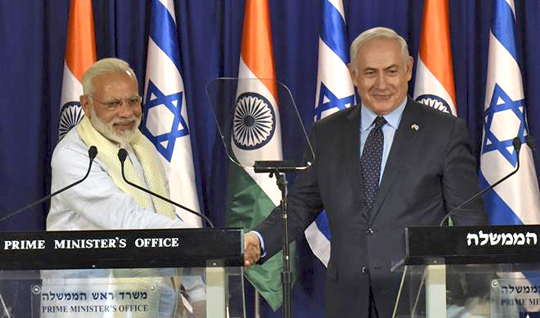
Jerusalem, Jul 5: Renowned Indian mathematician Srinivasa Ramanujan symbolises the talent of people of India, Israeli Prime Minister Benjamin Netanyahu said, emphasising that the two countries believe in the partnership of talent.

benjaman

Expressing his admiration for Ramanujan, Netanyahu said he was one of the greatest mathematicians of all times.

"We have a great admiration for people of India. I told you about my late uncle professor, who was a mathematician at the Israel Institute of Technology. He told me many times about his admiration for the great Indian mathematician Ramanujan," Netanyahu said in a statement along with Prime Minister Narendra Modi.

"He was perhaps the greatest mathematician in many centuries. And this symbolises the talent of people of India, as we know we have talent in Israel. We believe in this partnership of talent," he added.

Ramanujan, who died at an early age of 32, has contributed to mathematical analysis, including infinite series and continued fractions.

The Israeli prime minister said he and Modi both seek a better future for the people of the two countries.

"It requires a lot of work, it won't happen overnight but prime minister Modi and I want this to happen," he said.

Modi, the first Indian prime minister to visit the Jewish nation, received a warm welcome in Israel yesterday.

His three-day visit is aimed at commemorating 25 years of establishment of diplomatic ties between the two countries and will also see discussions between him and his Israeli counterpart Netanyahu to explore ways to enhance cooperation in key strategic areas.

Comments

Viren Kotian
 - 
Saturday, 8 Jul 2017

This is drama. Nothing has happened to him.

Add new comment

  • Coastaldigest.com reserves the right to delete or block any comments.
  • Coastaldigset.com is not responsible for its readers’ comments.
  • Comments that are abusive, incendiary or irrelevant are strictly prohibited.
  • Please use a genuine email ID and provide your name to avoid reject.
News Network
May 24,2020

New Delhi, May 24: The Indian economy is likely to slip into recession in the third quarter of this fiscal as loss in income and jobs and cautiousness among consumers will delay recovery in consumer demand even after the pandemic, says a report.

According to Dun & Bradstreet's latest Economic Observer, the country's economic recovery will depend on the efficacy and duration of implementation of the government's stimulus package.

"The multiplier effect of the stimulus measures on the economy will depend on three key aspects i.e. the time taken for effecting the withdrawal of the lockdown, the efficacy of implementation and duration of execution of the measures announced," Dun & Bradstreet India Chief Economist Arun Singh said.

The report noted that the government's larger-than-expected stimulus package is likely to re-start economic activities.

Besides, measures taken by the Reserve Bank of India like reducing the repo rate by a further 40 basis points to 4 per cent, extending the moratorium period by three months and facilitating working capital financing will also help stimulate the momentum.

Singh said while the measures announced by the government are "positive", most of them have been directed towards strengthening the supply side of the economy, and "it is to be noted that supply needs to be matched with demand", he said.

Besides, "in the absence of cash-in-hand benefits under the government's stimulus package, demand for goods and services is expected to remain depressed", he added.

He further said the loss in income and employment opportunities, and cautiousness among consumers, will lead to a delayed recovery in consumer demand, even after the pandemic. As debt and bad loan levels increase, the banking sector might face challenges.

The report further noted that even as the monetary stimulus is expected to inject liquidity and stimulate demand for a wider section of the economy, the channelisation of funds from the financial institutions will be subjected to several constraints.

The foremost concern being increase in risk averseness, as the balance sheets of firms, households, and banks/NBFCs have weakened considerably and low demand for funds by firms as production activities have been on a standstill during the lockdown period, Singh said.

India has been under lockdown since March 25 to contain the spread of the coronavirus, resulting in supply disruptions and demand compression.

Prime Minister Narendra Modi imposed a nationwide lockdown to control the spread of coronavirus on March 25. It has been extended thrice, with some relaxations. The fourth phase of the lockdown is set to expire on May 31. 

Comments

Add new comment

  • Coastaldigest.com reserves the right to delete or block any comments.
  • Coastaldigset.com is not responsible for its readers’ comments.
  • Comments that are abusive, incendiary or irrelevant are strictly prohibited.
  • Please use a genuine email ID and provide your name to avoid reject.
News Network
April 11,2020

Apr 11: India has sent back 20,473 foreigners who wanted to return to their countries following the Covid-19 global pandemic, it was revealed on Friday (April 10).

"So far, we have successfully evacuated 20,473 foreign nationals as of yesterday. This is an ongoing process," said Dammu Ravi, Coordinator on Covid-19 issues at the Ministry of External Affairs, MEA.

"This involves several countries," Ravi said during the daily government briefing on Covid-19, although he could not list the countries offhand. "We are receiving excellent cooperation from governments all over the world for this process."

Many foreigners, especially tourists, were stranded in India when domestic and international flights were abruptly cancelled last month in a bid to curb transmission of the coronavirus.

The Ministry of Tourism has asked stranded foreigners to get in touch with the government through a special portal started for the purpose, through their embassies in India and other sources to facilitate their evacuation if they wished to head home.

As of Friday evening, the Ministry of Health and Family Welfare had confirmed 6,761 Covid-19 cases in India, of whom 515 patients have been cured.

There were 206 deaths reported from across the country.

Two states, Punjab and Orissa, have extended the ongoing lockdown until April 30.

Prime Minister Narendra Modi will consult state chief ministers on Saturday to decide whether to extend the country-wide lockdown, which is due to end at midnight on April 14.

Comments

Add new comment

  • Coastaldigest.com reserves the right to delete or block any comments.
  • Coastaldigset.com is not responsible for its readers’ comments.
  • Comments that are abusive, incendiary or irrelevant are strictly prohibited.
  • Please use a genuine email ID and provide your name to avoid reject.
News Network
February 10,2020

New Delhi, Feb 10: Former finance minister P Chidambaram on Monday tore into the Modi government's handling of the economy, saying it was close to collapse and was been attended by "very incompetent doctors."

Initiating the debate on the Union Budget for 2020-21, he said rising unemployment and falling consumption was making India poorer.

The economy, he said, is facing demand constraints and is investment starved. The economy is facing fall in consumption and rising unemployment.

"Fear and uncertainty prevails in the country," he added.

He said the chief economic advisor to the BJP government for four years, Arvind Subramanian has stated that the economy is in the ICU. But "I would say the patient has been kept out of ICU and incompetent doctors are looking at the patient," Chidambaram said.

"It is dangerous to have a patient out of ICU and being looked upon by incompetent doctors. What is the point standing around and chanting slogan 'Sab ka saath, sab ka vishwas'," he said, adding every competent doctor the Modi government could ever identify has left the country.

His said a list of such people included former RBI governor Raghurman Rajan, former CEA Arvind Subramanian, former RBI governor Urjit Patel and former NITI Aayog vice chairman Arvind Panagariya.

"Who are your doctors, I want to know," he said, adding the government considers Congress as untouchable and doesn't think of any good about the rest of the opposition and so doesn't consult them.

Chidambaram charged that instead of putting money in the hands of people, the Modi government "put money in hands of 200 corporates" by way of corporate tax.

He said Finance Minister Nirmala Sitharaman in her 160- minute budget speech did not talk of the economy and its management.

"You are living in echo chambers. You want to hear your own voice," he said.

Listing problems with the Modi government, Chidambaram said it refuses to admits in mistakes, lives in denial and has predispositions.

The demonetisation of old 1000 and 500 rupee notes, as well as the hurried implementation of the Goods and Services Tax (GST), are "monumental blunders" that ruined the economy, he said, adding the Modi regime is predisposed to protectionism, a 'strong' rupee and is against bilateral and multilateral agreements.

"It is living in denial," he said, adding the economic growth has fallen for hereto unseen six consecutive quarters.

He wondered on the narrative Finance Minister Nirmala Sitharaman was trying to give after reading out a 160-minute budget speech with few pages left unread.

Her budget neither made any reference to the Economic Survey nor picked up a single idea from it, he said.

Chidambaram, who is credited with presenting a 'dream budget' more than two decades back, said the GDP growth has declined for six consecutive quarters, agriculture is growing by just 2 per cent, while consumer price inflation has risen from 1.9 per cent in January 2019 to 7.4 per cent in a matter of 11 months.

Also, food inflation is at 12.2 per cent. Bank credit is growing 8 per cent with non-food credit rising by 7-8 per cent and credit to industry by just 2.7 per cent. Credit to agriculture has declined from 18.3 per cent to 5.3 per cent and that for MSMEs from 6.7 per cent to 1.6 per cent.

Overall industrial index showed just 0.6 per cent growth. "Every major industry is either near zero or in negative zone," he said, adding thermal power plants are operating at just 55 per cent of the capacity as factories have either closed or are on the verge of closure.

"That gives you a good picture of the state of economy. You don't require MRI," he said. "You are in management for six years. How long can you blame previous managers."

He charged the government with burying unfavourable reports such as the labour survey that put unemployment at 45 -year high of 6.1 per cent at end of 2017-18. Also, consumer expenditure has falling to 3.7 per cent between 2011-12 and 2017-18.

Drilling holes in Budget numbers, he said the 2019-20 budget projected a nominal GDP growth of 12 per cent but ended with just 8.5 per cent. Fiscal deficit was targeted to be shrunk to 3.3 per cent of the GDP but ended by at 3.8 per cent and in the next fiscal it is being targeted at 3.5 per cent.

Revenue deficit was targeted at 2.3 per cent in fiscal ending March 31, 2020 but ended up at 2.4 per cent and in the next it will rise to 2.8 per cent, he said, adding capital expenditure in the next fiscal will shrink to 0.7 per cent from 1.4 per cent in the current.

Net tax revenue in the current fiscal was targeted at Rs 16.49 lakh crore but only Rs 9 lakh crore was collected in first nine months till December 2019 and "you want us to believe this will rise to Rs 15 lakh crore by March 2020," he said.

Similarly, expenditure in 2019-20 was pegged at Rs 27.86 lakh crore but only Rs 11.78 lakh crore spent during April- December and by March this is projected to rise to Rs 27 lakh crore.

"You have no money to spend... and these are masked by numbers," he said. "Numbers are not easily acceptable or believable."

Chidambaram said the government is facing shortfall in all forms of taxes - Rs 1.56 lakh crore on corporate tax, Rs 10,000 crore on personal income tax, Rs 30,000 crore on customs, Rs 52,000 crore on excise and Rs 51,000 crore on GST.

This despite "the extraordinary powers" and "all kinds of power" given to lower level tax officials, he said.

He read of list of heads under which allocation has fallen - food subsidy, agriculture, PM-Kisan, rural roads, mid-day meal scheme, ICDS, skill development, Ayushman Bharat, rural development and MGNEGA.


Comments

Add new comment

  • Coastaldigest.com reserves the right to delete or block any comments.
  • Coastaldigset.com is not responsible for its readers’ comments.
  • Comments that are abusive, incendiary or irrelevant are strictly prohibited.
  • Please use a genuine email ID and provide your name to avoid reject.