Rape and murder of girl in temple is a small issue: New J&K Deputy CM

coastaldigest.com web desk
April 30, 2018

Srinagar, Apr 30: Within an hour of taking oath as the new Deputy Chief Minister of in Mehbooba Mufti coalition government of Jammu and Kashmir, Kavinder Gupta debuted with a shocker on the rape and murder of an eight-year-old girl at a temple in Kathua earlier this year.

"It’s a small issue... We have to think this should never happen again and the child gets justice. There are many challenges like this facing the government. We should not give Rasana so much bhaav (importance)," Mr Gupta told reporters.

The comment was received with shock and disbelief after a revamp that was linked widely to the outrage over the BJP's former ministers participating in a rally in support of the men arrested for kidnapping, drugging, gang-raping and murdering the child in a temple in Kathua's Rasana village.

All eight accused are pro-BJP while the little girl belonged to a Muslim nomadic tribe.

Questions were also raised over the inclusion in the cabinet of Rajiv Jasrotia, the BJP legislator from Kathua, who had participated in the Hindu Ekta Manch Rally in support of the rapist-killers.

Also Read: BJP leader took part in rally to defend Kathua rapists promoted as minister

Comments

Hameed INDIAN
 - 
Tuesday, 1 May 2018

Let this fellow think  for a while what could have been his approach when his daughter is put in Asifa's place. It gives suspicion that Mr. Gupta has some "Gupta" link with accused?. Why these fellows are devoid of humanity at least??......


AG
 - 
Tuesday, 1 May 2018

Its a Small Issue to you because you are not a Human and that girl is not your Daughter. Cant imagine if you have a Daughter how she will react by hearing your Comments. Shame on you.. 

Mr Frank
 - 
Tuesday, 1 May 2018

Really it is a small issue if you agrees that it also applies to my daughter,sister,and mother.

A Kannadiga
 - 
Monday, 30 Apr 2018

​​​​​​Mr. Gupta, it is a small issue because the innocent girl raped was not your daughter.  

Shocked Indian
 - 
Monday, 30 Apr 2018

Aren't you a human, a father? Don't you have a child? Why don't they think before uttering words? 

Sindhu
 - 
Monday, 30 Apr 2018

Not surprised. This is what I expect from Sangh Parivar. Your language shows your culture

Pulimunchi
 - 
Monday, 30 Apr 2018

If this is minor, then what is a major incident? Just because the girl is a Muslim the incident become a small issue for you?

Add new comment

  • Coastaldigest.com reserves the right to delete or block any comments.
  • Coastaldigset.com is not responsible for its readers’ comments.
  • Comments that are abusive, incendiary or irrelevant are strictly prohibited.
  • Please use a genuine email ID and provide your name to avoid reject.
News Network
April 23,2020

Washington, Apr 23: Air pollution over northern India has plummeted to a 20-year-low for this time of the year, according to satellite data published by US space agency National Aeronautics and Space Administration (NASA).
The US space agency's satellite sensors observed aerosol levels at a 20-year low post the countrywide lockdown, implemented to slow the spread of the novel coronavirus.

"We knew we would see changes in atmospheric composition in many places during the lockdown," said Pawan Gupta, a Universities Space Research Association (USRA) scientist at NASA''s Marshall Space Flight Center. "But I have never seen aerosol values so low in the Indo-Gangetic Plain at this time of year," added Mr Gupta.

Acting Assistant Secretary of State for South and Central Asia Alice G Wells tweeted, "These images from NASA were taken each spring starting in 2016 and show a 20-year low in airborne particle levels over India. When India and the world are ready to work and travel again, let's not forget that collaborative action can result in cleaner air."

The data published with maps show aerosol optical depth (AOD) in 2020 compared to the average for 2016-2019. Aerosol optical depth is a measure of how light is absorbed or reflected by airborne particles as it travels through the atmosphere.

If aerosols are concentrated near the surface, an optical depth of 1 or above indicates very hazy conditions. An optical depth, or thickness, of less than 0.1 over the entire atmospheric vertical column is considered "clean." The data were retrieved by the Moderate Resolution Imaging Spectroradiometer (MODIS) on NASA's Terra satellite.

In the first few days of the lockdown, it was difficult to observe a change in the pollution signature. "We saw an aerosol decrease in the first week of the shutdown, but that was due to a combination of rain and the lockdown," said Mr Gupta.

Around March 27, heavy rain poured over vast areas of northern India and helped clear the air of aerosols. Aerosol concentrations usually increase again after such heavy precipitation.

"After the rainfall, I was really impressed that aerosol levels did not go up and return to normal. We saw a gradual decrease and things have been staying at the level we might expect without anthropogenic emissions," Mr Gupta said.

On March 25, the Indian government placed its 1.3 billion citizens under a strict lockdown to reduce the spread of COVID-19. The countrywide mandate decreased activity at factories and severely reduced car, bus, truck and airplane traffic. Every year, aerosols from anthropogenic (human-made) sources contribute to unhealthy levels of air pollution in many Indian cities.

Aerosols are tiny solid and liquid particles suspended in the air that reduce visibility and can damage the human lungs and heart.

In southern India though, the story is a little hazier. Satellite data show aerosol levels have not yet decreased to the same extent. In fact, levels seem to be slightly higher than in the past four years. The reasons are unclear but could be related to recent weather patterns, agricultural fires, winds or other factors.

"This a model scientific experiment," Robert Levy, program leader for NASA's MODIS aerosol products, said about the lockdown and its effects on pollution.

"We have a unique opportunity to learn how the atmosphere reacts to sharp and sudden reductions in emissions from certain sectors. This can help us separate how natural and human sources of aerosols affect the atmosphere," Mr Levy added.


Comments

Add new comment

  • Coastaldigest.com reserves the right to delete or block any comments.
  • Coastaldigset.com is not responsible for its readers’ comments.
  • Comments that are abusive, incendiary or irrelevant are strictly prohibited.
  • Please use a genuine email ID and provide your name to avoid reject.
News Network
January 18,2020

New Delhi, Jan 18: Lieutenant Governor (LG) Anil Baijal has granted the power of detaining authority to the Delhi Police Commissioner under the National Security Act (NSA), according to a notification. The NSA allows preventive detention of an individual for months if the authorities feel that the individual is a threat to the national security, and law and order, sources said.

In exercise of the powers conferred by sub-section (3) of section 3, read with clause (c) of Section 2 of the National Security Act, 1980, the Lt Governor is pleased to direct that during the period January 19 to April 18, the Delhi Police Commissioner may also exercise the powers of detaining authority under sub-section (2) of the section 3 of the aforesaid Act, the notification stated.

The notification has been issued on January 10 following the approval of the LG.

It comes at a time when the national capital has been witnessing a number of protests against the Citizenship Amendment Act (CAA) and the National Register of Citizens (NRC).

However, the Delhi Police said it is a routine order that has been issued in every quarter and has nothing to do with the current situation.

Comments

Add new comment

  • Coastaldigest.com reserves the right to delete or block any comments.
  • Coastaldigset.com is not responsible for its readers’ comments.
  • Comments that are abusive, incendiary or irrelevant are strictly prohibited.
  • Please use a genuine email ID and provide your name to avoid reject.
coastaldigest.com web desk
August 1,2020

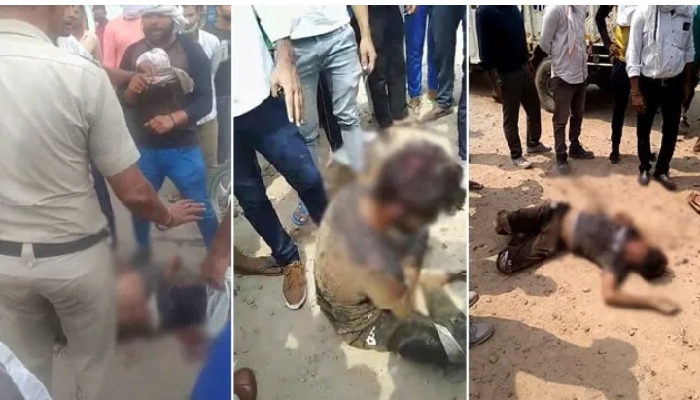
New Delhi, July 1: In a terrific incident with chilling echoes of the 2015 Dadri mob lynching, a Muslim man, who was carrying meat, was savagely attacked by a mob belonging to a saffron outfit in the presence of in BJP ruled Haryana on the eve of Eid al-Adha. 

The incident occurred at around 9 a.m. on Friday, July 31 at Badshahpur village in Haryana’s Gurgaon, when Lukman was transporting meat in a pic-kup truck. 

The attack was captured on mobile phones by onlookers and the video clips of the incident are now spreading on social media. 

A group of saffronite cow vigilantes chased the truck for about 8 km managed waylay it. Lukman, who was driving the truck was pulled out and brutally assaulted on the suspicion that he was transporting cow meat.

Just like Dadri, the police were faster at sending the meat to a lab for testing than catching any one of the suspects. One of the assailants - Pradeep Yadav- has been arrested. 

After being beating to an inch of his life, Lukman was bundled into the pick-up truck and taken back to Gurgaon's Badshahpur village where the goons started thrashing him again.

This is when the police stepped in and stopped them - only to find the assailants fearless enough to even take on them.

Lukman was taken to a hospital and the police filed a case against "unidentified individuals" even though the video of the incident recorded by witnesses shows the faces of the assailants.

The owner of the vehicles said that the meat was buffalo and he has been in the business for 50 years.

The police have so far refused to give a statement on record on the incident and explain their inaction as seen on video.

Comments

Add new comment

  • Coastaldigest.com reserves the right to delete or block any comments.
  • Coastaldigset.com is not responsible for its readers’ comments.
  • Comments that are abusive, incendiary or irrelevant are strictly prohibited.
  • Please use a genuine email ID and provide your name to avoid reject.