Rape convict godman’s bhakts go on rampage; over 30 killed, 300 injured

Agencies
August 25, 2017

Panchkula, Aug 25: At least 31 Dera Sacha Sauda followers were killed and more than 300 injured in an hour of violence after cops and paramilitary forces fired on angry mobs, shortly after the verdict convicting Dera chief Gurmeet Ram Rahim Singh of rape at 2.30pm on Friday. While 28 were killed in Panchkula, three Dera supporters were killed in Sirsa, the headquarters of the cult.

Fifteen years after he was accused of raping his sadhvis, Gurmeet was held guilty of the crime by special CBI judge Jagdeep Singh. The quantum of sentence would be pronounced on Monday after hearing the CBI and Dera's counsel. Gurmeet faces a minimum of seven years in jail, the maximum punishment being life term.

Doctors at government hospitals in Panchkula and Chandigarh said the death toll could rise as many of the injured are in serious condition. Sources said the government gave orders to fire at the rioters after Panchkula deputy commissioner Gauri Prashar found herself surrounded by an angry mob in Sector 5. Most of those killed were in the adjoining Sectors 3 and 4, where most of the violence took place.

The moment the verdict came, the followers unleashed a well-planned attack. This was the third major instance of the Manohar Lal Khattar government's failure in controlling law and order in Haryana since 2016.

At least six were killed when police entered preacher Rampal's ashram in Hisar to arrest him and produce him in the HC in a contempt case in 2014, a month after the Khattar government took charge.

Shockingly, while 30 were killed in three days during the Jat protests in Haryana in February 2016, in Panchkula, nearly as many were killed in an hour on Friday.

Curfew was imposed in Patiala, Sangrur, Bathinda, Mansa, Faridkot, Fazilka and Ferozepur districts in Malwa where dera followers went on the rampage. The followers targeted government service centres in Bathinda. A railway station nearby was torched.

Dera followers also threw petrol bombs at the grid sub-station, causing some damage.

But Panchkula bore the brunt. Nearly 1.5 lakh followers had gathered there in three days in an attempt to build pressure on the government and judiciary not to convict Gurmeet Ram Rahim Singh.

Despite the HC telling the government to ensure that there should be no violence, both cops and paramilitary forces seemed unprepared.

Witnesses said some protesters even had countrymade pistols. Although cops said they had disarmed many followers before they reached Panchkula, sources told TOI the initial bunch of followers that reached the city had a large quantity of petrol, diesel and kerosene with them.

The rioters set government offices and business establishments on fire.

After his conviction, Dera Sacha Sauda chief Gurmeet Ram Rahim Singh was first taken to a guesthouse meant for senior officers at Sunaria, near Rohtak. The Sunaria jail is within its compound. Jail SP (Rohtak) Sunil Sangwan confirmed that the guesthouse was designated as a jail.

However, in the evening, the government ordered that the dera chief should be shifted to jail.

Comments

ABUMOHAMMED
 - 
Saturday, 26 Aug 2017

What a shame rss leading Bjp government, can't control this internal kinds of rubbish people then how can secure your (Bjp) outside attacks. May tomorrow pakistan or china attack our country how can we defend. And alerady know the decision on this rubbish goons against him, he has a accused military & police force arranged. But what is the use? infornt of police & military, looting, burning, then were these security  wearing bangles in their hand ? and also his supporters giving statement which is anti national. where is now deshbakths ? If any muslim did this what would have happened we can't image. These all are cheating, looting people of Rss.

Add new comment

  • Coastaldigest.com reserves the right to delete or block any comments.
  • Coastaldigset.com is not responsible for its readers’ comments.
  • Comments that are abusive, incendiary or irrelevant are strictly prohibited.
  • Please use a genuine email ID and provide your name to avoid reject.
Ram Puniyani
January 14,2020

In the beginning of January 2020 two very disturbing events were reported from Pakistan. One was the attack on Nankana Sahib, the holy shrine where Sant Guru Nanak was born. While one report said that the place has been desecrated, the other stated that it was a fight between two Muslim groups. Prime Minister of Pakistan Imran Khan condemned the incident and the main accused Imran Chisti was arrested. The matter related to abduction and conversion of a Sikh girl Jagjit Kaur, daughter of Pathi (One who reads Holy Guru Granth Sahib in Gurudwara) of the Gurudwara. In another incident one Sikh youth Ravinder Singh, who was out on shopping for his marriage, was shot dead in Peshawar.

While these condemnable attacks took place on the Sikh minority in Pakistan, BJP was quick enough to jump to state that it is events like this which justify the Citizenship Amendment Act (CAA). Incidentally CAA is the Act which is discriminatory and relates to citizenship with Religion, which is not as per the norms of Indian constitution. There are constant debates and propaganda that population of Hindus has come down drastically in Pakistan and Bangla Desh. Amit Shah, the Home minister stated that in Pakistan the population of Hindus has come down from 23% at the time of partition to 3.7% at present. And in Bangla Desh it has come down from 22% to present 8%.

While not denying the fact that the religious minorities are getting a rough deal in both these countries, the figures which are presented are totally off the mark. These figures don’t take into consideration the painful migrations, which took place at the time of partition and formation of Bangla Desh later. Pakistan census figures tell a different tale. Their first census was held in 1951. As per this census the overall percentage of Non Muslim in Pakistan (East and West together) was 14.2%, of this in West Pakistan (Now Pakistan) it was 3.44 and in Eat Pakistan it was 23.2. In the census held in Pakistan 1998 it became 3.72%. As far as Bangla Desh is concerned the share of Non Muslims has gone down from 23.2 (1951) to 9.6% in 2011.

The largest minority of Pakistan is Ahmadis, (https://minorityrights.org/country/pakistan/) who are close to 4 Million and are not recognised as Muslims in Pakistan. In Bangla Desh the major migrations of Hindus from Bangla Desh took place in the backdrop of Pakistan army’s atrocities in the then East Pakistan.

As far as UN data on refugees in India it went up by 17% between 2016-2019 and largest numbers were from Tibet and Sri Lanka.  (https://www.un.org/en/development/desa/population/migration/publication…)

The state of minorities is in a way the index of strength of democracy. Most South Asian Countries have not been able to sustain democratic values properly. In Pakistan, the Republic began with Jinnah’s classic speech where secularism was to be central credo of Pakistan. This 11th August speech was in a way what the state policy should be, as per which people of all faiths are free to practice their religion. Soon enough the logic of ‘Two Nation theory” and formation of Pakistan, a separate state for Muslim took over. Army stepped in and dictatorship was to reign there intermittently. Democratic elements were suppressed and the worst came when Zia Ul Haq Islamized the state in collusion with Maulanas. The army was already a strong presence in Pakistan. The popular formulation for Pakistan was that it is ruled by three A’s, Army, America and Allah (Mullah).

Bangla Desh had a different trajectory. Its very formation was a nail in the coffin of ‘two nation theory’; that religion can be the basis of a state. Bangla Desh did begin as a secular republic but communal forces and secular forces kept struggling for their dominance and in 1988 it also became Islamic republic. At another level Myanmar, in the grip of military dictatorship, with democratic elements trying to retain their presence is also seeing a hard battle. Democracy or not, the army and Sanghas (Buddhist Sang has) are strong, in Myanmar as well. The most visible result is persecution of Rohingya Muslims.

Similar phenomenon is dominating in Sri Lanka also where Budhhist Sanghas and army have strong say in the political affairs, irrespective of which Government is ruling. Muslim and Christian minorities are a big victim there, while Tamils (Hindus, Christians etc.) suffered the biggest damage as ethnic and religious minorities. India had the best prospect of democracy, pluralism and secularism flourishing here. The secular constitution, the outcome of India’s freedom struggle, the leadership of Gandhi and Nehru did ensure the rooting of democracy and secularism in a strong way.

India so far had best democratic credentials amongst all the south Asian countries. Despite that though the population of minorities rose mainly due to poverty and illiteracy, their overall marginalisation was order of the day, it went on worsening with the rise of communal forces, with communal forces resorting to identity issues, and indulging in propaganda against minorities.

While other South Asian countries should had followed India to focus more on infrastructure and political culture of liberalism, today India is following the footsteps of Pakistan. The retrograde march of India is most visible in the issues which have dominated the political space during last few years. Issues like Ram Temple, Ghar Wapasi, Love Jihad, Beef-Cow are now finding their peak in CAA.

India’s reversal towards a polity with religion’s identity dominating the political scene was nicely presented by the late Pakistani poetess Fahmida Riaz in her poem, Tum bhi Hum Jaise Nikle (You also turned out to be like us). While trying to resist communal forces has been an arduous task, it is becoming more difficult by the day. This phenomenon has been variously called, Fundamentalism, Communalism or religious nationalism among others. Surely it has nothing to do with the religion as practiced by the great Saint and Sufi traditions of India; it resorts mainly to political mobilization by using religion as a tool.

Comments

Ashi
 - 
Tuesday, 14 Jan 2020

If Malaysia implement similar NRC/CAA, India and China are the loser.

Add new comment

  • Coastaldigest.com reserves the right to delete or block any comments.
  • Coastaldigset.com is not responsible for its readers’ comments.
  • Comments that are abusive, incendiary or irrelevant are strictly prohibited.
  • Please use a genuine email ID and provide your name to avoid reject.
News Network
May 30,2020

Bengaluru, May 30: People travelling to Bengaluru by flight or train must pay to get their Covid-19 tests done at designated private labs.

This is being done to improve the participation of private labs that have been approved by the Indian Council of Medical Research to do testing. Many of these labs are running at sub-optimal levels.

The new rule will also help the special categories of passengers and their attendants to leave early for home quarantine after giving the sample once the swab collection centres are established at airports and railway stations. The nodal officers at these places will coordinate in establishing the swab collection centres.

Each test will cost Rs 650 per sample. XCyton Diagnostics will cater to air passengers. Rail passengers will be tested at Neuberg Anand Reference Laboratory, Cancyte Technologies Pvt Ltd, Aster Labs, Narayana Hrudayalaya, Vydehi Hospital and Syngene International Ltd.

Comments

Add new comment

  • Coastaldigest.com reserves the right to delete or block any comments.
  • Coastaldigset.com is not responsible for its readers’ comments.
  • Comments that are abusive, incendiary or irrelevant are strictly prohibited.
  • Please use a genuine email ID and provide your name to avoid reject.
coastaldigest.com news network
July 30,2020

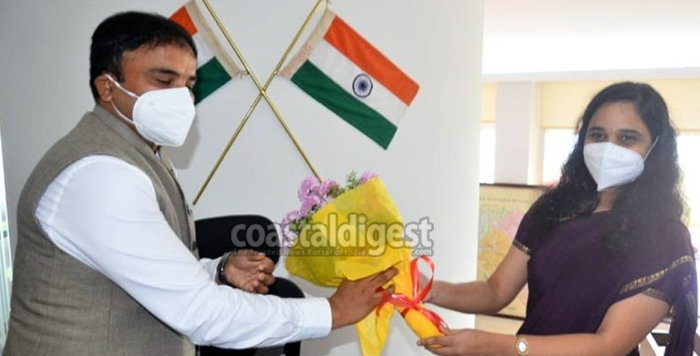
Mangaluru, July 30: Medical doctor turned IAS officer K V Rajendra assumed charge as the 130th deputy commissioner of Dakshina Kannada district here today.

The 2013 batch Karnataka cadre officer succeeds Sindhu B Rupesh, who was transferred as Director of Electronic Delivery of Citizen Services (EDCS), Bengaluru. The outgoing DC welcomed the new DC in the presence of staff. 

Dr Rajendra said that he expects cooperation from all stakeholders in administering the district, amidst the mounting Covid-19 cases.

Rajendra, an alumnus of JJM Medical College, Davanagere, was serving as the CEO of Belagavi zilla panchayat before being posted as DC of this coastal district. 

Having served as assistant commissioner of Puttur sub-division for nearly a year from December 2015, Dr Rajendra, hails from Thirthahalli in Shivamogga district, had his probationary training in Bidar. He posted as CEO of Ballari ZP where he worked for nearly three till 21, 2019.

He also had a brief stint as assistant secretary in the department of fertiliser with the ministry of chemicals and fertilisers.

Sindhu who was the CEO of Udupi zilla panchayat had succeeded Sasikanth Senthil, who resigned from the Indian Administrative Service on September 6, 2019. She had taken charge on September 7, 2019.

Comments

Add new comment

  • Coastaldigest.com reserves the right to delete or block any comments.
  • Coastaldigset.com is not responsible for its readers’ comments.
  • Comments that are abusive, incendiary or irrelevant are strictly prohibited.
  • Please use a genuine email ID and provide your name to avoid reject.