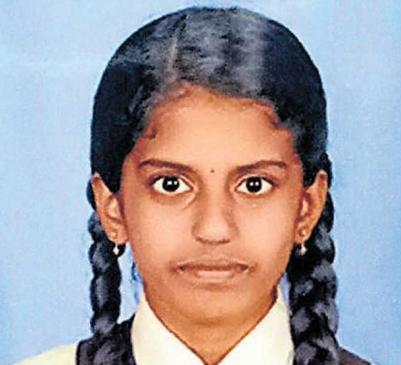
Re-evaluation gives Shivamogga girl 625/625 in SSLC, makes her state topper

CD Network
June 20, 2017

Shivamogga, Jun 20: By securing three more marks in the re-evaluation of answer scripts, Subhashini S., a student of Ramakrishna Vidyanikethana School in Shivamogga, has scored 625 out of 625 in the SSLC examination. With this four students in Karnataka have achieved full marks in SSLC this year.

Telugu

Barring Kannada, which was her first language, the Telugu speaking girl had scored full marks in the other five subjects when the results were announced in May. She had scored 122 out of 125 in Kannada.

However, according to Ms. Subhashini, after close examination of the photocopies of her evaluated Kannada answer scripts, her teachers suggested that she opt for re-evaluation as there were no spelling, grammatical or factual errors in her answer script.

The re-evaluation result proved her right. With the perfect score in Kannada, she has become one of the toppers in the SSLC exam in Karnataka. She scored a perfect centum in English, Hindi, Social Science, Science and Mathematics.

But what makes her achievement extraordinary is the fact that she had studied in a Telugu-medium school till Class 7 in Andhra Pradesh. Her parents — Srinivasulu Reddy and Sujata — hail from Kolar. She had moved to Shivamogga to live with her grandfather, Kannappa, to study SSLC.

She chose Kannada as the first language in high school. Shobha Ramakrishna, the secretary of the school management, said scoring 125 marks in Kannada was a great achievement for a student whose medium of instruction in primary school was Telugu. Subhashini initially struggled to write the Kannada alphabets, but picked up the language in just six months with the help of teachers and a little determination.

Sujata, her mother, said: “I am happy that my daughter has finally got justice. If she had obtained 625 marks last month, it would have been wonderful. Anyway, she has got the reward for hard work. She aspires to be a doctor.” Subhashini has enrolled at Narayana Guru College in Bengaluru for first-year PUC (Science).

Comments

Ashish
 - 
Wednesday, 21 Jun 2017

Congrats girl... Way to go.....
For me, even if I evaluate my own paper, it would be impossible to score out of out............

Add new comment

  • Coastaldigest.com reserves the right to delete or block any comments.
  • Coastaldigset.com is not responsible for its readers’ comments.
  • Comments that are abusive, incendiary or irrelevant are strictly prohibited.
  • Please use a genuine email ID and provide your name to avoid reject.
Media Release
February 14,2020

Veteran journalist P. Sainath has said that the nation is in a crisis. And this crisis is not limited to just the rural area. It has become a national crisis at various areas such as agriculture, education, economy, job creation etc.

He was delivering the endowment lecture on the topic ‘Indian democracy at the post-liberalization and post-truth era’ at Media Manthan 2020 organized by the PG department of journalism and mass communication at St Aloysius College (Autonomous). 

Mr Sainath said that the many policies adopted in the 90s led to India becoming unusually unequal. Referring to the speech Ambedkar had made at the Constituent Assembly while handing over the draft of the Constitution, Mr Sainath said, “Ambedkar had warned about the weakness of Indian democracy that liberty without equality allows the supremacy of a few over the multitude. Liberty, equality and fraternity must be kept together as we cannot have one without the other.” 

Mr Sainath stated that the agrarian crisis was no longer about the loss of productivity, employment or about farmer suicide; it was a societal, civilizational crisis. Commenting on the lopsided policies such as cow-slaughter ban, he explained how cow slaughter ban had adversely affected many industries due to their interdependency. While Muslims who slaughtered cows were rendered helpless, the cattle traders who were mostly OBCs lost their earnings as the cattle prices crashed. An important industry like Kolhapur sandals industry in Maharashtra went bankrupt as a result of the cow slaughter ban in Maharashtra. He said the policymakers had no idea how the rural industries were interconnected. Demonetisation too devastated the rural economy as 98 percent of rural transactions happen through cash. 

Mr Sainath also spoke about the crisis of inequality which affects the Dalits and the Adivasis far more than anyone else as 90 percent of the rural households take home less than Rs 10,000/- per month. “Women are yet another group whose labour is never counted in the gross domestic product. Women and girls globally do unpaid work which amounts to about 12.5 billion working hours per year. Monetarily speaking, this is worth 10.8 trillion dollars,” Mr Sainath added. 

Speaking about the crisis of jobs Mr Sainath said that major companies were laying off employees just to create more profits for the investors and the adoption of artificial intelligence in the industry would further destroy millions of jobs.

Rector of St Aloysius College Institutions Fr Dionysius Vaz SJ, Principal Dr (Fr) Praveen Martis SJ, HOD of Journalism and Mass Communication department Dr (Fr) Melwyn Pinto SJ were present.

‘Veerappan and Vijay Mallya’s business models are interesting!’

Addressing the gathering during his endowment lecture on Friday, Mr Sainath made an interesting comment on the so called ‘revenue model’. “Whenever I visit IIMs and IITs for lectures on my PARI project, the students there ask me what my revenue model for my project is. I tell them that I do not have a revenue model. In fact, journalism does not begin with a revenue model. Gandhiji, Ambedkar, Bhagat Singh were all great journalists. But they did not have a revenue model,” Mr Sainath said.

On a lighter note, he said that the best revenue model that he liked was that of forest brigand Veerappan and liquor baron Vijay Mallya. “Veerappan ruled the forest for forty years and from the top ministers to the villagers he could dictate terms and liver royally. Similarly, Mallya’s revenue model was to steal the banks and run away abroad and live like a king,” Mr Sainath added.

Journalism is not and can never be a business. It is a calling, he opined. While newspaper can be a business, television can be a business, journalism per se cannot be reduced to a business. “Unfortunately today, journalists are recruited on a contract basis and they have no bargaining power; and there are no unions to fight for their cause. Hence, they are at the mercy of the corporate media houses for their survival and are made to write stories that cannot be called journalism,” Mr Sainath said.

Answering a question as to the pressures he faced as a journalist, he said that external pressures from the government or others could be very well handled. It is the internal pressures from once own media house that journalists find it difficult to manage.


 

Comments

Add new comment

  • Coastaldigest.com reserves the right to delete or block any comments.
  • Coastaldigset.com is not responsible for its readers’ comments.
  • Comments that are abusive, incendiary or irrelevant are strictly prohibited.
  • Please use a genuine email ID and provide your name to avoid reject.
News Network
April 28,2020

Bengaluru, Apr 28: A local court in Karnataka on Tuesday granted bail to a CRPF commando who was arrested by state police officials for alleged assault on them during COVID-19 lockdown duty, a charge contested strongly by the paramilitary.

The jawan has been taken to the jungle warfare training school of the paramilitary force in Belagavi district, a senior official said.

Constable Sachin Savant of the 207th CoBRA battalion was granted regular bail by a court located in Chikodi taluka of the district, he said.

A team of CRPF and CoBRA officials were present in the court during the proceeding during which the state police did not oppose the bail, the official said.

The commando was arrested by police on April 23 from Examba village (Belagavi district) when he was washing his bike outside his house without wearing a mask, as required under the coronavirus prevention protocol.

An altercation and physical fight took place between the two sides, following which the trooper was taken to the local police station and arrested.

The Central Reserve Police Force (CRPF) had on Monday taken up the case with the Karnataka director general of police (DGP), calling the incident "unpleasant".

The CRPF letter said commando Savant was "manhandled, ill-treated, paraded to the police station barefooted, kept in chains and handcuffs" by police personnel and sought the intervention of state Director General of Police Praveen Sood.

The paramilitary had said that from the scrutiny of a viral video on social media of the incident "it is apparent that the conduct of the police personnel was not citizen-centric".

A police report had said the CoBRA commando "started the altercation" with the beat constable and another policeman accompanying him, and "assaulted" them.

As per the official Twitter handle of the Karnataka DGP's on Monday evening, "IGP (inspector-general of police) Belagavi has been asked to enquire into the incident involving the CRPF constable and action will be taken against guilty after receipt of the report".

The Commando Battalion for Resolute Action (CoBRA) unit of the CRPF specialises in guerrilla tactics and jungle warfare.

Comments

Add new comment

  • Coastaldigest.com reserves the right to delete or block any comments.
  • Coastaldigset.com is not responsible for its readers’ comments.
  • Comments that are abusive, incendiary or irrelevant are strictly prohibited.
  • Please use a genuine email ID and provide your name to avoid reject.
News Network
April 5,2020

Bengaluru, Apr 5: Opening of Karnataka's borders to Kerala at this point in time will be like "embracing death," chief minister B S Yediyurappa said on Saturday making clear his government's stand not opening the state border.

The chief minister repeatedly said that for his government interest of the people of the state was supreme.

Yediyurappa made his stand clear in a letter to former prime minister and JD(S) patriarch H D Deve Gowda.

Gowda had recently written to the chief minister on March 31 seeking relaxation of the border restrictions on "humanitarian" grounds.

He had also written to Kerala chief minister Pinarayi Vijayan expressing his anguish against Karnataka authorities for imposing restriction and promising to raise the matter with prime minister Narendra Modi.

Stating the decision to close the border was not sudden, Yediyurappa said, it was a conscious decision after analysing the health situation in the area following the spread of COVID-19.

The chief minister cited the Indian Medical Association, Mangaluru branch data regarding the spread of Covid-19 in Kasargod of Kerala and surrounding areas which was alarming.

Noting that the region has nearly 106 positive coronaviruscases, he said, "this is the region with most number of infections in the country."

If this restriction is removed, it puts the health of the people of Karnataka in to risk and create a situation of "embracing death", so we will not be able to open the border, Yediyurappa said.

He also clarified that there was no prejudice behind his government's decision, and the interest of the people of the state was of utmost importance.

"...There is also no political maliciousness. We want to have good and brotherly relationship with neighbouring states," he said, adding that opening the border will open a pandora's box that will be disastrous for the state.

Yediyurappa also thanked opposition parties for their support to his government in its fight against COVID-19.

Comments

Add new comment

  • Coastaldigest.com reserves the right to delete or block any comments.
  • Coastaldigset.com is not responsible for its readers’ comments.
  • Comments that are abusive, incendiary or irrelevant are strictly prohibited.
  • Please use a genuine email ID and provide your name to avoid reject.