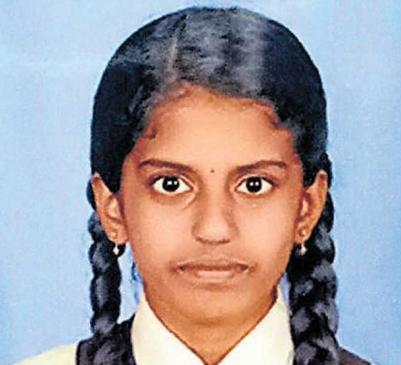
Re-evaluation gives Shivamogga girl 625/625 in SSLC, makes her state topper

CD Network
June 20, 2017

Shivamogga, Jun 20: By securing three more marks in the re-evaluation of answer scripts, Subhashini S., a student of Ramakrishna Vidyanikethana School in Shivamogga, has scored 625 out of 625 in the SSLC examination. With this four students in Karnataka have achieved full marks in SSLC this year.

Telugu

Barring Kannada, which was her first language, the Telugu speaking girl had scored full marks in the other five subjects when the results were announced in May. She had scored 122 out of 125 in Kannada.

However, according to Ms. Subhashini, after close examination of the photocopies of her evaluated Kannada answer scripts, her teachers suggested that she opt for re-evaluation as there were no spelling, grammatical or factual errors in her answer script.

The re-evaluation result proved her right. With the perfect score in Kannada, she has become one of the toppers in the SSLC exam in Karnataka. She scored a perfect centum in English, Hindi, Social Science, Science and Mathematics.

But what makes her achievement extraordinary is the fact that she had studied in a Telugu-medium school till Class 7 in Andhra Pradesh. Her parents — Srinivasulu Reddy and Sujata — hail from Kolar. She had moved to Shivamogga to live with her grandfather, Kannappa, to study SSLC.

She chose Kannada as the first language in high school. Shobha Ramakrishna, the secretary of the school management, said scoring 125 marks in Kannada was a great achievement for a student whose medium of instruction in primary school was Telugu. Subhashini initially struggled to write the Kannada alphabets, but picked up the language in just six months with the help of teachers and a little determination.

Sujata, her mother, said: “I am happy that my daughter has finally got justice. If she had obtained 625 marks last month, it would have been wonderful. Anyway, she has got the reward for hard work. She aspires to be a doctor.” Subhashini has enrolled at Narayana Guru College in Bengaluru for first-year PUC (Science).

Comments

Ashish
 - 
Wednesday, 21 Jun 2017

Congrats girl... Way to go.....
For me, even if I evaluate my own paper, it would be impossible to score out of out............

Add new comment

  • Coastaldigest.com reserves the right to delete or block any comments.
  • Coastaldigset.com is not responsible for its readers’ comments.
  • Comments that are abusive, incendiary or irrelevant are strictly prohibited.
  • Please use a genuine email ID and provide your name to avoid reject.
News Network
April 7,2020

Bengaluru, Apr 7: Leader of Opposition in Karnataka Siddaramaiah on Monday urged Chief Minister B S Yediyurappa to announce a special package to help farmers, agriculture labourers and also working class in various sectors who are affected by the lockdown.

Mr Siddaramaiah put forth his demands during a telephonic conversation and the Chief Minister positively responding to it informed that he will formulate a programme keeping in mind the suggestions made by the Opposition, a statement from the LoP's office said.

It said, the Chief Minister also spoke to Mr Siddaramaiah regarding the government's decision to stop supply of free food for poor and needy through Indira Canteens.

Mr Siddaramaiah on Saturday had written to Yediyurappa urging him to utilise Indira Canteens efficiently and provide food for poor and needy until the coronavirus crisis and lockdown is over.

The former Chief Minister's letter had come a day after the state government had decided not to provide free food at Indira Canteens as concerns were raised about the quality and misuse that was happening.

It had, however, decided to continue to provide subsidised food- breakfast at Rs 5 and lunch and dinner at Rs 10, as usual.

Mr Yediyurappa during the phone conversation on Monday appraised Siddaramaiah that the decision to supply food by fixing a price was taken to stop misuse that was happening.

Mr Siddaramaiah, however, insisted the government should provide food free of cost to the poor and needy, by taking care that misuse doesn't happen.

The senior Congress leader asked the Chief Minister to take action against errant officials who allowed misuse to happen, the statement said, adding that Yediyurappa has promised to look into it.

Initially, the government last month had decided that the state subsidised Indira Canteens would provide food packets free of cost to the poor and needy in the wake of the lockdown.

Comments

Add new comment

  • Coastaldigest.com reserves the right to delete or block any comments.
  • Coastaldigset.com is not responsible for its readers’ comments.
  • Comments that are abusive, incendiary or irrelevant are strictly prohibited.
  • Please use a genuine email ID and provide your name to avoid reject.
coastaldigest.com news network
February 5,2020

Bengaluru, Jan 5: B S Yediyurappa-led Karnataka cabinet has finally decided to resume supply of subsidised rice and wheat to students of welfare institutions and hostels including those run by religious mutts under the Dasoha Scheme’s welfare programme. The supply was stopped over two months ago.

“Cabinet has decided to continue supply of subsidised foodgrains (rice and wheat) for the benefit of 37,700 children under the Dasoha scheme in 351 welfare institutions for the next one year at the cost of Rs 18 crore,” said J C Madhuswamy, Law and Parliamentary Affairs Minister. Under this scheme, institutions that provide free accommodation and food for students are entitled to avail 10 kg rice and 5 kg wheat per student every month at subsidised rates. But following a central government directive in November, the state government had stopped supply to private institutions since December.

Hours before the cabinet meeting, Khader addressed a press conference and said, “This government is snatching away food from children by stalling the supply of foodgrains. Institutions like Suttur Mutt, Siddaganga Mutt that have worldwide fame for their service are being inconvenienced by this,” Khader said.

Finding itself in a fix, especially in a matter that involves mutts, the cabinet was quick to restore the supply. “Foodgrains were being supplied to 183 government-run institutions and 281 institutions run by private entities. As per a central government directive, supply to private institutions was stopped but the decision was made by the previous government,” Shashikala Jolle, Women and Child Development Minister, said.

Comments

Add new comment

  • Coastaldigest.com reserves the right to delete or block any comments.
  • Coastaldigset.com is not responsible for its readers’ comments.
  • Comments that are abusive, incendiary or irrelevant are strictly prohibited.
  • Please use a genuine email ID and provide your name to avoid reject.
Wafa Sultana
April 4,2020

Over the last couple of days when the world was occupied with unifying efforts to fight the deadly Covid19 pandemic, sections of Indian media provided viewers a familiar scapegoat – the Indian Muslims – who are often stereotyped as a community being constantly at loggerheads with the citizenry and the State. Biased media channels were quick to resort to blaming the entire Muslim community for the spread of the disease in the country, thanks to an ill-timed Tablighi Jamaat gathering at its international headquarters in Delhi’s Nizamuddin. Unsurprisingly, the opprobrium was also marked by a sudden spike in WhatsApp forwards of videos with people wearing skullcaps licking spoons and performing Sufi breathing rituals, suggesting some sort of wild conspiracy on the part of the community to spread the virus.  Some media channels were quick to formulate, hypothesize and provide loose definitions of a newly discovered form of Jihad i.e. ‘Corona Jihad ’ thereby vilifying the Islamic faith and its followers.

While the investigation on the culpability of the organizers of the Nizamuddin event is still ongoing, there is enough information to suggest that the meeting was held before any lockdown was in force, and the problem began when there was no way of getting people out once the curfew was announced. Be that as it may, there is little doubt that organizing a meet of such a scale when there is a global pandemic smacks of gross misjudgment, and definitely the organizers should be held accountable if laws or public orders were defied. Attendees who attempt to defy quarantine measures must be dealt with strictly. However, what is alarming is that the focus and narrative have now shifted from the unfortunate event at Nizamuddin to the Tablighi Jamaat itself.

For those not familiar with the Tablighi Jamaat, the organization was founded in 1926 in Mewat by scholar Maulana Mohammad Ilyas. The Jamaat’s main objective was to get Muslim youth to learn and practice pristine Islam shorn of external influences. This is achieved through individuals dedicating time for moral and spiritual upliftment secluded from the rest of the world for a brief period of time. There is no formal membership process. More senior and experienced participants typically travel from one mosque to other delivering talks on religious topics, inviting local youth to attend and then volunteer for a spiritual retreat for a fixed number of days to a mosque in a nearby town or village to present the message to their co-religionists. Contrary to ongoing Islamophobic rhetoric, the movement does not actively proselytize. The focus is rather on getting Muslims to learn the teachings and practices of Islam.  This grassroots India-based movement has now grown to almost all countries with substantial Muslim populations. Its annual meets, or ‘ijtemas’ are among the largest Islamic congregations in the world after the annual Haj. One of the reasons for its popularity and wide network in the subcontinent and wordwide is the fact that it has eschewed the need for scholarly intervention, focusing on peer learning of fundamental beliefs and practice rather than high-falutin ideological debates. The Tablighi Jamaat also distinguishes itself from other Islamic movements through its strictly apolitical nature, with a focus on individual self-improvement rather than political mobilization. Hardships and difficulty in the world are expected to be face through ‘sabr’ (patience) and ‘dua’ (supplication),  than through quest for political power or influence. In terms of ideology, it is very much based on mainstream Sunni Islamic principles derived from the Deobandi school.

So, why is all this background important in the current context? While biased media entities have expectedly brought out their Islamophobic paraphernalia out for full display, more neutral commentators have tried to paint the Tablighi Jamaat as a fringe group and have tried to distance it from 'mainstream Muslims'. While the intent is no doubt innocent, this is a trap we must not fall into. This narrative, unfortunately, is also gaining ground due to apathy some Muslims have for the group, accusing it of being “disconnected from the realities of the world”. Unlike other Muslim organizations and movements, the Tablighi Jamat, by virtue of its political indifference, does not boast of high-profile advocates and savvy spokespersons who can defend it in mainstream or social media.  The use of adjectives such as 'outdated' and 'orthodox' by liberal columnists to describe the Jamaat feeds into the malignant attempt to change the narrative from the control of the spread of the pandemic due to the Nizamuddin gathering to 'raison d'etre' of the organization itself.

A large mainstream religious group like the Tablighi Jamaat with nearly a hundred-year history, normally considered to be peaceful, apolitical and minding its own business is now suddenly being villainized owing to unfortunate circumstances. Biased media reactions filled with disgust and hate seem to feed the Indian public conscience with a danngerous misconception - to be a nominal Muslim is okay but being a practicing one is not.  For those committed to the truth and fighting the spread of Islamophobia, the temptation to throw the entire Tablighi Jamaat under the bus must be resisted.

The writer is a lawyer and research scholar at Qatar University. Her research interests include Islamic law and politics.


Comments

zahoorahmed
 - 
Saturday, 4 Apr 2020

great article! provides a great perspective on tableeg jamat

Add new comment

  • Coastaldigest.com reserves the right to delete or block any comments.
  • Coastaldigset.com is not responsible for its readers’ comments.
  • Comments that are abusive, incendiary or irrelevant are strictly prohibited.
  • Please use a genuine email ID and provide your name to avoid reject.