


Real Ayodhya is in Nepal, Lord Ram was Nepali, says Nepal PM

News Network
July 14, 2020

Kathmandu, Jul 14: After staking claim to Indian territories of Lipulekh-Kalapani in  a new controversial map,  Nepal Prime Minister KP Sharma Oli on Monday claimed that Ayodhya, the birthplace of Lord Rama, is in Nepal and Lord Rama was Nepali.

“Although real Ayodhya lies at Thori, city in the west of Birgunj, India has claimed that Lord Rama was born there. Due to these continuous claims, even we have believed that deity Sita got married to Prince Rama of India. However, in reality, Ayodhya is a village lying west of Birgunj,” Oli claimed at an event organised at Prime Minister's residence in Kathmandu.

The Prime Minister also blamed India of cultural encroachment by “creating a fake Ayodhya.”

“Balmiki Ashram is in Nepal and the holy place where King Dashrath had executed the rites to get the son is in Ridi. Dashrath’s son Ram was not an Indian and Ayodhya is also in Nepal,” he claimed.

In an attempt to save self from criticism, Oli questioned how Lord Rama could come to Janakpur to marry Sita when there were "no means" of communication. He further said that it to be impossible for Lord Rama to come to Janakpur from present Ayodhya that lies in India.

“Janakpur lies here and Ayodhya there and there is talk of marriage. There was neither telephone nor mobile then how could he know about Janakpur,” Oli said.

Comments

Ahmed Ali Kulai
 - 
Tuesday, 14 Jul 2020

New controversy

 
BJP got next election Muddah

Farhan
 - 
Tuesday, 14 Jul 2020

Ab Ram Mandir Kaha Banega???

Add new comment

  • Coastaldigest.com reserves the right to delete or block any comments.
  • Coastaldigset.com is not responsible for its readers’ comments.
  • Comments that are abusive, incendiary or irrelevant are strictly prohibited.
  • Please use a genuine email ID and provide your name to avoid reject.
News Network
August 8,2020

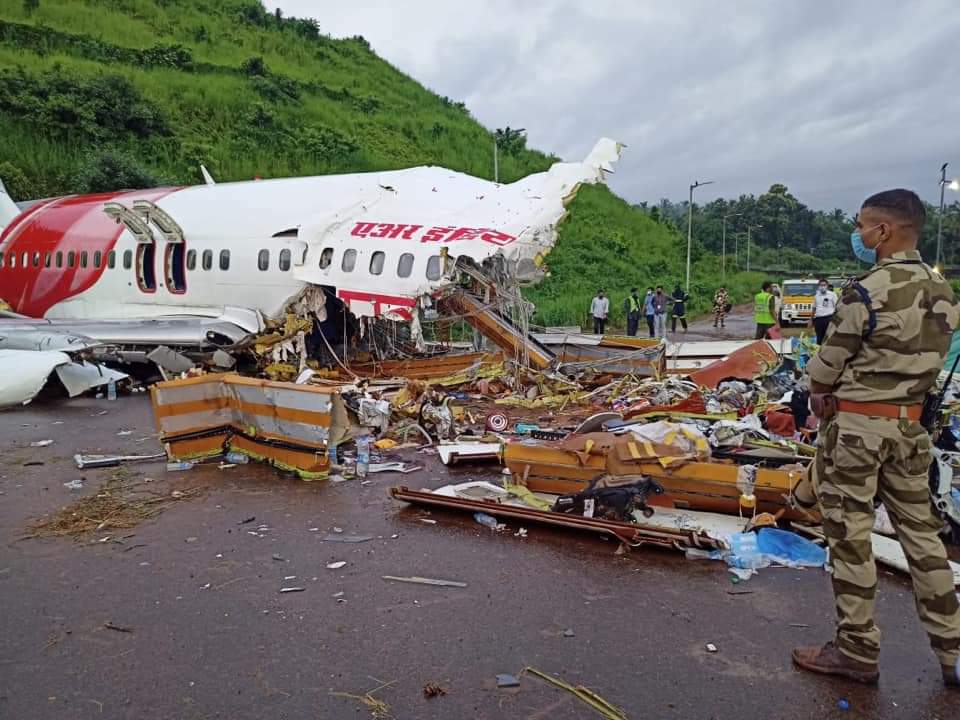
Kozhikode, Aug 8: Minister of State (Mos) for External Affairs V Muraleedharan on Saturday reached Kozhikode where Air India Express flight (IX-1344) crash-landed yesterday. 

He is likely to meet those injured in the crash and their family members.

At least 17 people including two pilots have lost their lives in the incident. However, the four-cabin crew members are safe, said the Air India Express in a statement. 

The injured are admitted to hospitals in Malappuram and Kozhikode, as per the state government officials.

Informing about his visit to Kozhikode, Muraleedharan tweeted: "Taking off to #Calicut by @airindiain
special flight. Hope to visit the crash site at the Calicut Airport and also meet those injured in the crash and their family members."

Muraleedharan on Friday expressed grief after an Air India Express plane carrying 190 passengers including 10 infants skidded while landing at Karipur Airport in Kozhikode.

"Deeply anguished to hear about the mishap in Calicut airport involving the flight from Dubai to Calicut. Was informed that the plane overshot the runway and seemingly nosedived," the Minister tweeted.

Comments

Add new comment

  • Coastaldigest.com reserves the right to delete or block any comments.
  • Coastaldigset.com is not responsible for its readers’ comments.
  • Comments that are abusive, incendiary or irrelevant are strictly prohibited.
  • Please use a genuine email ID and provide your name to avoid reject.
coastaldigest.com news network
August 8,2020

Kozhikode, Aug 8: A tailwind or crosswind could be the reason for the Air India Express flight mishap at Kozhikode international airport in Kerala, according to some aviation experts. 

Team of DGCA and AIE already reached the spot. With the death of the captain and co-pilot in the mishap, the investigation would be focusing mainly on the voice recorders and other technical aspects.

It is learnt that the ill-fated aircraft, IX 1344 with 190 onboard including crew, was initially planning to land on runway-28 of the airport. But later the pilot opted runway-10 which is toward the other direction. Pilots would be taking the decisions on the basis of inputs from ATC.

The questions now doing the rounds are what made the pilot opt runway-10 and whether the tabletop runway lacked adequate safety parameters.

An aviation expert, who didn't want to be quoted, said that Capt Deepak Sathe, who was commandeering the aircraft, was a well-experienced pilot and was also familiar with the terrains. Hence the chances of any error from his part was very unlikely. Hence a fair in-depth probe was required to find the exact cause.

Though the Kozhikode airport has an Instrument Landing System, it was of category-I for which pilot's visibility is very crucial toward a touchdown. Since it is a tabletop airport and rough weather prevailing in the region, the chances of tailwind was also high, said sources.

There had been safety concerns about the airport over quite some time. In 2011 aviation safety consultant captain Mohan Ranganathan reportedly gave a report citing the safety issues, especially the buffer zones at the end of the runway.

However, an AAI officer said that rectification steps were already done by last year by widening the Runway End Safety Area (RESA) from 90 metre to 240 metre. However, the length of the runway had to be reduced to 2,700 metre from 2,850. The AAI was also constantly pressing for increasing the runway length to 3,150 metres. But that was getting delayed due to land acquisition issues pending with the state government.

stm88 info live rtp slot

slot auto scatter hitam

Comments

Add new comment

  • Coastaldigest.com reserves the right to delete or block any comments.
  • Coastaldigset.com is not responsible for its readers’ comments.
  • Comments that are abusive, incendiary or irrelevant are strictly prohibited.
  • Please use a genuine email ID and provide your name to avoid reject.
News Network
May 21,2020

Bengaluru, May 21: The COVID-19-induced lockdown saw a spurt in crybercrimes in India with Kerala recording the highest number during the period, according to an analysis of IT security solutions provider K7 Computing.

The report analyses various cyberattacks within India during the pandemic and reveals that threat actors targeted the States with COVID-19-themed attacks aimed at exploiting user trust.

The sudden surge in the frequency of attacks witnessed from February 2020 to mid-April 2020 indicates that scamsters across the world were exploiting the widespread panic around coronavirus at both the individual and corporate level, the company said in a statement.

These attacks aimed to compromise computers and mobile devices to gain access to users confidential data, banking details and cryptocurrency accounts.

The key threats seen during this period ranged from phishing attacks to rogue apps disguised as COVID-19 information apps that targeted users sensitive data.

Phishing attacks were noticed more in Tier-II and Tier-III cities while the metros fared better.

Smaller cities saw over 250 attacks being blocked per 10,000 users.

Users from Ghaziabad and Lucknow seem to have faced almost six and four times the number of attacks, respectively, as Bengaluru users.

In Kerala, regions like Kottayam, Kannur, Kollam, and Kochi saw the highest hits with 462, 374, 236, and 147 attacks respectively, while the state as a whole saw around 2,000 attacks during the period, the highest thus far in the country.

This was followed by Punjab with 207 attacks and Tamil Nadu at 184 attacks, the statement said.

A majority of the recorded attacks were phishing attacks with sophisticated campaigns that could easily snare even the most educated users, it said.

These attacks were aimed at heightening users fears and creating a sense of urgency to take action.

The report noted phishing attacks where scamsters posed as representatives of the United States Department of the Treasury, the World Health Organisation, and the Centres for Disease Control and Prevention.

Users were encouraged to visit links that would automatically download malware on the host computer such as the Agent Tesla keylogger or Lokibot information-stealing malware, infamous banking Trojans such as Trickbot or Zeus Sphinx, and even disastrous ransomware.

Other attacks included infected COVID-19 Android apps like CoronaSafetyMask that scam users with promises of masks for an upfront payment; the spyware app Project Spy; and seemingly genuine apps that are infected with dangerous malware like banking Trojans such as Ginp, Anubis and Cerberus, it was stated.

Comments

Add new comment

  • Coastaldigest.com reserves the right to delete or block any comments.
  • Coastaldigset.com is not responsible for its readers’ comments.
  • Comments that are abusive, incendiary or irrelevant are strictly prohibited.
  • Please use a genuine email ID and provide your name to avoid reject.