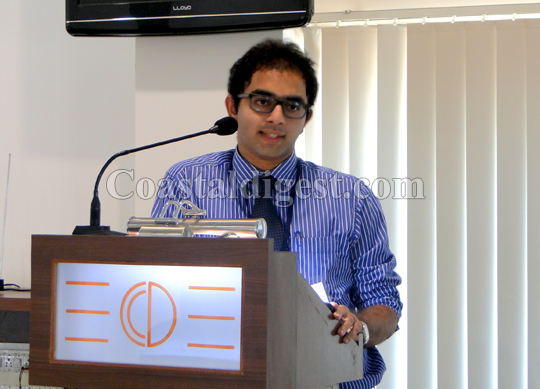
Remove mandatory retirement' age for medical teachers: Dr Edmond Fernandes

[email protected] (CD Network)
June 10, 2016

Mangaluru, Jun 10: Dr Edmond Fernandes, CEO, Center for Health and Development [CHD-India] has written to Bhanu Pratap Sharma, Secretary, Health and Family Welfare, Government of India urging to remove mandatory retirement' age for medical teachers in private and Government medical colleges and Universities.

edmond

Considering the acute shortage of doctors in the country, which is way below the WHO recommended doctor patient ratio, he said the senior doctors will be instrumental to guide quality control needed by accreditation councils like NAAC, NABH and improve the overall development of health sector and human resources etc.

In the letter, Dr Edmond mentioned that employment should be seen as a human right which ensures independence, social security and promotes a sense of dignity and self-worth.

Setting a time-line for retirement at 70 is obsolete and unfair. The medical teachers post 70 should not aspire for posts of Heading departments and moving as examiners to other institutes, that should be clearly declared of in an undertaking and they should be assigned other development roles, he wrote.

He pointed out that a few medical teachers have dual MD degrees and a few might have Dual PHD's and it is important to cultivate these teachers without letting them go. If the mental faculty of the teacher is sound with physical movement at ease, there should be no retirement as such. Ontario Human Rights Commission, advocated and came up with the enlightened decision to remove mandatory retirement on 12th December, 2006, many other countries have followed suit. He has appealed to the Secretary to table this for immediate solution.

The letter has been copied to Dr Jayshree Mehta, President, Medical Council of India and Dr Shalini Rajneesh, Principal Secretary, Health and Family Welfare, Government of Karnataka.

Comments

Althaf
 - 
Friday, 10 Jun 2016

good job, u may get help from UT Khader.

Add new comment

  • Coastaldigest.com reserves the right to delete or block any comments.
  • Coastaldigset.com is not responsible for its readers’ comments.
  • Comments that are abusive, incendiary or irrelevant are strictly prohibited.
  • Please use a genuine email ID and provide your name to avoid reject.
Media Release
February 14,2020

Veteran journalist P. Sainath has said that the nation is in a crisis. And this crisis is not limited to just the rural area. It has become a national crisis at various areas such as agriculture, education, economy, job creation etc.

He was delivering the endowment lecture on the topic ‘Indian democracy at the post-liberalization and post-truth era’ at Media Manthan 2020 organized by the PG department of journalism and mass communication at St Aloysius College (Autonomous). 

Mr Sainath said that the many policies adopted in the 90s led to India becoming unusually unequal. Referring to the speech Ambedkar had made at the Constituent Assembly while handing over the draft of the Constitution, Mr Sainath said, “Ambedkar had warned about the weakness of Indian democracy that liberty without equality allows the supremacy of a few over the multitude. Liberty, equality and fraternity must be kept together as we cannot have one without the other.” 

Mr Sainath stated that the agrarian crisis was no longer about the loss of productivity, employment or about farmer suicide; it was a societal, civilizational crisis. Commenting on the lopsided policies such as cow-slaughter ban, he explained how cow slaughter ban had adversely affected many industries due to their interdependency. While Muslims who slaughtered cows were rendered helpless, the cattle traders who were mostly OBCs lost their earnings as the cattle prices crashed. An important industry like Kolhapur sandals industry in Maharashtra went bankrupt as a result of the cow slaughter ban in Maharashtra. He said the policymakers had no idea how the rural industries were interconnected. Demonetisation too devastated the rural economy as 98 percent of rural transactions happen through cash. 

Mr Sainath also spoke about the crisis of inequality which affects the Dalits and the Adivasis far more than anyone else as 90 percent of the rural households take home less than Rs 10,000/- per month. “Women are yet another group whose labour is never counted in the gross domestic product. Women and girls globally do unpaid work which amounts to about 12.5 billion working hours per year. Monetarily speaking, this is worth 10.8 trillion dollars,” Mr Sainath added. 

Speaking about the crisis of jobs Mr Sainath said that major companies were laying off employees just to create more profits for the investors and the adoption of artificial intelligence in the industry would further destroy millions of jobs.

Rector of St Aloysius College Institutions Fr Dionysius Vaz SJ, Principal Dr (Fr) Praveen Martis SJ, HOD of Journalism and Mass Communication department Dr (Fr) Melwyn Pinto SJ were present.

‘Veerappan and Vijay Mallya’s business models are interesting!’

Addressing the gathering during his endowment lecture on Friday, Mr Sainath made an interesting comment on the so called ‘revenue model’. “Whenever I visit IIMs and IITs for lectures on my PARI project, the students there ask me what my revenue model for my project is. I tell them that I do not have a revenue model. In fact, journalism does not begin with a revenue model. Gandhiji, Ambedkar, Bhagat Singh were all great journalists. But they did not have a revenue model,” Mr Sainath said.

On a lighter note, he said that the best revenue model that he liked was that of forest brigand Veerappan and liquor baron Vijay Mallya. “Veerappan ruled the forest for forty years and from the top ministers to the villagers he could dictate terms and liver royally. Similarly, Mallya’s revenue model was to steal the banks and run away abroad and live like a king,” Mr Sainath added.

Journalism is not and can never be a business. It is a calling, he opined. While newspaper can be a business, television can be a business, journalism per se cannot be reduced to a business. “Unfortunately today, journalists are recruited on a contract basis and they have no bargaining power; and there are no unions to fight for their cause. Hence, they are at the mercy of the corporate media houses for their survival and are made to write stories that cannot be called journalism,” Mr Sainath said.

Answering a question as to the pressures he faced as a journalist, he said that external pressures from the government or others could be very well handled. It is the internal pressures from once own media house that journalists find it difficult to manage.


 

Comments

Add new comment

  • Coastaldigest.com reserves the right to delete or block any comments.
  • Coastaldigset.com is not responsible for its readers’ comments.
  • Comments that are abusive, incendiary or irrelevant are strictly prohibited.
  • Please use a genuine email ID and provide your name to avoid reject.
coastaldigest.com news network
June 13,2020

Bengaluru, Jun 12: Karnataka on Saturday reported 209 discharges, as the state confirmed 308 new cases of COVID-19 and three related fatalities, taking the total number of infections to 6,824 and the death toll to 81.

With the 14 new cases, the total number of covid cases in Udupi district alone today reached 1005. Dakshina Kannada today reported 30 cases and the tally mounted to 263. 

Today highest cases were reported from Kalaburgi (67), followed by Yadgir (52), Bidar (42) and Bengaluru Urban (31). More details to follow.

Comments

Add new comment

  • Coastaldigest.com reserves the right to delete or block any comments.
  • Coastaldigset.com is not responsible for its readers’ comments.
  • Comments that are abusive, incendiary or irrelevant are strictly prohibited.
  • Please use a genuine email ID and provide your name to avoid reject.
coastaldigest.com news network
June 10,2020

Udupi, June 10: Philanthropist and businessman Haji P K Abuswalih Kannangar passed away today at a private hospital in Mangaluru. He was 85. 

He was a resident of Pombathota house at Kannangar in Kaup taluk of Udupi district.

He was the proprietor of Green Store in Mudigere for past five decades and also was a coffee planter. 

He had served as the president of Muhayaddin Juma Masjid at Mudigere Hand-post in the past. He was also former president of Mudigere Taluk unit of Indian National Congress.

Comments

Add new comment

  • Coastaldigest.com reserves the right to delete or block any comments.
  • Coastaldigset.com is not responsible for its readers’ comments.
  • Comments that are abusive, incendiary or irrelevant are strictly prohibited.
  • Please use a genuine email ID and provide your name to avoid reject.