


Remove photos of political leaders on all hoardings and ads: EC

January 10, 2017

New Delhi, Jan 10: The Election Commission has asked the poll machinery in the five poll-bound states to either cover or remove photographs of political leaders on all hoardings and advertisements which seek to project the achievements of any living political functionary or political party.
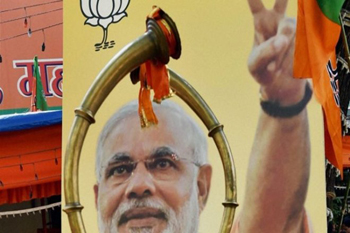
modi2The commission gave these fresh directions by reiterating its instructions issued on December 12, 2004 after the chief electoral officer of Goa raised the issue after the election schedule was announced on January 4. The poll watchdog said photos in advertisements or hoardings of similar type should also be removed or "covered suitably" so that spirit of its instructions is fully complied with.

It, however, made it clear that hoardings put up by the government which convey general message to the masses on family planning or social welfare schemes "may be allowed to be displayed". "However, all those hoardings, advertisements which seek or purport to project the achievements of any living political functionary or political party and which carry their photos or name or party symbol should be removed forthwith...

"...No political party or functionary can use public resources and incur or authorise expenditure from public exchequer to eulogise himself or itself or enhance his/its own or any political leader's image," it said.

The poll panel made it clear that such images or hoardings "undoubtedly amount to their individual/party election campaign at public cost". Between February 4 and March 8, Uttar Pradesh, Uttarakhand, Punjab, Goa and Manipur are going for Assembly polls and the Model Code of Conduct came into force on January 4 when the schedule was announced.

Comments

Alethea
 - 
Tuesday, 17 Jan 2017

Amazing! This blog looks exactly like my old one! It's on a
totally different topic but it has pretty much the
same layout and design. Wonderful choice of colors!

Here is my homepage - Jim: http://yahoo.net

Althaf
 - 
Wednesday, 11 Jan 2017

Put Black ink or Cow dung on Fenku's poster so that his face can hide..

s
 - 
Tuesday, 10 Jan 2017

Modi no 1 on this list of people using public exchequer

Add new comment

  • Coastaldigest.com reserves the right to delete or block any comments.
  • Coastaldigset.com is not responsible for its readers’ comments.
  • Comments that are abusive, incendiary or irrelevant are strictly prohibited.
  • Please use a genuine email ID and provide your name to avoid reject.
coastaldigest.com news network
February 23,2020

Mangalore University has been participating in the campus bird count a sub-event of ‘Great backyard bird count’ (GBBC) organized by Bird Count India for the past 5 years. This year, CBC was held from 14th to 17th February of 2020 across various campuses in India.

This year the four days event was successfully ended up with the sightings of 103 species of birds from various locations across the campus spread on 300 acres. In this Black Drongo, Black Kite, Brahminy Kite, Common Iora, Green Wabler, Purple-rumed Sunbird, Red-whiskered Bulbul, White-cheeked Barbet, Jungle Babbler and Plum headed parakeets were the common birds, and also observed House Crow with nest and nestlings, Indian Robin nest with eggs, Bronzed Drongo constructing the nest and Shikra mating and carrying nesting materials.  Whereas Yellow-billed Babbler is rare in the campus, Ashy Drongo, Barn Swallow, Booted Eagle, Grey Wagtail, Indian Pitta etc. were migratory birds, Grey-headed Bulbul (Near Threatened bird), Rufous Babbler and Grey-headed Bulbul were Western Ghats Endemics  and Brown Wood Owl, Barn Owl, Spotted Owlet, Nightjars (Savanna, Indian and Jerdon’s) and Sri Lanka Frogmouth were nocturnal birds. Blue-eared Kingfisher Grey-bellied Cuckoo which was very rare and new additions to avian list of the campus.

In the first year (2016) of Mangalore University’s CBC recorded 77 species, in 2017 recorded 95 species, in 2018 recorded 110 species and in 2019 recorded 107 species of birds. However some of the common species like Rose ringed parakeets, Blue tailed bee-eater, Nilgiri Flowerpecker and Indian roller etc., sighted last year were not seen this year. But with 2 new additions from this CBC, the checklist of Mangalore University Campus has been updated with a total of 141 species.

This event was coordinated by Vivek Hasyagar from the Department of Applied Zoology and Maxim Rodrigues from the Department of Marine Geology. Survey trails were led by more than 60 students and research scholars from various Departments of Mangalore University includes Applied Zoology, Biosciences, Microbiology, Botany, Physics, Chemistry and Material Science.  In addition, some enthusiastic participants from St. Aloysius College had involved in identifying the birds around the campus.

Quote:

Wild/planned fire affects negatively on the existing ecologically sensitive areas in and around the campus especially in lateritic grasslands. Because many insectivorous birds are dependent on these lateritic grassland habitats for their food and breeding grounds for many ground dwelling birds like Yellow wattled lapwing, Red wattled lapwing, Indian Robin and Barred buttonquails. Conserving these habitats will be helpful in protecting these birds.

Quotes from the participants: “The Campus Bird Count 2020 at Mangalore University was an experience of its own kind. Observing birds in their natural habitat gave me new perspective of viewing them not only as another living being, but as equals, or even of higher intelligence. The Campus Bird Count is an important step towards documenting bird life year after year, and creating awareness amongst youngsters, so that proper conservation steps can be taken to protect them from human interference”.

-Jyotsna Dessai ( 1 M.Sc Zoology)

Comments

Add new comment

  • Coastaldigest.com reserves the right to delete or block any comments.
  • Coastaldigset.com is not responsible for its readers’ comments.
  • Comments that are abusive, incendiary or irrelevant are strictly prohibited.
  • Please use a genuine email ID and provide your name to avoid reject.
News Network
April 1,2020

Mangaluru, Apr 1: Dakshina Kannada District in-charge minister Kota Srinivas Poojary on Tuesday announced that essential shops including grocery stores, fruits and vegetable shops will be allowed to open from Wednesday between 0700 hrs to 1200 hrs across the district.

Speaking at a press conference, he said that Milk, Medical, Gas distribution, Petrol Bunks, Banks will be opened as usual, he informed adding that Central Market and the Suratkal Market will remain closed.

With the Dakshin Kannada district administration relaxing the lockdown from 0600 hrs to 1500 hrs to purchase essential commodities, panic-stricken citizens rushed to the shops early in the morning itself.

Comments

Add new comment

  • Coastaldigest.com reserves the right to delete or block any comments.
  • Coastaldigset.com is not responsible for its readers’ comments.
  • Comments that are abusive, incendiary or irrelevant are strictly prohibited.
  • Please use a genuine email ID and provide your name to avoid reject.
News Network
May 29,2020

Thiruvananthapuram, May 29: Chief Minister Pinarayi Vijayan said that fishing in Kerala coast and southeast Arabian Sea has been completely banned from Thursday midnight as the state is expected to receive rainfall early next month.

"India Meteorological Department (IMD) has informed that southwest monsoon will arrive in Kerala coast by the first week of June. The state will receive rainfall in the next five days. Fishing in Kerala coast and the southeast Arabian sea to be completely banned from midnight," Vijayan said.

On Thursday, the IMD announced that conditions are favourable in Kerala for the onset of the southwest monsoon on June 1.

"A low-pressure area is likely to form over the southeast and adjoining east-central Arabian Sea from May 31 to June 4, 2020. In view of this, conditions are very likely to become favourable from June 1, 2020 for the onset of southwest monsoon over Kerala," the IMD said in its bulletin.

It also stated that the southwest monsoon has further advanced into some parts of Maldives-Comorin area, some more parts of south Bay of Bengal, remaining parts of Andaman Sea and Andaman and the Nicobar Islands. 

Comments

Add new comment

  • Coastaldigest.com reserves the right to delete or block any comments.
  • Coastaldigset.com is not responsible for its readers’ comments.
  • Comments that are abusive, incendiary or irrelevant are strictly prohibited.
  • Please use a genuine email ID and provide your name to avoid reject.