



Republican-led Senate takes first step to repeal 'Obamacare'

January 12, 2017

Washington, Jan 12: The United States Senate, on early Thursday, passed a measure to take the first step forward to dismantle President Barack Obama's health care law, responding to pressure to move quickly, even as Republicans and President-elect Trump grapple with what to replace it with.
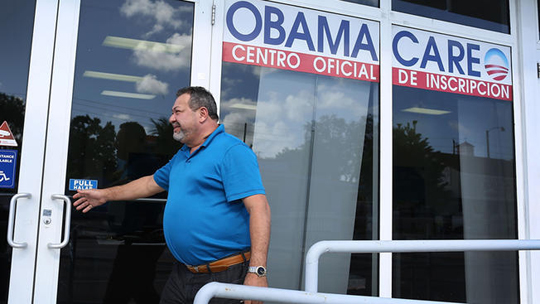
Obamacare

The nearly party line 51-48 vote came on a non-binding Republican backed budget measure that eases the way for action on subsequent repeal legislation as soon as next month.

“We must act quickly to bring relief to the American people,” said Senate Majority Leader Mitch McConnell, R-Ky.

The House is slated to vote on the measure on Friday, though some Republicans there have misgivings about setting the repeal effort in motion without a better idea of the replacement plan.

Trump oozed confidence at a news conference on Tuesday, promising that his incoming administration would soon reveal a plan to both repeal ‘Obamacare' and replace it with legislation to “get health care taken care of in this country.”

“We're going to do repeal and replace, very complicated stuff,” Mr. Trump told reporters, adding that both elements would pass virtually at the same time. That promise, however, will be almost impossible to achieve in the complicated web of Congress, where Republican leaders must navigate complex Senate rules, united Democratic opposition and substantive policy disagreements among Republicans.

Passage of Thursday's measure would permit follow-up legislation to escape the threat of a filibuster by Senate Democrats. Republicans are not close to agreement among themselves on what any “Obamacare” replacement would look like, however.

Republicans plan to get legislation voiding Obama's law and replacing parts of it to Trump by the end of February, House Majority Leader Kevin McCarthy, R-Calif., said Wednesday on “The Hugh Hewitt Show,” a conservative radio programme. Other Republicans have said they expect the process to take longer.

The 2010 law extended health insurance to some 20 million Americans, prevented insurers from denying coverage for pre-existing conditions and steered billions of dollars to states for the Medicaid health program for the poor. Republicans fought the effort tooth and nail and voter opposition to Obamacare helped carry the party to impressive wins in 2010, 2014, and last year.

Thursday's Senate procedural vote will set up special budget rules that will allow the repeal vote to take place with a simple majority in the 100-member Senate, instead of the 60 votes required to move most legislation.

That means Republicans, who control 52 seats, can push through repeal legislation without Democratic cooperation. They're also discussing whether there are some elements of a replacement bill that could get through at the same time with a simple majority. But for many elements of a new health care law, Republicans are likely to need 60 votes and Democratic support, and at this point the two parties aren't even talking.

Increasing numbers of Republicans have expressed anxiety over obliterating the law without a replacement to show voters.

Sen. Susan Collins, R-Maine, said she wants to at least see “a detailed framework” of an alternative health care plan before voting on repeal. She said Republicans would risk “people falling through the cracks or causing turmoil in insurance markets” if lawmakers voided Mr. Obama's statute without a replacement in hand.

Ms. Collins was among a handful of Republicans to occasionally break ranks to support some Democratic messaging amendments aimed at supporting such things as rural hospitals and a mandate to cover patients with pre-existing medical conditions. They were all shot down by majority Republicans anyway.

Many members of the conservative House Freedom Caucus were insisting on first learning details about what a substitute would look like or putting some elements of the replacement measure in the repeal bill.

“We need to be voting for a replacement plan at the same time that we vote for repeal,” said Rep. Mark Meadows, R-N.C., an influential conservative.

Some Republican senators have discussed a phase-in of three years or longer to give lawmakers more time to replace Mr. Obama's overhaul and make sure people now covered by that law can adjust to a new program.

Some more moderate House Republicans were unhappy, too, including Rep. Tom MacArthur, R—N.J., a leader of GOP centrists in the House Tuesday Group. He said he would oppose the budget because there was too little information about the replacement, including whether people receiving expanded Medicaid coverage or health care subsidies under the existing law would be protected.

“We're loading a gun here,” MacArthur said. “I want to know where it's pointed before we start the process.”

Comments

Add new comment

  • Coastaldigest.com reserves the right to delete or block any comments.
  • Coastaldigset.com is not responsible for its readers’ comments.
  • Comments that are abusive, incendiary or irrelevant are strictly prohibited.
  • Please use a genuine email ID and provide your name to avoid reject.
News Network
May 20,2020

London, May 20: The current physical distancing guidelines of 6 feet may be insufficient to prevent COVID-19 transmission, according to a study which says a mild cough in low wind speeds can propel saliva droplets by as much as 18 feet.

Researchers, including those from the University of Nicosia in Cyprus, said a good baseline for studying the airborne transmission of viruses, like the one behind the COVID-19 pandemic, is a deeper understanding of how particles travel through the air when people cough.

In the study, published in the journal Physics of Fluids, they said even with a slight breeze of about four kilometres per hour (kph), saliva travels 18 feet in 5 seconds.

"The droplet cloud will affect both adults and children of different heights," said study co-author Dimitris Drikakis from the University of Nicosia.

According to the scientists, shorter adults and children could be at higher risk if they are located within the trajectory of the saliva droplets.

They said saliva is a complex fluid, which travels suspended in a bulk of surrounding air released by a cough, adding that many factors affect how saliva droplets travel in the air.

These factors, the study noted, include the size and number of droplets, how they interact with one another and the surrounding air as they disperse and evaporate, how heat and mass are transferred, and the humidity and temperature of the surrounding air.

In the study, the scientists created a computer simulation to examine the state of every saliva droplet moving through the air in front of a coughing person.

The model considered the effects of humidity, dispersion force, interactions of molecules of saliva and air, and how the droplets change from liquid to vapour and evaporate, along with a grid representing the space in front of a coughing person.

Each grid, the scientists said, holds information about variables like pressure, fluid velocity, temperature, droplet mass, and droplet position.

The study analysed the fates of nearly 1,008 simulated saliva droplets, and solved as many as 3.7 million equations.

"The purpose of the mathematical modelling and simulation is to take into account all the real coupling or interaction mechanisms that may take place between the main bulk fluid flow and the saliva droplets, and between the saliva droplets themselves," explained Talib Dbouk, another co-author of the study.

However, the researchers added that further studies are needed to determine the effect of ground surface temperature on the behaviour of saliva in air.

They also believe that indoor environments, especially ones with air conditioning, may significantly affect the particle movement through air.

This work is important since it concerns safety distance guidelines, and advances the understanding of the transmission of airborne diseases, Drikakis said.

Comments

Add new comment

  • Coastaldigest.com reserves the right to delete or block any comments.
  • Coastaldigset.com is not responsible for its readers’ comments.
  • Comments that are abusive, incendiary or irrelevant are strictly prohibited.
  • Please use a genuine email ID and provide your name to avoid reject.
News Network
February 24,2020

Kuala Lumpur, Feb 24: Malaysian Prime Minister Mahathir Mohamad has submitted his resignation to the king, two sources with direct knowledge of the matter told Reuters on Monday, amid talks of forming a new coalition to govern the country.

Mahathir, 94, assumed office in May 2018 for his second stint as prime minister.

A spokesman from the prime minister's office declined to comment, saying only that a statement will be issued soon.

The sources declined to be named as they were not authorised to talk to the media.

Comments

Add new comment

  • Coastaldigest.com reserves the right to delete or block any comments.
  • Coastaldigset.com is not responsible for its readers’ comments.
  • Comments that are abusive, incendiary or irrelevant are strictly prohibited.
  • Please use a genuine email ID and provide your name to avoid reject.
News Network
January 30,2020

New York, Jan 30: Three Indian citizens were arrested by border patrol agents here for entering the US illegally.

US Border Patrol agents stopped a vehicle near Massena in New York state along the county's northern border on January 24. During the vehicle checking, the agents found that two of the passengers were Indian citizens who entered the US illegally and not at a designated port of entry.

Both the passengers were transported to the Border Patrol Station for processing and charged.

The vehicle driver, also an Indian citizen who originally entered illegally into the US in 2012 and was ordered removed from the country in absentia last December, was charged with alien smuggling, a felony, which carries a penalty of a fine and up to five years of imprisonment for each violation.

Comments

Add new comment

  • Coastaldigest.com reserves the right to delete or block any comments.
  • Coastaldigset.com is not responsible for its readers’ comments.
  • Comments that are abusive, incendiary or irrelevant are strictly prohibited.
  • Please use a genuine email ID and provide your name to avoid reject.