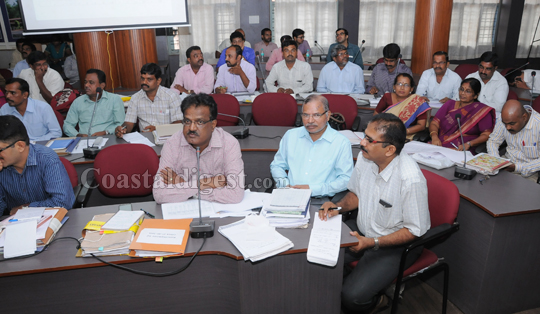
Revenue officials in Dakshina Kannada given deadline to clear RTC files

[email protected] (CD Network | Suresh Vamanjoor)
June 5, 2016

Mangaluru, Jun 5: Revenue officials in Dakshina Kannada have been urged to clear files on time instead of causing inconveniences to the people.
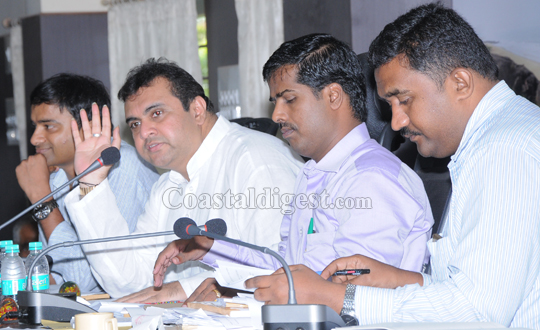
dc ofc 7

Pramod Madhwaraj, Udupi MLA and parliamentary secretary to the revenue minister, who attended a review meeting of revenue officials of the district here on Saturday said that land records should be made up to date.

Mr Madhwaraj fixed deadline for officials to clear files related to issuance of Record of Rights, Tenancy and Crop Inspection (RTC) or pahani, corrections in RTC and other works related to land records. He also warned officials of filing criminal cases if files are found missing in the department.

"No files related to correction in RTC should be pending for more than six months. There are 978 cases related to correction in RTC pertaining to government land in Dakshina Kannada district. There are 2,499 cases related to correction in RTC pertaining to non-government land," he said.

Under the Urban Property Ownership Records (UPOR) project, the process of survey and measurement has been completed in 1,43,387 properties in the city. UPOR cards have been distributed to 15,500 property owners in the city. Officials have informed that there is a shortage of surveyors and inquiry officers in the revenue department. Hence, the process of survey under UPOR is being delayed, he said, adding that the matter will be discussed with revenue minister V Srinivas Prasad.

On regularization of encroached government land, Pramod said the revenue department has received a total of 56,000 applications under 94C from rural areas in the district.

Meanwhile, 4,036 applications are pending under 94CC scheme in Mangaluru city limits, he said.
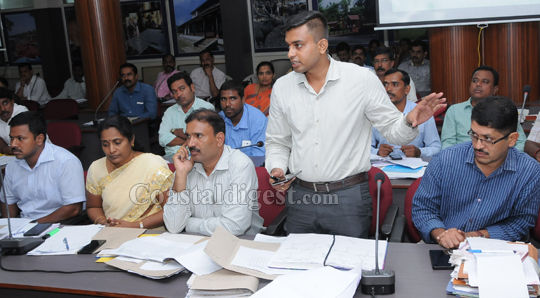
dc ofc 1

dc ofc 6

Comments

SK
 - 
Sunday, 5 Jun 2016

Govt officers should be taken to task and made accountable.....Lazy officers, they work only for money,,, Hell with these officers......

Add new comment

  • Coastaldigest.com reserves the right to delete or block any comments.
  • Coastaldigset.com is not responsible for its readers’ comments.
  • Comments that are abusive, incendiary or irrelevant are strictly prohibited.
  • Please use a genuine email ID and provide your name to avoid reject.
News Network
July 28,2020

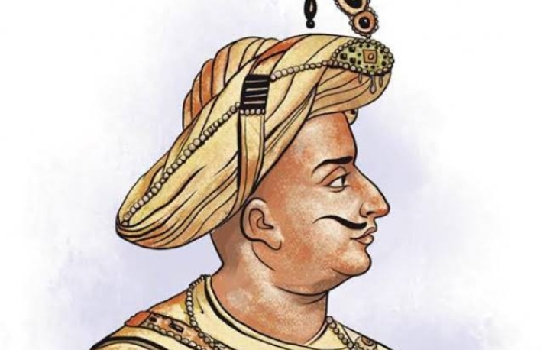
Bengaluru, Jul 28: After the Central Board of Secondary Education (CBSE) reduced the syllabi for Classes 9 to 12 due to COVID-19 pandemic, the Karnataka government has followed the suit. The Department of Public Instruction has omitted the chapters on legendary south Indian rulers Hyder Ali and Tipu Sultan from the textbooks of Class 7 in their attempt to reduce syllabus for state board schools by 30 per cent. 

The department, however, has decided to retain similar chapters on Tipu Sultan in 6th and 10th Classes, though the syllabus in text books for all classes from 1 to 10th has been trimmed. 

The trimmed textbooks uploaded on the website of the Department of State Education Research and Training (DSERT) by Karnataka state Textbook Society revealed removal of chapters on Tipu Sultan for the seventh grade.

Justifying the decision, officials said, "students study similar chapters in Class 6 and more in the 10th grade." Yet another senior official from the Text Book Society said, "Trimming does not mean we have removed half of the syllabus from textbooks. It is only keeping in mind the repetition we have condensed the chapters. In case students study about a particular dynasty in higher grades, then the same had been removed from lower grades."

A few months ago, there was an uproar over dropping of content on Tipu Sultan and MLAs from the ruling BJP also demanded the same and petitioned to the Chief Minister. Even an expert committee led by Prof Baraguru Ramachandrappa suggested to not drop any content on the historic figure. However, the department still decided to drop lessons from one of the classes while keeping the syllabus short for the next 120 active academic days.

Earlier this month, a controversy had erupted over the CBSE's decision to omit topics like federalism, secularism, citizenship, etc while reducing the syllabus for Classes 9 to 12. The education board had issued a detailed clarification later, stating that topics claimed to be dropped "are either being covered by the rationalised syllabus or in the Alternative Academic Calendar of NCERT".

"The rationalisation of syllabus up to 30 per cent has been undertaken by the Board for nearly 190 subjects of class 9 to 12 for the academic session 2020-21 as a one-time measure only. The objective is to reduce the exam stress of students due to the prevailing health emergency situation and prevent learning gaps," it said.

Last week, the Congress in Uttar Pradesh expressed its concern over 'deliberate and systematic' deletions of chapters related to the freedom struggle and the party's role in it from the Class 10-12 syllabi of the Secondary Education Board.

Comments

Add new comment

  • Coastaldigest.com reserves the right to delete or block any comments.
  • Coastaldigset.com is not responsible for its readers’ comments.
  • Comments that are abusive, incendiary or irrelevant are strictly prohibited.
  • Please use a genuine email ID and provide your name to avoid reject.
News Network
February 23,2020

The euphoria over the claim that around 3,000 tonnes of gold reserves, worth Rs 12 trillion, have been discovered in Uttar Pradesh’s Sonbhadra district could not last even 24 hours, with the Geological Survey of India (GSI) clarifying on Saturday there had been no such discovery.

The GSI, headquartered in Kolkata, rebutted the claims of the Uttar Pradesh Directorate of Geology and Mining (UPDGM), and said “miscommunication” must have led to the wrong reporting of facts.

M Sridhar, director general of the GSI, said nobody in the agency gave any such data. He said 52,806 tonnes of gold ore was found in Sonbhadra district during the exploration work in 1998-2000. From this reserve, only 160 kg of gold can be extracted.

“There must have been some miscommunication of facts because of which the gold ore deposits have been overestimated. We have written a letter to Uttar Pradesh (UPDGM), stating the facts. The GSI has not estimated such kind of vast resource of gold deposits in Sonbhadra,” Sridhar said.

ALSO READ: 2,900-tonne gold mine found in Sonbhadra, 4 times that of India's reserves

The UPDGM had said on Friday that gold deposits were found in Son Pahadi and Hardi areas of the district. Sridhar said while gold ore was found in the area during the GSI’s exploration work in 1998-2000, it had told the state government about the discovery in November last year.

Under the new regulation, which came into effect from 2015, the GSI has to inform the state government when ore deposits are discovered. Earlier, no such action was mandatory. In its report, the GSI estimated that only 3.03 gm of gold can be extracted from a tonne of ore. It also clarified that even the extraction amount was tentative and could not be established for certain.

Moreover, Sridhar said the deposits were spread across only 0.5 sq km in forest land, which made the mining of ore economically unviable. “When there are several mines nearby, we can club it into a block and then it makes sense to mine the ore. But in this case, the deposits are too small to make it viable for any company to mine it,” he said. The GSI usually prioritises its exploration work based on the needs of the Centre. While strategic minerals like tin, cobalt, lithium, beryllium, germanium, gallium, indium, tantalum, niobium, selenium, and bismuth are atop the list in GSI exploration, gold is another commodity on its priority list.

According to the World Gold Council, India has reserves of 630 tonnes of gold.

Comments

Add new comment

  • Coastaldigest.com reserves the right to delete or block any comments.
  • Coastaldigset.com is not responsible for its readers’ comments.
  • Comments that are abusive, incendiary or irrelevant are strictly prohibited.
  • Please use a genuine email ID and provide your name to avoid reject.
Agencies
January 9,2020

New Delhi, Jan 9: A total of 10,349 people involved in the farming sector, including 5,763 farmers or cultivators, committed suicide in 2018, the National Crime Records Bureau (NCRB)'s report on 'Crime in India-2018' reveals.

The annual data was released around three months after the government released the NCRB report on 'Crime in India-2017'.

As per the latest data, of the 10,349 persons, who committed suicide in 2018, 4,586 were agricultural labourers.

The number of suicides in the farming sector in 2018 accounted for 7.7 per cent of the total suicide-victims (1,34,516) in the country, the NCRB data said.

Suicides in the country in 2018 rose to 1,34,516 from 1,29,887 in 2017.

The rate of suicides was up from 9.9 per cent in 2017 to 10.2 per cent in 2018. In 2017, a total of 10,655 farming sector-suicides were reported.

West Bengal, Bihar, Odisha, Uttarakhand, Meghalaya, Goa, Chandigarh, Daman and Diu, Delhi, Lakshadweep and Puducherry reported zero suicides of farmers or cultivators and agricultural labourers during 2018, said the report.

Comments

Add new comment

  • Coastaldigest.com reserves the right to delete or block any comments.
  • Coastaldigset.com is not responsible for its readers’ comments.
  • Comments that are abusive, incendiary or irrelevant are strictly prohibited.
  • Please use a genuine email ID and provide your name to avoid reject.