Rights panel directs Kashmir govt to pay Rs 10L to human shield victim

TNN
July 10, 2017

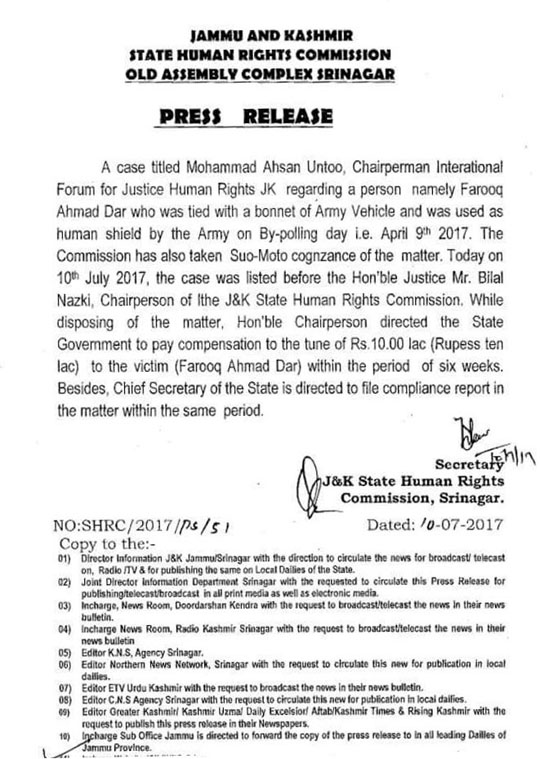
New Delhi, Jul 10: The Jammu and Kashmir State Human Rights Commission (SHRC) on Monday directed the state government to provide Rs 10 lakh as "compensation" to the civilian allegedly used as a human shield by the Army earlier this year.jk

"I have asked the state government to compensate Farooq Ahmad Dar for endangering his life and dignity," Justice Bilal Nazki,Chairman SHRC, said.

However, the SHRC refused to direct the Army in the case saying "it doesn't have jurisdiction."

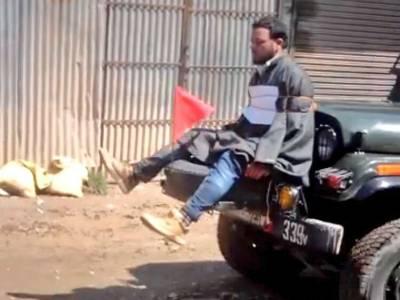
On April 9, Dar was allegedly tied to the bonnet of an Army jeep and paraded through several villages in Jammu and Kashmir's Budgam district. The incident happened during the by-polls of the parliamentary seat of Srinagar.

Master

Comments

Add new comment

  • Coastaldigest.com reserves the right to delete or block any comments.
  • Coastaldigset.com is not responsible for its readers’ comments.
  • Comments that are abusive, incendiary or irrelevant are strictly prohibited.
  • Please use a genuine email ID and provide your name to avoid reject.
News Network
April 3,2020

New Delhi, Apr 3: Jamiat Ulema-e-Hind leader Mahmood Madani on Thursday said that misbehaviour with doctors cannot be tolerated as they are working to protect everyone.

"We can only spread awareness about coronavirus that its only cure is by taking precautions. The government shared the precautions that people should not take part in any gathering, be clean and maintain social distance. After the reports, it will clear that how it is spread in the country," Madani told news agency.

"People who are objecting to testing in Lok Nayak Jai Prakash Narayan Hospital are very wrong and they should follow the instructions.

Hospital authorities and administration should talk to them. Today doctors are our soldiers who protect us and wrong behaviour with doctors cannot be tolerated," he added.

He further said that Jamiat wrote to the PM Narendra Modi that they will provide a place for 10,000 people in different states. Our workers also distributed food to one lakh people, he added.

People who attended a religious prayer meeting from March 13-15 at Markaz in the Nizamuddin area of Delhi were sent to Lok Nayak Hospital for coronavirus test on March 30.

The Union Ministry of Health and Family Welfare on Thursday said that there are 2,069 coronavirus positive cases in India, including 1,860 active cases, 156 cured/discharged/migrated people and 53 deaths.

Comments

Add new comment

  • Coastaldigest.com reserves the right to delete or block any comments.
  • Coastaldigset.com is not responsible for its readers’ comments.
  • Comments that are abusive, incendiary or irrelevant are strictly prohibited.
  • Please use a genuine email ID and provide your name to avoid reject.
News Network
March 2,2020

Feb 2: The Supreme court on Monday decided to hear on March 4 a plea seeking registration of FIRs against politicians for hate speeches which allegedly led to violence in the national capital.

A bench headed by Chief Justice S A Bobde agreed to hear the plea filed by riots victims.

The petition was mentioned for urgent listing by senior advocate Colin Gonsalves, appearing for the riots victims.

Gonsalves said that the Delhi High Court has deferred for four weeks the matters related to riots in the national capital despite the fact that people are still dying due to the recent violence.

Comments

Add new comment

  • Coastaldigest.com reserves the right to delete or block any comments.
  • Coastaldigset.com is not responsible for its readers’ comments.
  • Comments that are abusive, incendiary or irrelevant are strictly prohibited.
  • Please use a genuine email ID and provide your name to avoid reject.
News Network
April 23,2020

Washington, Apr 23: Air pollution over northern India has plummeted to a 20-year-low for this time of the year, according to satellite data published by US space agency National Aeronautics and Space Administration (NASA).
The US space agency's satellite sensors observed aerosol levels at a 20-year low post the countrywide lockdown, implemented to slow the spread of the novel coronavirus.

"We knew we would see changes in atmospheric composition in many places during the lockdown," said Pawan Gupta, a Universities Space Research Association (USRA) scientist at NASA''s Marshall Space Flight Center. "But I have never seen aerosol values so low in the Indo-Gangetic Plain at this time of year," added Mr Gupta.

Acting Assistant Secretary of State for South and Central Asia Alice G Wells tweeted, "These images from NASA were taken each spring starting in 2016 and show a 20-year low in airborne particle levels over India. When India and the world are ready to work and travel again, let's not forget that collaborative action can result in cleaner air."

The data published with maps show aerosol optical depth (AOD) in 2020 compared to the average for 2016-2019. Aerosol optical depth is a measure of how light is absorbed or reflected by airborne particles as it travels through the atmosphere.

If aerosols are concentrated near the surface, an optical depth of 1 or above indicates very hazy conditions. An optical depth, or thickness, of less than 0.1 over the entire atmospheric vertical column is considered "clean." The data were retrieved by the Moderate Resolution Imaging Spectroradiometer (MODIS) on NASA's Terra satellite.

In the first few days of the lockdown, it was difficult to observe a change in the pollution signature. "We saw an aerosol decrease in the first week of the shutdown, but that was due to a combination of rain and the lockdown," said Mr Gupta.

Around March 27, heavy rain poured over vast areas of northern India and helped clear the air of aerosols. Aerosol concentrations usually increase again after such heavy precipitation.

"After the rainfall, I was really impressed that aerosol levels did not go up and return to normal. We saw a gradual decrease and things have been staying at the level we might expect without anthropogenic emissions," Mr Gupta said.

On March 25, the Indian government placed its 1.3 billion citizens under a strict lockdown to reduce the spread of COVID-19. The countrywide mandate decreased activity at factories and severely reduced car, bus, truck and airplane traffic. Every year, aerosols from anthropogenic (human-made) sources contribute to unhealthy levels of air pollution in many Indian cities.

Aerosols are tiny solid and liquid particles suspended in the air that reduce visibility and can damage the human lungs and heart.

In southern India though, the story is a little hazier. Satellite data show aerosol levels have not yet decreased to the same extent. In fact, levels seem to be slightly higher than in the past four years. The reasons are unclear but could be related to recent weather patterns, agricultural fires, winds or other factors.

"This a model scientific experiment," Robert Levy, program leader for NASA's MODIS aerosol products, said about the lockdown and its effects on pollution.

"We have a unique opportunity to learn how the atmosphere reacts to sharp and sudden reductions in emissions from certain sectors. This can help us separate how natural and human sources of aerosols affect the atmosphere," Mr Levy added.


Comments

Add new comment

  • Coastaldigest.com reserves the right to delete or block any comments.
  • Coastaldigset.com is not responsible for its readers’ comments.
  • Comments that are abusive, incendiary or irrelevant are strictly prohibited.
  • Please use a genuine email ID and provide your name to avoid reject.