


Rohith Vemula's mother, brother say goodbye to Hinduism; embrace new faith

April 14, 2016

Mumbai, Apr 14: Mother and brother of Dalit scholar Rohith Vemula, who committed suicide at Hyderabad Central University in January sparking strong protests across the country, today embraced Buddhism on the occasion of Dr B R Ambedkar's 125th birth anniversary.
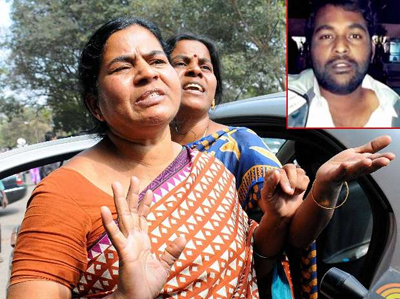
VemulaRohith's mother Radhika and brother Naga Chaitanya Vemula, also known as Raja Vemula, were given 'deeksha' at a function in Dadar here in the presence of Prakash Ambedkar, the grandson of Dr B R Ambedkar.

Ambedkar, Dalit icon and architect of the Indian Constitution, coverted to Buddhism at a grand ceremony in Nagpur in 1956 as he was strongly opposed to the caste system in Hindusim. At the venue of the deeksha ceremony, the mother-son duo paid tributes to Dr Ambedkar and bowed before his portrait.

Raja Vemula said, "My brother Rohith was a Buddhist at heart although he did not convert. He took his own life as he was discriminated because he was a Dalit. We performed his last rites according to Buddhist traditions, honouring his love for Buddhism."

"Rohith used to talk of Buddhism a lot. He had also written a letter to the Vice Chancellor about how Dalits are discriminated against on the campus. My mother feels that we should honour Rohith by embracing Buddhism," he said.

"We are against the caste system in Hinduism and have, therefore, decided to embrace Buddhism which does not have such an oppressive system of castes," Rohith's brother said.

Prakash Ambedkar said Buddhist monks gave 'deeksha' to Rohith's mother and brother at a function on the sidelines of a programme marking the birth anniversary of Dr Ambedkar.

"The function to covert the duo to Buddhism was organised after Radhika Vemula approached me and conveyed their wish to embrace Buddhism when I visited Hyderabad recently," he said.

Raja and Radhika Vemula, along with Rohith's childhood friend Riyaz Shaikh and Hyderabad university student Charbad Raju, had left for Mumbai from Hyderabad yesterday. Rohith's elder sister, who is married, has not converted to Buddhism.

Rohith Vemula, 27, committed suicide on January 17 in a hostel room in Hyderabad Central University where he was a PhD scholar after he and four others were suspended from the hostel last year and restrictions were put on their movement by the university administration as part of disciplinary action for allegedly assaulting ABVP leader N Susheel Kumar.

Comments

Dean
 - 
Thursday, 14 Apr 2016

We welcome Dalits to convert to Islam for peaceful dignified life. In sha Allah

Ahmed
 - 
Thursday, 14 Apr 2016

Islaam is the only religion which last long.So learn Islam.

Dean
 - 
Thursday, 14 Apr 2016

Majority of Muslims converted to Islam in India are from Buddism.

HUMANS PONDER
 - 
Thursday, 14 Apr 2016

ALLAH says in QURAN 49:13
O mankind, We have created you from a male and a female and have made you into nations and tribes for you to know one another. Truly, the noblest of you with God is the MOST PIOUS. Truly God is all knowing, All aware.

Prophet of ALLAH (Mohammad pbuh) said : Lend me an attentive ear.
All mankind is from Adam & Eve, An Arab has NO Superiority over a Non Arab NOR a Non Arab has any superiority over An Arab, also a WHITE has No superiority over a Black, Nor a Black has any superiority over a White EXCEPT BY PIETY and GOOD ACTION.
Remember ONE DAY U will appear before ALLAH and answer YOUR DEEDS. So beware, Do not stray from the path of RIGHTEOUSNESS after Im Gone.

A very beautiful teaching which kills the RACISM from the SOCIETY...
THANK YOU ALLAH for making me A MUSLIM

Add new comment

  • Coastaldigest.com reserves the right to delete or block any comments.
  • Coastaldigset.com is not responsible for its readers’ comments.
  • Comments that are abusive, incendiary or irrelevant are strictly prohibited.
  • Please use a genuine email ID and provide your name to avoid reject.
News Network
June 24,2020

Bengaluru, Jun 24: About 8,48,203 students will appear in the Secondary School Leaving Certificate (SSLC) examination tomorrow, i.e., June 24, said Karnataka Health Minister B Sriramulu on Wednesday.

Students have been advised to report to the examination centre three-hour before the commencement of the examination i.e., at 07:30 am. The examination will commence at 10:30 am.

Early entry to the centres will also help maintain social distancing that is very much essential during the pandemic, minister for primary and secondary education S Suresh Kumar said.

"SSLC exams to take place tomorrow. About 8,48,203 students will write the exam. Social distancing needs to be followed and the mask should be used. Minister of Education and I have already held a lot of meetings. Students from containment zones will be carefully handled," said Sriramulu.

Commenting upon the situation arising in the state due to COVID-19, Sriramulu said, "There is a panel of experts to decide about lockdown. There has been an opinion that the COVID-19 test should be increased. Workers, traders, and others should be categorised in 15 categories and tests must be conducted," he added.

Sriramulu further said that there will be a meeting of task force on the coming Monday.

"All the issues will be brought to the notice of the Chief Minister at the task force meeting, then CM will take a call on what needs to be done," he said.

Meanwhile, Suresh Kumar, Minister of Education inspected the schools and places where SSLC exams will be held.

Earlier Karnataka Education Minister S Suresh Kumar had announced that SSLC examinations, which were stayed in view of the coronavirus pandemic, will be conducted 'between June 25 and July 4' in the state.

According to the Union Health Ministry, Karnataka has 9,721 COVID-19 cases including 150 fatalities.

Comments

Add new comment

  • Coastaldigest.com reserves the right to delete or block any comments.
  • Coastaldigset.com is not responsible for its readers’ comments.
  • Comments that are abusive, incendiary or irrelevant are strictly prohibited.
  • Please use a genuine email ID and provide your name to avoid reject.
News Network
April 17,2020

Bengaluru, Apr 17: The Karnataka government on Friday asked Information Technology, biotechnology and allied companies not to go for closure or layoffs citing lack of work orders due to COVID-19 lockdown and instead consider measures like cutting salaries among other things.

It said IT/BT companies in the state can resume operations with 50 per cent from their office space after April 20.

Deputy chief minister C N Ashwath Narayan, who is also in charge of IT & BT department, held video consultation with the captains of the industry in light of the disruption caused due to the lockdown, and discussed on the way forward - both for effective implementation of the lockdown as well as the future course to deal with the unique circumstances.

"Immediately we are going to permit 50 per cent, but it doesn't mean that they will be able to mobilise 50 per cent immediately. It will take few weeks for them to do so. Gradually percentage will increase and it will start getting back to normalcy," Ashwath Narayan told reporters.

Stating that there were discussions regarding layoffs, he said, companies should not go for layoffs, instead of that gradation or deduction in the salary should be taken up, so that it doesn't affect the functioning of companies also that are facing less orders.

"On handling such financial crisis they (industry) wanted government consideration with mutual cooperation and understanding the concerns," he added.

Pointing out that concerns were also expressed regarding measures or protocol that needs to be followed if any positive cases are reported in any of the office spaces, Ashwath Narayan said, certain guidelines will be issued in consultation with the Health Department.

"Once the relaxation is given this may become the usual phenomena, as cases will be reported here and there... so in that scenario how we need to work and handle the situation is important, so we will be working on protocols how to handle the situation. So far we have planned for residential areas and not for work spaces," he said.

The deputy chief minister said the IT and BT industry leaders are extremely happy with regard to the support system or backup given by the government of Karnataka, particularly IT/BT department.

Even during this crisis period in the entire world, Karnataka and Bengaluru were able to get a good reputation and become reliable partner, as IT/BT service providers in both the city and the state were able to provide excellent quality services to their clients without any interruption, he said.

If you compare with any state or country, we have done extremely well, and hope that this would get more business, he added.

Biocon chief Kiran Mazumdar Shaw, Infosys co-founder Kris Gopalakrishnan, who is also the Chairman of Vision Group IT, were among others present at the video conferencing.

Noting that concerns expressed by the industry regarding passes for employees to commute to office, Ashwath Narayan said, the government would make necessary arrangements in this regard, considering measures that need to be taken after April 20.

Regarding providing transport facility, they can seek for services from public transport Bangalore Metropolitan Transport Corporation (BMTC) on a contract basis, he said, adding that "We will be ready to facilitate BMTC."

The minister said the industry leaders wanted internet services to continue with the same quality and without any interruption.

Comments

Add new comment

  • Coastaldigest.com reserves the right to delete or block any comments.
  • Coastaldigset.com is not responsible for its readers’ comments.
  • Comments that are abusive, incendiary or irrelevant are strictly prohibited.
  • Please use a genuine email ID and provide your name to avoid reject.
Agencies
May 8,2020

Washington D.C., May 8: The prime time for brain development in a child's life is the first year, where the infant spends most of the time asleep. It is the time when neural connections form and sensory memories are encoded.

However, when sleep is disrupted, as occurs more often among children with autism, brain development may be affected, too.

New research led by the University of Washington finds that sleep problems in a baby's first 12 months may not only precede an autism diagnosis but also may be associated with altered growth trajectory in a key part of the brain, the hippocampus.

The study, which was published in the American Journal of Psychiatry, researchers report that in a sample of more than 400 taken of 6- to 12-month-old infants, those who were later diagnosed with autism were more likely to have had difficulty falling asleep.

It also states that this sleep difficulty was associated with altered growth trajectories in the hippocampus.

"The hippocampus is critical for learning and memory, and changes in the size of the hippocampus have been associated with poor sleep in adults and older children.

As many as 80 per cent of the children with autism spectrum disorder have sleep problems," said Annette Estes, director of the UW Autism Center and senior author of the study.

"In our clinical experience, parents have a lot of concerns about their children's sleep, and in our work on early autism intervention, we observed that sleep problems were holding children and families back," added Estes, who is also a UW professor of speech and hearing sciences.

"It could be that altered sleep is part-and-parcel of autism for some children. One clue is that behavioural interventions to improve sleep don't work for all children with autism, even when their parents are doing everything just right. This suggests that there may be a biological component to sleep problems for some children with autism," said Estes.

To consider links among sleep, brain development, and autism, researchers at the IBIS Network looked at MRI scans of 432 infants, surveyed parents about sleep patterns, and measured cognitive functioning using a standardized assessment.

At the outset of the study, infants were classified according to their risk for developing autism: Those who were at higher risk of developing autism -- about two-thirds of the study sample -- had an older sibling who had already been diagnosed.

Infant siblings of children with autism have a 20 per cent chance of developing autism spectrum disorder -- a much higher risk than children in the general population.

In the current study, 127 of the 432 infants were identified as "low risk" at the time the MRI scans were taken because they had no family history of autism.

They later evaluated all the participants at 24 months of age to determine whether they had developed autism. Of the roughly 300 children originally considered "high familial risk," 71 were diagnosed with autism spectrum disorder at that age.

Problems with sleep were more common among the infants later diagnosed with an autism spectrum disorder, as were larger hippocampi. No other subcortical brain structures were affected, including the amygdala, which is responsible for certain emotions and aspects of memory, or the thalamus, a signal transmitter from the spinal cord to the cerebral cortex.

The authors note that while parents reported more sleep difficulties among infants who developed autism compared to those who did not, the differences were very subtle and only observed when looking at group averages across hundreds of infants.

Sleep patterns in the first years of life change rapidly as infants transition from sleeping around the clock to a more adult-like sleep/wake cycle. Until further research is completed, Estes said, it is not possible to interpret challenges with sleep as an early sign of increased risk for autism.

Comments

Add new comment

  • Coastaldigest.com reserves the right to delete or block any comments.
  • Coastaldigset.com is not responsible for its readers’ comments.
  • Comments that are abusive, incendiary or irrelevant are strictly prohibited.
  • Please use a genuine email ID and provide your name to avoid reject.