


Rohith Vemula's mother, brother say goodbye to Hinduism; embrace new faith

April 14, 2016

Mumbai, Apr 14: Mother and brother of Dalit scholar Rohith Vemula, who committed suicide at Hyderabad Central University in January sparking strong protests across the country, today embraced Buddhism on the occasion of Dr B R Ambedkar's 125th birth anniversary.
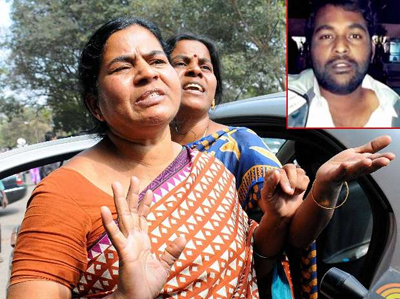
VemulaRohith's mother Radhika and brother Naga Chaitanya Vemula, also known as Raja Vemula, were given 'deeksha' at a function in Dadar here in the presence of Prakash Ambedkar, the grandson of Dr B R Ambedkar.

Ambedkar, Dalit icon and architect of the Indian Constitution, coverted to Buddhism at a grand ceremony in Nagpur in 1956 as he was strongly opposed to the caste system in Hindusim. At the venue of the deeksha ceremony, the mother-son duo paid tributes to Dr Ambedkar and bowed before his portrait.

Raja Vemula said, "My brother Rohith was a Buddhist at heart although he did not convert. He took his own life as he was discriminated because he was a Dalit. We performed his last rites according to Buddhist traditions, honouring his love for Buddhism."

"Rohith used to talk of Buddhism a lot. He had also written a letter to the Vice Chancellor about how Dalits are discriminated against on the campus. My mother feels that we should honour Rohith by embracing Buddhism," he said.

"We are against the caste system in Hinduism and have, therefore, decided to embrace Buddhism which does not have such an oppressive system of castes," Rohith's brother said.

Prakash Ambedkar said Buddhist monks gave 'deeksha' to Rohith's mother and brother at a function on the sidelines of a programme marking the birth anniversary of Dr Ambedkar.

"The function to covert the duo to Buddhism was organised after Radhika Vemula approached me and conveyed their wish to embrace Buddhism when I visited Hyderabad recently," he said.

Raja and Radhika Vemula, along with Rohith's childhood friend Riyaz Shaikh and Hyderabad university student Charbad Raju, had left for Mumbai from Hyderabad yesterday. Rohith's elder sister, who is married, has not converted to Buddhism.

Rohith Vemula, 27, committed suicide on January 17 in a hostel room in Hyderabad Central University where he was a PhD scholar after he and four others were suspended from the hostel last year and restrictions were put on their movement by the university administration as part of disciplinary action for allegedly assaulting ABVP leader N Susheel Kumar.

Comments

Dean
 - 
Thursday, 14 Apr 2016

We welcome Dalits to convert to Islam for peaceful dignified life. In sha Allah

Ahmed
 - 
Thursday, 14 Apr 2016

Islaam is the only religion which last long.So learn Islam.

Dean
 - 
Thursday, 14 Apr 2016

Majority of Muslims converted to Islam in India are from Buddism.

HUMANS PONDER
 - 
Thursday, 14 Apr 2016

ALLAH says in QURAN 49:13
O mankind, We have created you from a male and a female and have made you into nations and tribes for you to know one another. Truly, the noblest of you with God is the MOST PIOUS. Truly God is all knowing, All aware.

Prophet of ALLAH (Mohammad pbuh) said : Lend me an attentive ear.
All mankind is from Adam & Eve, An Arab has NO Superiority over a Non Arab NOR a Non Arab has any superiority over An Arab, also a WHITE has No superiority over a Black, Nor a Black has any superiority over a White EXCEPT BY PIETY and GOOD ACTION.
Remember ONE DAY U will appear before ALLAH and answer YOUR DEEDS. So beware, Do not stray from the path of RIGHTEOUSNESS after Im Gone.

A very beautiful teaching which kills the RACISM from the SOCIETY...
THANK YOU ALLAH for making me A MUSLIM

Add new comment

  • Coastaldigest.com reserves the right to delete or block any comments.
  • Coastaldigset.com is not responsible for its readers’ comments.
  • Comments that are abusive, incendiary or irrelevant are strictly prohibited.
  • Please use a genuine email ID and provide your name to avoid reject.
Agencies
May 8,2020

Washington D.C., May 8: The prime time for brain development in a child's life is the first year, where the infant spends most of the time asleep. It is the time when neural connections form and sensory memories are encoded.

However, when sleep is disrupted, as occurs more often among children with autism, brain development may be affected, too.

New research led by the University of Washington finds that sleep problems in a baby's first 12 months may not only precede an autism diagnosis but also may be associated with altered growth trajectory in a key part of the brain, the hippocampus.

The study, which was published in the American Journal of Psychiatry, researchers report that in a sample of more than 400 taken of 6- to 12-month-old infants, those who were later diagnosed with autism were more likely to have had difficulty falling asleep.

It also states that this sleep difficulty was associated with altered growth trajectories in the hippocampus.

"The hippocampus is critical for learning and memory, and changes in the size of the hippocampus have been associated with poor sleep in adults and older children.

As many as 80 per cent of the children with autism spectrum disorder have sleep problems," said Annette Estes, director of the UW Autism Center and senior author of the study.

"In our clinical experience, parents have a lot of concerns about their children's sleep, and in our work on early autism intervention, we observed that sleep problems were holding children and families back," added Estes, who is also a UW professor of speech and hearing sciences.

"It could be that altered sleep is part-and-parcel of autism for some children. One clue is that behavioural interventions to improve sleep don't work for all children with autism, even when their parents are doing everything just right. This suggests that there may be a biological component to sleep problems for some children with autism," said Estes.

To consider links among sleep, brain development, and autism, researchers at the IBIS Network looked at MRI scans of 432 infants, surveyed parents about sleep patterns, and measured cognitive functioning using a standardized assessment.

At the outset of the study, infants were classified according to their risk for developing autism: Those who were at higher risk of developing autism -- about two-thirds of the study sample -- had an older sibling who had already been diagnosed.

Infant siblings of children with autism have a 20 per cent chance of developing autism spectrum disorder -- a much higher risk than children in the general population.

In the current study, 127 of the 432 infants were identified as "low risk" at the time the MRI scans were taken because they had no family history of autism.

They later evaluated all the participants at 24 months of age to determine whether they had developed autism. Of the roughly 300 children originally considered "high familial risk," 71 were diagnosed with autism spectrum disorder at that age.

Problems with sleep were more common among the infants later diagnosed with an autism spectrum disorder, as were larger hippocampi. No other subcortical brain structures were affected, including the amygdala, which is responsible for certain emotions and aspects of memory, or the thalamus, a signal transmitter from the spinal cord to the cerebral cortex.

The authors note that while parents reported more sleep difficulties among infants who developed autism compared to those who did not, the differences were very subtle and only observed when looking at group averages across hundreds of infants.

Sleep patterns in the first years of life change rapidly as infants transition from sleeping around the clock to a more adult-like sleep/wake cycle. Until further research is completed, Estes said, it is not possible to interpret challenges with sleep as an early sign of increased risk for autism.

Comments

Add new comment

  • Coastaldigest.com reserves the right to delete or block any comments.
  • Coastaldigset.com is not responsible for its readers’ comments.
  • Comments that are abusive, incendiary or irrelevant are strictly prohibited.
  • Please use a genuine email ID and provide your name to avoid reject.
coastaldigest.com news network
March 23,2020

Mangaluru/Udupi, Mar 23: The coastal district of Dakshina Kannada including the city of Mangaluru today refused to return to normalcy from yesterday’s Janata Curfew, as the government imposed lockdown in the district till the month end to contain the Covid-19 caused by the deadly novel coronavirus.

The lockdown coupled with the prohibitory orders under Section 144 has forced all the commercial establishments barring few to remain closed in the district.

The police started issuing stern warning to the people through loudspeakers against venturing out of their homes unnecessarily. People are allowed to move only in case of any emergency or basic needs.

The police warning came after a few people started ignoring the lockdown and ban orders. A few private buses also were seen plying on the roads in the morning.

Under the proibitory orders, the district administration banned from venturing out of their homes except in case of emergency or extreme necessity. All public programmes including religious ceremonies, cultural programmes also are banned. All shops, commercial establishments, workshops and godowns with other unessential goods are supposed to remain closed. Bus service, both government and private, are to suspended. Mass prayers and religious ceremonies are not allowed in temples, mosques and churches. Beaches and other tourist spots are closed.

Udupi

The lockdown in 9 districts of Karnataka has forced many private buses in Udupi to stay off the roads for second day on Monday. Some buses plying between Udupi to Kundapur have resumed service a day after Janata Curfew, with very minimum occupancy.

Due to lockdown in Dakshina Kannada, all services operating from Mangaluru to Udupi, Manipal, and Kundapur have been suspended till the month end. Buses on Karkala-Udupi route have also stopped their operations.

Comments

Add new comment

  • Coastaldigest.com reserves the right to delete or block any comments.
  • Coastaldigset.com is not responsible for its readers’ comments.
  • Comments that are abusive, incendiary or irrelevant are strictly prohibited.
  • Please use a genuine email ID and provide your name to avoid reject.
News Network
July 2,2020

Bengaluru, Ju 2 As many as 19 deaths and 1,502 new COVID-19 cases were reported in Karnataka till 5 pm on Thursday, as per information provided by the State Health Department.

The total number of COVID-19 cases in the state now stands at 18,016, including 9,406 active cases.

While 8,334 patients have been discharged after treatment, 272 people have succumbed to the virus.

India's COVID-19 tally breached the 6 lakh cases mark with 19,148 new coronavirus cases being reported in the last 24 hours, informed the Union Ministry of Health and Family Welfare on Thursday.

The total cases now stand at 6,04,641 of which there are 2,26,947 active cases while 3,59,860 patients have been cured/discharged/migrated. 434 deaths have been reported in the last 24 hours taking the number of COVID-19 deaths in the country to 17,834.

Comments

Add new comment

  • Coastaldigest.com reserves the right to delete or block any comments.
  • Coastaldigset.com is not responsible for its readers’ comments.
  • Comments that are abusive, incendiary or irrelevant are strictly prohibited.
  • Please use a genuine email ID and provide your name to avoid reject.