



Romanian government seeks loophole on corruption

February 7, 2017

Bucharest, Feb 7: Romania's government is on a high-risk mission: devise a legal and politically acceptable way to remove penalties for some types of official corruption.
Romanian

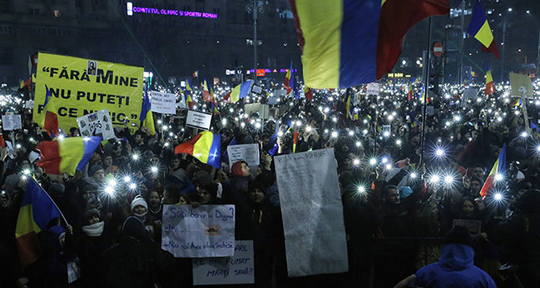
First, the government tried to effect the change by imposing an emergency decree without public debate. The move backfired badly, sparking massive demonstrations in the capital of Bucharest and other major cities that caused the government to reverse course.

The standing of the left-leaning government that assumed power two months ago has fallen so quickly that leaders found it necessary Monday to assert they would not resign even as the protests continued. The prime minister says a new proposal will be put before Parliament instead.

Is there a legal and political path for the government to accomplish its goal of easing corruption rules for public officials? Experts say Parliament can indeed pass such a law, and it could take effect if the president signs it, but the political task of winning support is trickier.

Laura Stefan, a Romanian anti-corruption specialist with the Expert Forum public policy think tank in Bucharest, said the government made a strategic blunder with the emergency decree. It would have tolerated abuse of power by officials, ranging from a mayor in a small village to a top government minister, if the amount of graft involved totaled less than about $48,500.

"It's simply un-defendable," Stefan said. "How can you explain to the people of this country, who maybe don't make $50,000 in their lifetime, that it is okay for public officials to misuse their office in order to obtain less than $50,000 from the state budget."

Public officials have not offered a specific explanation for why the law is needed, although one minister said it would bring the country in line with other European nations. The decree also would have applied retroactively to officials already convicted of corruption offenses involving less than $48,500.

The threshold figure would not have applied to case in which money was stolen, which would still be prosecuted as theft, but could apply to mismanagement of public funds, kickbacks on purchases or contracts, or other types of official misconduct. It would apply to officials who have hidden interests in companies that they set up and then make purchases from while in office.

One possible beneficiary would be Social Democratic Party leader Social Democratic Party leader Liviu Dragnea, whose path to becoming prime minister has been effectively blocked by corruption charges. His party enjoys broad support in Parliament, giving backers hope the redrafted measure will pass despite vocal opposition in the streets.

The provocative proposal could be difficult to enact even if it passes in Parliament, however, because it would still require the approval of President Klaus Iohannis, who has expressed opposition to the measure in its current form.

Transparency International, which lobbies for greater openness in government, has opposed both the way in which the emergency measure was imposed without public scrutiny and the proposal now set to be debated in Parliament.

Adam Foldes, one of the group's international lawyers at its Berlin headquarters, said the proposal does not meet international conventions set out by the United Nations and the Organization for Economic Cooperation and Development that call for corruption penalties to be "proportionate, effective, and a deterrent."

"It doesn't look good from an international perspective or a domestic legal perspective," Foldes said, adding that the original proposal cost the relatively new government a substantial amount of public support and should have been put before elected representatives all along.

Many protesters say they plan to continue nightly demonstrations until the government steps down even though the emergency ordinance was withdrawn on Sunday.

Lawyer Nicholas Hammond, who practices in Romania, said the procedure for approving emergency decrees was put in place after the country's 1989 anti-communist revolution to deal with critical situations that developed when Parliament was not in session.

However, it soon was abused by officials seeking to act without input from legislators, he said.

"They realized they could do it even when Parliament was in session," Hammond said. "This wasn't even on the agenda and it was done at 10 at night."

There were signs Monday that the government, facing nightly protests, is wavering in its commitment to press for quick adoption of the proposal in Parliament.

Justice Minister Florin Iordache said in a statement Monday that he is "not preoccupied" with drawing up a draft law and will await clarification from the Constitutional Court.

Comments

Add new comment

  • Coastaldigest.com reserves the right to delete or block any comments.
  • Coastaldigset.com is not responsible for its readers’ comments.
  • Comments that are abusive, incendiary or irrelevant are strictly prohibited.
  • Please use a genuine email ID and provide your name to avoid reject.
News Network
April 14,2020

New Delhi, Apr 14: The World Health Organization on Tuesday lauded "India's tough and timely actions" against the coronavirus spread as Prime Minister Narendra Modi announced the extension of current lockdown till May 3.

"It may be early to talk about results in numbers, but a six-week nationwide lockdown to facilitate effective physical distancing, coupled with the expansion of core public health measures such as detection, isolation and tracing contact of coronavirus positive people, would go a long way in arresting the virus spread," said WHO's South-East Asia Regional Director, Dr Poonam Khetrapal Singh.

"Despite huge and multiple challenges, India has been demonstrating unwavering commitment in its fight against the pandemic," she said.

"In these testing times, the action lies as much with the communities as with the authorities and the health workforce," she added.

"It is indeed time for each and every one to contribute their best and together to beat the virus," Dr Singh said.

Modi on Tuesday said the implementation of the lockdown will be strictly ensured in coming days to ensure that the virus does not spread to new areas

The prime minister said a detailed guideline on the implementation of the new lockdown will be announced on Wednesday.

According the Union Health Ministry figures, a total of 339 people have died of COVIOD-19 till date in the country, while the number of infected cases has soared to 10,363 on Tuesday.

A PTI tally of figures reported by various states as on Monday evening, however, showed at least 346 deaths.

There has been a lag in the Union Health Ministry figures, compared to the number of deaths announced by different states, which officials attribute to procedural delays in assigning the cases to individual states.

Comments

Add new comment

  • Coastaldigest.com reserves the right to delete or block any comments.
  • Coastaldigset.com is not responsible for its readers’ comments.
  • Comments that are abusive, incendiary or irrelevant are strictly prohibited.
  • Please use a genuine email ID and provide your name to avoid reject.
Agencies
May 28,2020

More than one in six youths were jobless since the onset of the COVID-19 pandemic while those who remain employed have seen their working hours cut by 23 per cent, according to a report by the International Labour Organisation (ILO).

According to the 'ILO Monitor: COVID-19 and the world of work: 4th edition' published on Wednesday, youths are being disproportionately affected by the pandemic, and the substantial and rapid increase in youth unemployment seen since February is affecting young women more than young men, reports Xinhua news agency.

The pandemic is inflicting a triple shock on young people.

Not only is it destroying their employment, but it is also disrupting education and training, and placing major obstacles in the way of those seeking to enter the labour market or to move between jobs, said the report.

At 13.6 per cent, the youth unemployment rate in 2019 was already higher than any other group.

There were around 267 million young people not in employment, education or training worldwide.

"If we do not take significant and immediate action to improve their situation, the legacy of the virus could be with us for decades," said ILO Director-General Guy Ryder.

"If their talent and energy is sidelined by a lack of opportunity or skills, it will damage all our futures and make it much more difficult to re-build a better, post-COVID economy."

The report called for urgent, large-scale and targeted policy responses to support youth, including broad-based employment/training guarantee programs in developed countries, and employment-intensive programs and guarantees in low- and middle-income economies.

Comments

Add new comment

  • Coastaldigest.com reserves the right to delete or block any comments.
  • Coastaldigset.com is not responsible for its readers’ comments.
  • Comments that are abusive, incendiary or irrelevant are strictly prohibited.
  • Please use a genuine email ID and provide your name to avoid reject.
News Network
July 11,2020

Singapore, Jul 11: Singapore Prime Minister Lee Hsien Loong has secured a “clear mandate” with his ruling People’s Action Party (PAP) winning 83 of the 93 contested parliamentary seats in the general election held amidst the Covid-19 pandemic, with the Opposition gaining ground by winning a record 10 seats.

The ruling party, in power since independence in 1965, secured 61.24 percent of the total votes cast in the election, down from 69.9 percent in 2015. About 2.6 million Singaporeans voted on Friday.

“We have a clear mandate, but the percentage of the popular vote is not as high as I had hoped for,” 68-year old Lee told a PAP’s post-results press conference on Saturday morning.

The opposition Workers’ Party secured 10 seats and defeated a team in the Group Representation Constituency of Sengkang led by former Minister in the Prime Minister’s Office Ng Chee Meng who is also the Secretary-General of the power National Trades Union Congress (NTUC).

The Prime Minister assured it is “only right” that Workers’ Party’s Indian-origin secretary-general Pritam Singh be “formally designated” as the Leader of the Opposition, and that he will be provided with “appropriate staff support and resources to perform his duties”.

Lee took the results in “these circumstances” as an “endorsement” of the party’s policies and plans as he had called the elections amidst Covid-19 pandemic.

For latest updates and live news on coronavirus, click here

“We’ll take this forward and work with Singapore to realise those plans and solve the problems which we have,” Channel News Asia quoted the premier as saying.

Lee, who leads the PAP as secretary-general, said, “Singaporeans understand what’s at stake and why we must come together to uphold our national interests.”

He pledged to use this mandate “responsibly” to deal with the Covid-19 situation and economic downturn, to take Singapore “safely through the crisis and beyond”.

“The results reflect the pain and uncertainty that Singaporeans feel in this crisis, the loss of income, the anxiety about jobs, the disruption caused by the circuit breaker and the safe distancing restrictions,” he said.

This was not a “feel-good” election, said Lee, Singapore’s third prime minister who faces the city state’s worst recession with the economy projected to shrink between 7 and 4 per cent.

Lee acknowledged that the result also showed a “clear desire” for a diversity of voices in Parliament.

“Singaporeans want the PAP to form the government, but they, and especially the younger voters, also want to see more opposition presence in parliament,” he noted.

Lee added that he looks forward to the participation and contribution of the Opposition in parliament.

Singh, whose Workers’ Party team retained Aljunied Group Representation Constituency (GRC), will have 10 elected MPs now, up from six previously. His fellow member also retained the Hougang single-member constituency seat.

“Whether it works out… and whether it’s seen as a strengthening of Singapore will depend not only on what the PAP does but also on what the Opposition does because the Opposition now has 10 MPs elected from constituencies,” said Lee.

He assured that the ruling party will listen to Singaporeans and do its best to address their concerns, and “try to win” their support, whether or not they voted for the PAP.

When asked by the media if the party had lost the youth vote, he noted that different generations have different life experiences, and the young have significantly different life aspirations and priorities compared to the older generations.

“That’ll have to be reflected in our political process and in the government’s policies because, in the end, the government’s policies must be to achieve the aspirations of every generation of Singaporeans,” Lee said, assuring Singaporeans.

He hoped that the new generations of Singaporeans “look critically, but with an open mind” at what previous generations have done, “examine what’s relevant and what continues to make sense to them in a new environment” and “learn from these experiences hard-won by their parents and grandparents”.

This is so that they do not have to “learn them all over again and pay a high price which has already been paid”.

Lee added that he was, naturally, disappointed at the loss of the newly formed Sengkang GRC, which the Workers’ Party won with 52.13 percent of the valid votes.

“Ng Chee Meng and his team -- Lam Pin Min, Amrin Amin and Raymond Lye -- always knew it was going to be a tough fight,” he said.

“They gave it their all, but Sengkang voters have spoken, and we respect their decision.”

Lee described it as a “major loss to my team” and to the fourth-generation leaders, especially as Ng is the secretary-general of the Labour Movement, the NTUC.

Singh, 43, told a press conference following the results that his team would “continue to endeavour for good outcomes on the ground” and to represent voters “faithfully in parliament”.

“Today’s results are positive, but we have to hit the ground running. We should not get over our head with the results. There’s much work to do. And I can assure you this Workers’ Party team is committed to serve Singapore,” he stressed.

The PAP contested all 93 seats and the Workers’ Party 21 seats. Nine other political parties also contested the elections.

A total of 192 candidates contested for seats through 17 Group Representation Constituencies (GRCs).

Comments

Add new comment

  • Coastaldigest.com reserves the right to delete or block any comments.
  • Coastaldigset.com is not responsible for its readers’ comments.
  • Comments that are abusive, incendiary or irrelevant are strictly prohibited.
  • Please use a genuine email ID and provide your name to avoid reject.