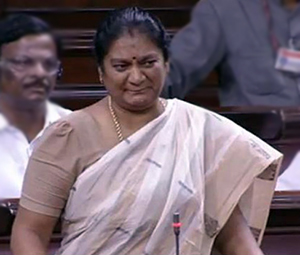
RS MP Sasikala Pushpa expelled from AIADMK

August 1, 2016

pushpaChennai, Aug 1: Days after she reportedly got into a scuffle with a DMK MP at Delhi airport, Rajya Sabha MP M Sasikala Pushpa was today expelled from the AIADMK by party supremo Jayalalithaa for "bringing disrepute to the party".

In a brief statement, Jayalalithaa said that Pushpa was being expelled from all party posts, including primary membership, as she had acted in violation of the party principles and ethics.

"Her behaviour has brought great disrepute to the party," she said.
Jayalalithaa asked party supporters not to have any truck henceforth with the Thoothukudi based Rajya Sabha MP.

Last week, Pushpa had reportedly got into a scuffle with her Rajya Sabha colleague from DMK Tiruchi Siva at Delhi airport.

Comments

Ahmed Bava
 - 
Monday, 1 Aug 2016

Dear PM Modi and his BJP Learn something from Jayalalitha.

Add new comment

  • Coastaldigest.com reserves the right to delete or block any comments.
  • Coastaldigset.com is not responsible for its readers’ comments.
  • Comments that are abusive, incendiary or irrelevant are strictly prohibited.
  • Please use a genuine email ID and provide your name to avoid reject.
News Network
April 24,2020

New Delhi, Apr 24: The trajectory of COVID-19 cases could have plateaued and might even fall for some weeks after the lockdown is lifted but India is likely to see a second wave in late July or August with a surge in the number of cases during the monsoon, say scientists.

The timing of the peak will depend on how India is able to control physical distancing and on the level of infection spreads after restrictions are relaxed, they said.

It looks apparent that the trajectory of daily new cases has reached a plateau and eventually it will take a downward fall, maybe for some weeks or even months, Samit Bhattacharya, associate professor at the Department of Mathematics, Shiv Nadar University, said.

Still, we may get a surge of new cases of the same coronavirus and this will be considered a second wave, Bhattacharya explained.

The second epidemic may come back in late July or August in the monsoon, although the peak timing will depend on how we control social distancing during that time, he said.

Rajesh Sundaresan, professor at Bengaluru's Indian Institute of Science (IISc), agreed.

“Once we return to normal activity levels, there is a chance that infection may begin to rise again. China is seeing this to some extent post easing of some restrictions on travel,” Sundaresan, corresponding author of a working paper by researchers at IISc and the Tata Institute of Fundamental Research (TIFR) in Mumbai, said.

On March 25, when the number of coronavirus cases was 618 with 13 deaths, the government announced a nationwide lockdown that was later extended to May 3.

On Friday, the death toll due to COVID-19 rose to 718 and the number of cases to 23,077, according to the Union Health Ministry.

In good news, officials said this week that the doubling rate of cases has slowed down in the period, going from 3.4 days before lockdown to 7.5 days, with 18 states doing better than the national average. The recovery rate has also almost doubled in the last 10 days.

"Looking at the new cases in the past few days, it seems the growth of new daily infection is much slower than earlier. This apparently indicates that we might have reached at the plateau of the growth curve, Bhattacharya said.

He noted that recent studies in China and Europe observed that the infection might relapse in those people who have already recovered from earlier phases.

So, there is no evidence that the earlier infection may help acquire immunity against the second infection. And in that way, the entire population may be vulnerable to the second wave to some extent, said the scientist.

In their study unveiled this week, IISc and TIFR researchers analysed the impact of strategies such as case isolation, home quarantine, social distancing and various post-lockdown restrictions on COVID-19 that might remain in force for some time.

The study modelled on Bengaluru and Mumbai suggests the infection is likely to have a second wave and the public health threat will remain, unless steps are taken to aggressively trace, localise, isolate the cases, and prevent influx of new infections.

The new levels and the peaking times for healthcare demand depend on the levels of infection spreads in each city at the time of relaxation of restrictions, they said.

The lockdown is currently upon us. It has given us valuable time. Let us test, trace, quarantine, isolate, practice better hygiene, search for a vaccine, etc. We should do these anyway, and these are being done. When and how to lift the lockdown is going to be a difficult decision to make, said Sundaresan.

It's clear that it's going to be phased. What our team is focusing on is to come up with tools to help the decision makers assess the public health impact of various choices, he said.

According to the experts, infectious diseases spread via contact between infectious and susceptible people. In the absence of any control measures, an outbreak will grow as long as the average number of people infected by each infectious person is more than one.

Once enough people are immune there will be fewer people susceptible to the infection and the outbreak will die.

However, when an outbreak is brought under control by social distancing and other interventions, it is possible only a small proportion of the population will have been infected and gained immunity, they said.

This means enough susceptible people may remain to fuel a second wave if controls are relaxed and infection is reintroduced.

Until the vaccine comes on the market, we have to remain alert Once sporadic cases occur here and there in the country, we immediately need to implement quarantine or social distancing locally for the people in that region, and also need to perform tests to identify positive cases irrespective of showing symptoms, Bhattacharya explained.

Note that these monsoon months are also flu season in many places of India. So, we should not ignore the early signs of the flu symptoms. Irrespective of symptoms, we need to increase tests in the hotspots to identify people and contain the surge, he said.

Sundaresan added that the timeline for a second wave will depend on a lot of circumstances which may change as the time passes.

Significant testing may have been underway, there may be behavioural changes with people becoming more careful about their hygiene, wearing masks may become more common, etc. All these responses may help restrict the second wave, he said.

A study published in The Lancet journal earlier this month modelled the potential adverse consequences of premature relaxation of interventions, and found it might lead to a second wave of infections.

The finding is critical to governments globally, because it warns against premature relaxation of strict interventions, the researchers said.

While interventions to control the spread of SARS-CoV-2 are in place, countries will need to work toward returning to normalcy; thus, knowledge of the effect of each intervention is urgently required, they said in the study.

According to a recent analysis by the Harvard Chan School of Public Health, the best strategy to ease the critical care burden and loss of life from COVID-19 might be on-again, off-again social distancing.

In the absence of such interventions, surveillance and intermittent distancing may need to be maintained into 2022, which would present a substantial social and economic burden, the researchers wrote.p


Comments

Add new comment

  • Coastaldigest.com reserves the right to delete or block any comments.
  • Coastaldigset.com is not responsible for its readers’ comments.
  • Comments that are abusive, incendiary or irrelevant are strictly prohibited.
  • Please use a genuine email ID and provide your name to avoid reject.
Agencies
June 7,2020

New Delhi, Jun 7: A day after India and China military commanders held "cordial and positive" talks at Chushul-Moldo point along the Line of Actual Control in Eastern Ladakh, Ministry of External Affairs said the two countries have agreed to "peacefully" resolve the situation in the border areas by continuing the military and diplomatic engagements.

The Indian delegation led by 14 Corps Commander Lt Gen Harinder Singh on Saturday met his Chinese equivalent Maj Gen Liu Lin, who is the commander of South Xinjiang Military Region of the Chinese People's Liberation Army, to address the ongoing tussle in Eastern Ladakh.

In a statement on Sunday, the MEA said that the meeting between the Corps Commander based in Leh and the Chinese Commander took place in a "cordial and positive atmosphere".

"Both sides agreed to peacefully resolve the situation in the border areas in accordance with various bilateral agreements and keeping in view the agreement between the leaders that peace and tranquillity in the India-China border regions is essential for the overall development of bilateral relations," the statement read.

They also noted that this year marked the 70th anniversary of the establishment of diplomatic relations between the two countries and agreed that an early resolution would contribute to the further development of the relationship.

"Accordingly, the two sides will continue the military and diplomatic engagements to resolve the situation and to ensure peace and tranquillity in the border areas," it further read.

China has moved its troops along the Line of Actual Control (LAC) in the Eastern Ladakh areas including the Finger area, Pangong Tso Lake, and Galwan Nala area.

The meeting between military commanders was to discuss and resolve the stand-off in Eastern Ladakh.

Following the meeting, the Army Headquarters' Directorate General of Military Operations also briefed the Ministry of External Affairs and other concerned government officials about the discussions.

On Friday, officials of India and China interacted through video-conferencing with the two sides agreeing that they should handle "their differences through peaceful discussion" while respecting each other's sensitivities and concerns and not allowing them to become disputes in accordance with the guidance provided by the leadership.

In the last few days, there has not been any major movement of the PLA troops at the multiple sites where it has stationed itself along the LAC opposite Indian forces.

The Chinese Army's intent to carry out deeper incursions was checked by the Indian security forces by quick deployment.

The Chinese have also brought in heavy vehicles with artillery guns and infantry combat vehicles in their rear positions close to the Indian territory.

Comments

Add new comment

  • Coastaldigest.com reserves the right to delete or block any comments.
  • Coastaldigset.com is not responsible for its readers’ comments.
  • Comments that are abusive, incendiary or irrelevant are strictly prohibited.
  • Please use a genuine email ID and provide your name to avoid reject.
Agencies
March 15,2020

New Delhi, Mar 15: Dozens of Hindu activists held a cow urine party in New Delhi on Saturday to protect themselves from the new coronavirus, as countries around the world struggle to control the deadly pandemic.

Members and supporters of the All India Hindu Mahasabha staged fire rituals and drank from earthen cups to fight the Covid-19 virus at the gathering in New Delhi dubbed a "gaumutra (cow urine) party".

"Whoever drinks cow urine will be cured and protected," Hari Shankar Kumar, a volunteer at the event, said as he served the remedy in brown clay cups.

Governments and scientists have said no medicine or vaccine is available to protect or cure people of the infection that has killed more than 5,400 people and infected nearly 150,000 across six continents.

Two people have died in India while more than 80 have fallen ill, and the government has ordered the closure of some land routes into the country and cancelled all visas to stop the spread of the virus in the world's second most populous country.

Members draped in saffron clothes chanted Hindu hymns at the fire ritual as devotees sang paeans for the sacred animal.

"We have gathered here and prayed for world peace and we will make an offering to the corona (virus) to calm it," Chakrapani Maharaj, the group's leader, told reporters before gulping down a cup of urine.

He then offered a glass to a devil-shaped caricature of the virus to "pacify" it.

He urged people to adopt the "tried and tested" practice of drinking cow urine to ward off diseases, and desist from killing animals and eating meat.

"The coronavirus is also a bacteria and cow urine is effective against all forms of bacteria that harm us," claimed Om Prakash, a participant from the neighbouring state of Uttar Pradesh.

One legislator from the BJP last week suggested use of the urine as well as cow dung can cure the coronavirus.

Comments

PK
 - 
Sunday, 15 Mar 2020

A Waste is a Waste.... God has created a system in our body and animals to throw out the excess wastage from our body... Guys please stay away from drinking the wastage and putting the wastage inside the body again . U will be a loser health wise and mentally. 


Cows will surely think by seeing these people that human beings are stupid to drink our wastage... Drink its milk which is beneficial drink that God has given us.


Fairman
 - 
Sunday, 15 Mar 2020

If your faith is scientific, simply go to Corona infected patients and cure it.


If you are successful, Not only India the whole world will be Hindus. 


If you cant, you will never do it with cow urine or any other urine. People will losse faith on your type of Hinduism.


Kumaran
 - 
Sunday, 15 Mar 2020

wrost of worst human being..

when you worship the devil, the god will make you to dring urine, shit etc..and root in helll forver


Hindu regilion was very pure before now it become very ugly by so called hindu protector.


Add new comment

  • Coastaldigest.com reserves the right to delete or block any comments.
  • Coastaldigset.com is not responsible for its readers’ comments.
  • Comments that are abusive, incendiary or irrelevant are strictly prohibited.
  • Please use a genuine email ID and provide your name to avoid reject.