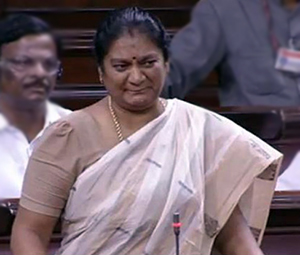
RS MP Sasikala Pushpa expelled from AIADMK

August 1, 2016

pushpaChennai, Aug 1: Days after she reportedly got into a scuffle with a DMK MP at Delhi airport, Rajya Sabha MP M Sasikala Pushpa was today expelled from the AIADMK by party supremo Jayalalithaa for "bringing disrepute to the party".

In a brief statement, Jayalalithaa said that Pushpa was being expelled from all party posts, including primary membership, as she had acted in violation of the party principles and ethics.

"Her behaviour has brought great disrepute to the party," she said.
Jayalalithaa asked party supporters not to have any truck henceforth with the Thoothukudi based Rajya Sabha MP.

Last week, Pushpa had reportedly got into a scuffle with her Rajya Sabha colleague from DMK Tiruchi Siva at Delhi airport.

Comments

Ahmed Bava
 - 
Monday, 1 Aug 2016

Dear PM Modi and his BJP Learn something from Jayalalitha.

Add new comment

  • Coastaldigest.com reserves the right to delete or block any comments.
  • Coastaldigset.com is not responsible for its readers’ comments.
  • Comments that are abusive, incendiary or irrelevant are strictly prohibited.
  • Please use a genuine email ID and provide your name to avoid reject.
Agencies
June 8,2020

Lucknow, Jun 8: The coronavirus which has now been assigned a gender, is being worshipped in Uttar Pradesh also after Bihar as superstition run deep. Women in some villages in Tumkuhiraj, Kasia, Hata, Captanganj and Khadda tehsil in Kushinagar district have started worshipping 'Corona Mai' and are pleading with her to spare lives.

These women have dug a small pit in the field, filled it with water and each one offers nine cloves and nine 'laddoos' to 'Corona Mai' to appease her.

Women from adjoining villages are now flocking to the 'temple' to pray to 'Corona Mai'.

Some local people have appealed to the district administration to stop such activities which spread superstition and misinformation.

Radhey Lal, a school teacher in Kasia, said, "The authorities must stop such activities which promote superstition. Everyone knows that there is no cure for corona and this kind of activities must be stopped."

Comments

Add new comment

  • Coastaldigest.com reserves the right to delete or block any comments.
  • Coastaldigset.com is not responsible for its readers’ comments.
  • Comments that are abusive, incendiary or irrelevant are strictly prohibited.
  • Please use a genuine email ID and provide your name to avoid reject.
News Network
February 24,2020

New Delhi, Feb 24: The shared values between India and the US are "discrimination, bigotry, and hostility towards refugees and asylum seekers", Amnesty International USA said in a joint statement with Amnesty International India ahead of US President Donald Trump's visit to India on Monday.

Trump, accompanied by his wife Melania, daughter Ivanka and son-in-law Jared Kushner as well as senior officials of his administration, landed in Ahmedabad on the first leg of his two-day visit to India.

"Anti-Muslim sentiment permeates the policies of both U.S. and Indian leaders. For decades, the U.S.-India relationship was anchored by claims of shared values of human rights and human dignity. Now, those shared values are discrimination, bigotry, and hostility towards refugees and asylum seekers,” Margaret Huang, Amnesty International USA’s executive director, was quoted as saying in the statement.

It was a reference to the anti-CAA protests in India, the internet lockdown in Jammu and Kashmir and the Muslim ban expansion by President Trump affecting Nigeria, Eritrea, Myanmar, Kyrgyzstan, Sudan and Tanzania, the statement said.

It added that Amnesty International USA’s researchers travelled to Lebanon and Jordan to conduct nearly 50 interviews with refugees that as a result of the previous version of the ban have been stranded in countries where they face restrictive policies, increasingly hostile environments, and lack the same rights as permanent residents or citizens.

The statement also came down hard on the Indian government, hitting out at the Citizenship (Amendment) Act (CAA) 2019 and saying it legitimises discrimination based on religious grounds.

It criticised statements such as “identify them (the protestors) by their clothes” or “shoot the traitors” by Prime Minister Modi and his party workers. Such remarks "peddled the narrative of fear and division that has fuelled further violence", it said.

“The internet and political lockdown in Kashmir has lasted for months and the enactment of CAA and the crackdown on protests has shown a leadership that is lacking empathy and a willingness to engage. We call on President Trump and Prime Minister Modi to work with the international community and address our concerns in their bilateral conversations,” Avinash Kumar, executive director, Amnesty International India said in the statement.


Comments

Add new comment

  • Coastaldigest.com reserves the right to delete or block any comments.
  • Coastaldigset.com is not responsible for its readers’ comments.
  • Comments that are abusive, incendiary or irrelevant are strictly prohibited.
  • Please use a genuine email ID and provide your name to avoid reject.
Agencies
July 29,2020

New Delhi, Jul 29: The new National Education Policy (NEP) approved by the Union Cabinet on Wednesday is set to usher in a slew of changes with the vision of creating an education system that contributes directly to transforming the country, providing high-quality education to all, and making India a global knowledge superpower.

The draft of the NEP by a panel headed by former Indian Space Research Organisation (ISRO) chief Kasturirangan and submitted to the Union Human Resource Development Minister Ramesh Pokhriyal when he took charge last year. The new NEP replaces the one formulated in 1986.

Some of the key highlights of the New Education Policy are:-

The policy aims to enable an individual to study one or more specialized areas of interest at a deep level, and also develop character, scientific temper, creativity, spirit of service, and 21st century capabilities across a range of disciplines including sciences, social sciences, arts, humanities, among others.

It identified the major problems facing the higher education system in the country and suggested changes such as moving towards multidisciplinary universities and colleges, with more institutions across India that offer medium of instruction in local/Indian languages, a more multidisciplinary undergraduate education, among others. 

The governance of such institutions by independent boards having academic and administrative autonomy has also been suggested.

Under the suggestions for institutional restructuring and consolidation, it has suggested that by 2040, all higher education institutions (HEIs) shall aim to become multidisciplinary institutions, each of which will aim to have 3,000 or more students, and by 2030 each or near every district in the country there will be at least one HEI.

The aim will be to increase the Gross Enrolment Ratio in HEIs including vocational education from 26.3 per cent (2018) to 50 per cent by 2035.

Single-stream HEIs will be phased out over time, and all will move towards becoming vibrant multidisciplinary institutions or parts of vibrant multidisciplinary HEI clusters.

It also pushes for more holistic and multidisciplinary education to be provided to the students.

Comments

Add new comment

  • Coastaldigest.com reserves the right to delete or block any comments.
  • Coastaldigset.com is not responsible for its readers’ comments.
  • Comments that are abusive, incendiary or irrelevant are strictly prohibited.
  • Please use a genuine email ID and provide your name to avoid reject.